ZenPundit
Thursday, September 20, 2007
A QUICK INTRO FOR LATECOMERS

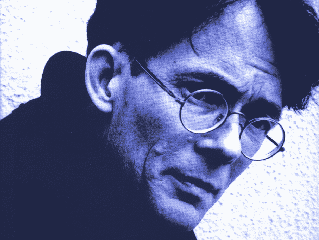
Your Host
An anonymous but quite gracious commenter from Britain wrote in, asking:
"....what I would find really helpful is if you did a sort of re-introduction - something on what your influences are, what you're trying to achieve, what books you think are most important in your area - it would be a good way of educating us latecomers..."
Fair enough. The durability of my regular commenters tends to make me forget the dynamic nature of blogospheric audiences. A brief history of Zenpundit:
My background is in diplomatic and economic history, where my mentors were from " the Open Door School" and " the Maryland Mafia" circle of historians, respectively. As a result, I received a thorough schooling in economic forces as a major driver of historical causation ( though I disagreed with many of their normative conclusions). A secondary influence were the late historians, Jordan Schwarz (American political history) and W. Bruce Lincoln (Russian history). My primary area of research interest was Soviet-American relations during the Nixon administration and American foreign policy during the Cold War but I spent almost as much time on what is loosely called "Soviet Studies".
Authors who had an impact on shaping my worldview, earlier on, include Friedrich von Hayek, Ludwig von Mises, Aleksandr Solzhenitsyn, Eric Hoffer, Ayn Rand, Alvin Toffler, George Kennan, Alexis de Tocqueville, John Galbraith, Adam Ulam, Machiavelli, George Orwell, Thorstein Veblen and a few others. Generally, it was systemic thinkers and iconoclasts who caught my eye. My library shelf (part of it, anyway) is visible for your perusal at Shelfari
Blogging became attractive for me when the H-Net listserv, H-Diplo became somewhat overmoderated some years back. Evidently, others felt the same way because other posters on H-Diplo who have also joined the blogosphere include Juan Cole, Austin Bay, Rick Shenkman, Judith Klinghoffer, Bruce Kesler and David Kaiser. I'm sure by now there are many other H-Diplo veterans busy blogging. Another well known H-Diplo member, though he seemed to be more active on C-NET, was David Horowitz, the conservative author and publisher of Frontpagemag.com. It was a vibrant listserv back then, with many brilliant and accomplished scholars participating ( or getting unceremoniously kicked off for intemperate posts) but blogging ultimately offered a better platform for debate and intellectual dialogue.
After connecting with Tom Barnett shortly after his first book was published, I've increasingly become more interested in strategy, intelligence, military theory, technology, futurism and social networks with less time for diplomatic history and "pure" foreign policy postings. However, as the blog tends to reflect what I'm reading at any given time, the subjects can wander fairly far afield.
Hope this helped fill in any blanks for new readers. Thanks again to anon for his suggestion!
Your Host
An anonymous but quite gracious commenter from Britain wrote in, asking:
"....what I would find really helpful is if you did a sort of re-introduction - something on what your influences are, what you're trying to achieve, what books you think are most important in your area - it would be a good way of educating us latecomers..."
Fair enough. The durability of my regular commenters tends to make me forget the dynamic nature of blogospheric audiences. A brief history of Zenpundit:
My background is in diplomatic and economic history, where my mentors were from " the Open Door School" and " the Maryland Mafia" circle of historians, respectively. As a result, I received a thorough schooling in economic forces as a major driver of historical causation ( though I disagreed with many of their normative conclusions). A secondary influence were the late historians, Jordan Schwarz (American political history) and W. Bruce Lincoln (Russian history). My primary area of research interest was Soviet-American relations during the Nixon administration and American foreign policy during the Cold War but I spent almost as much time on what is loosely called "Soviet Studies".
Authors who had an impact on shaping my worldview, earlier on, include Friedrich von Hayek, Ludwig von Mises, Aleksandr Solzhenitsyn, Eric Hoffer, Ayn Rand, Alvin Toffler, George Kennan, Alexis de Tocqueville, John Galbraith, Adam Ulam, Machiavelli, George Orwell, Thorstein Veblen and a few others. Generally, it was systemic thinkers and iconoclasts who caught my eye. My library shelf (part of it, anyway) is visible for your perusal at Shelfari
Blogging became attractive for me when the H-Net listserv, H-Diplo became somewhat overmoderated some years back. Evidently, others felt the same way because other posters on H-Diplo who have also joined the blogosphere include Juan Cole, Austin Bay, Rick Shenkman, Judith Klinghoffer, Bruce Kesler and David Kaiser. I'm sure by now there are many other H-Diplo veterans busy blogging. Another well known H-Diplo member, though he seemed to be more active on C-NET, was David Horowitz, the conservative author and publisher of Frontpagemag.com. It was a vibrant listserv back then, with many brilliant and accomplished scholars participating ( or getting unceremoniously kicked off for intemperate posts) but blogging ultimately offered a better platform for debate and intellectual dialogue.
After connecting with Tom Barnett shortly after his first book was published, I've increasingly become more interested in strategy, intelligence, military theory, technology, futurism and social networks with less time for diplomatic history and "pure" foreign policy postings. However, as the blog tends to reflect what I'm reading at any given time, the subjects can wander fairly far afield.
Hope this helped fill in any blanks for new readers. Thanks again to anon for his suggestion!
Labels: blogging, personal, reader response, readers
¶ 6:58 PM 2 comments
Sunday, September 09, 2007
THE LITERARY WINDFALL OF THE BLOG
This will amuse certain parties.
A few weeks ago, I had a post on William Gibson and in the course of the post, solicited reader opinions on Gibson. This sparked a lively discussion and many recommendations for further sci-fi reading in the comments section.
The other night, Mrs. Zenpundit had a surprise gathering for me, to honor the annual increase in my age, at one of the better local restaurants. One of the frequent lurkers here, "Dona Julia" and her husband "The Brown Guitar", had read the post and comments and, as a result, presented me with copies of:
All Tomorrow's Parties
Idoru
Virtual Light
Ender's Game
Speaker For the Dead
A rare instance of life imitating the blogosphere. Much thanks to Dona Julia, her Guitar and Mrs. Z. for yesterday evening and to the readers for their helpful suggestions.
This will amuse certain parties.
A few weeks ago, I had a post on William Gibson and in the course of the post, solicited reader opinions on Gibson. This sparked a lively discussion and many recommendations for further sci-fi reading in the comments section.
The other night, Mrs. Zenpundit had a surprise gathering for me, to honor the annual increase in my age, at one of the better local restaurants. One of the frequent lurkers here, "Dona Julia" and her husband "The Brown Guitar", had read the post and comments and, as a result, presented me with copies of:
All Tomorrow's Parties
Idoru
Virtual Light
Ender's Game
Speaker For the Dead
A rare instance of life imitating the blogosphere. Much thanks to Dona Julia, her Guitar and Mrs. Z. for yesterday evening and to the readers for their helpful suggestions.
Labels: blogging, book, personal, reader response, readers, william gibson
¶ 8:45 AM 7 comments
Monday, April 02, 2007
FEEDBACK ON WISE AND STUPID CROWDS
Dr.Von took the time from his busy schedule to send me a comment on my post on WISE AND STUPID CROWDS, CREATIVITY AND THE IC:
"I tend to believe that many are falling into the usual trappings we humans are prone to do. The concept of 'Groupthink' has its positive features, but I fear it does hamper creativity. It often takes revolutionary thinkers, who are largely isolated from the establisment, to go against mainstream beliefs to get at deeper truth and innovation in thought. It was to Einstein's advantage that he was isolated from the bias of academia at the turn of the last century, so he could reach the conclusion that Newtonian physics had limits and the world worked in very different ways than what the 'Group' thought. We will always need that individual freedom working in parallel with the Group. Creativity and innovation can come from either branch, so we cannot fall into a phase of 'all group, all the time,' as some might be suggesting. It reminds me a lot of how we need both pure and applied science, and both horizonta l/vertical thinking. This relates to some thoughts about intellectual absolutism that have always bothered me...it won't help us figure out the complex systems and problems we are dealing with."
I agree both specifically to the point regarding revolutionary thinkers coming from outside the mainstream as well as for the general philosophy of accepting the paradox of opposing ends of spectrums in order to gain comprehension.
My qualification to Von's comment is that the isolation he cites here is of an intermediate variety; Newton was a social misfit but was still connected to the formal academic world. Freud and Einstein, contemporaries, were initially marginalized in their fields prior to their respective breakthroughs due to their dissatisfaction with prevailing orthodoxies ( Newtonian physics and physiologically based psychology) as well as their status as Jews in conservative, Catholic, Imperial Austria-Hungary. Brilliant outlier figures who well understood the premises of their fields and found them inadequate, rather than hermits or dilettantes.
ADDENDUM:
If you live North of Chicago or have an interest in education, Dr. Von is being the good citizen and is running for his local school board. Aside from his past scientific work at Fermilab, Von's experience in innovative educational programs, such as Project Excite, which is supported in part by Northwestern University, is both extensive and impressive. He could use your support and feedback, if you are so inclined, here is his site.
Dr.Von took the time from his busy schedule to send me a comment on my post on WISE AND STUPID CROWDS, CREATIVITY AND THE IC:
"I tend to believe that many are falling into the usual trappings we humans are prone to do. The concept of 'Groupthink' has its positive features, but I fear it does hamper creativity. It often takes revolutionary thinkers, who are largely isolated from the establisment, to go against mainstream beliefs to get at deeper truth and innovation in thought. It was to Einstein's advantage that he was isolated from the bias of academia at the turn of the last century, so he could reach the conclusion that Newtonian physics had limits and the world worked in very different ways than what the 'Group' thought. We will always need that individual freedom working in parallel with the Group. Creativity and innovation can come from either branch, so we cannot fall into a phase of 'all group, all the time,' as some might be suggesting. It reminds me a lot of how we need both pure and applied science, and both horizonta l/vertical thinking. This relates to some thoughts about intellectual absolutism that have always bothered me...it won't help us figure out the complex systems and problems we are dealing with."
I agree both specifically to the point regarding revolutionary thinkers coming from outside the mainstream as well as for the general philosophy of accepting the paradox of opposing ends of spectrums in order to gain comprehension.
My qualification to Von's comment is that the isolation he cites here is of an intermediate variety; Newton was a social misfit but was still connected to the formal academic world. Freud and Einstein, contemporaries, were initially marginalized in their fields prior to their respective breakthroughs due to their dissatisfaction with prevailing orthodoxies ( Newtonian physics and physiologically based psychology) as well as their status as Jews in conservative, Catholic, Imperial Austria-Hungary. Brilliant outlier figures who well understood the premises of their fields and found them inadequate, rather than hermits or dilettantes.
ADDENDUM:
If you live North of Chicago or have an interest in education, Dr. Von is being the good citizen and is running for his local school board. Aside from his past scientific work at Fermilab, Von's experience in innovative educational programs, such as Project Excite, which is supported in part by Northwestern University, is both extensive and impressive. He could use your support and feedback, if you are so inclined, here is his site.
Labels: cognition, creativity, public school, reader response, von
¶ 6:51 PM 1 comments