Some of my older readers may be familiar with the late Mortimer J. Adler of the University of Chicago, a "popular" philosopher and lifelong advocate of "Great Books" and "Western Canon" programs of liberal education. One of Adler's many efforts in this regard was his editorship of The Encyclopedia Britannica 's 53 volume "Great Books of the Western World" series, which the public could buy on subscription, one volume at a time.
It seems quaint now, in the Google age, to recall buying sets of encyclopedias or series like Great Books but as a product line, it had a definite market appeal for the GI generation that had suffered through depression and world war and only about half of whom had managed to graduate high school. I suspect they liked seeing the rows of "serious", leather-bound books on a shelf and took some pride in the fact that their children, the Boomers, had access to them for school work ( though they were probably used with as little enthusiasm as encyclopedias are used by students now).
I mention this because earlier today, I picked up Adler's entire 53 volume Great Books set from a library for free, saving it from the discard pile when the librarian was kind enough to let me cart them away. Between forty and fifty years old, aside from a little dust, they are essentially brand new books of the highest quality. Few of them were ever opened and they will look quite handsome on my shelf, as I'm sure they once did on someone else's. Running from Homer to Freud they include about every "deep" book that we generally feel guilty that we never read yet. I've read quite a few ( though less than I imagined) and look forward to reading more and I am generally, quite pleased with myself for snagging them.
Part of me though, suspects that Adler would have been chagrined to learn that in 2007 a library had no room or interest in his beloved canon. Or that college students could conceivably graduate from a university without ever having read, cover to cover, any "great book" whatsoever. Times change of course but some things have a lasting value and the Net generation is missing out on some of them.
Labels: adler, book, culture, education, intellectuals, personal, reading
¶ 6:41 PM 6 comments


Picked up both of these on a lark on Saturday, as I cruised through Border's with The Son of Zenpundit, who was getting some independent reader level books about Spider-Man fighting -well- some villain or other. The usual suspects.
Any thoughts from readers as to how high these tomes merit being placed on the "Must read" pile ? I'm currently innundated with things to read, so prioritizing is a must.
Labels: book, bush, COIN, foreign policy, history, insurgency, iraq, islamic world, islamist, mideast, war
¶ 7:35 PM 2 comments
I'm tired and mentally foggy but still have an itch to blog a little, so I'm going to do something I don't usually do outside of twitter - microblog!
Shloky was justly praised for Naxalite Rage. Not a conflict of which I know much about but Shlok will help get me up to speed.
Wikinomics is a book worth the time spent reading, despite my not being a fan of "business lit". It bridges those constraints to also be a " big idea" book.
Regarding the Mukasey hearings, the Left seems less interested in stopping intrusive electronic surveillance of Americans than it does of throwing up abstruse procedural delays to monitoring foreigners who are suspected Islamist terrorists living overseas in third countries. The Liberal Democrats in the House have so voted:
"Rules Committee Chair Louise Slaughter did something unusual however, in the hearing on legislation to extend the Foreign Intelligence Surveillance Act--she announced at the start of the hearing that no amendments of any type would be allowed for debate. Committee Democrats followed Slaughter's lead and voted against amendments to: authorize surveillance of those engaged in the creation of Weapons of Mass Destruction; authorize surveillance of foreign terrorists outside the United States; extend liability protection to telecommunications companies that relied on government directives and shared information deemed necessary for protection from terrorist attack; and, allow a debate on the Bush administration's alternative."
Hat tip to Bruce Kesler.
This is why, despite everything the Bush administration has done wrong in Iraq, that the Democrats still have a " national security problem" with the public. Frankly, they always will ,so long as the Boomer-Left remains generationally dominant in that party.
Labels: book, IC, intelligence, kesler, national security, rambling, shloky, wikinomics
¶ 8:13 PM 5 comments
A CFR interview with Walter Russell Mead about God and Gold: Britain, America, and the Making of the Modern World . ( Hat tip to Lexington Green)
Labels: book, history, intellectuals
¶ 8:52 PM 0 comments

My copy of The Mislabeled Child by Drs. Brock and Fernette Eide, that I ordered through work last spring, finally arrived the other day ( Use private sector Amazon.com, the book arrives in a few days. Use an educational bureaucracy and it arrives five months later). I have been looking forward to reading this for some time ( literally).
The Drs. Eide, in addition to being authors, clinicians and researchers, also have two excellent blogs, The Neurolearning Blog and The Classical School Blog, where they share their professional expertise and deep interest in enhancing learning for children, particularly those in outlier populations with special needs. The Eides have been less active in the blogosphere this year but The Neurolearning Blog is one of my few daily "must reads".
It's a moderately thick text with an impressive bibliography for a book written for laymen rather than specialists. I look forward to diving in and learning something new!
Labels: attention, blogroll, book, brain, cognition, creativity, education, eide, ideas, intellectuals, intelligence, metacognition, science, teaching
¶ 6:14 PM 0 comments

My friend Shane Deichman had an important post at Wizards of Oz - a review of Dr. John Kao's new book, Innovation Nation (Kao's site is here). I have not read the book yet but Shane's review of Kao's work struck a chord with my interest in educational reform. We are living in a transformative era but our educational system's paradigm, structures and methodologies are looking dangerously anachronistic. Shane writes, in part:
"He is also a man with a true “long view” – a vision not just for our immediate future, but for this and the next century. In Innovation Nation, Kao describes the evolution of “innovation models” – from individual achievement to today’s “version 4.0” that rapidly adapts best practices across a globally diffuse environment of open architectures and collaboration. America is the “incumbent”, but also seemingly blind to the challenges posed by emergent innovation powers like Singapore, Denmark and Finland.
The book continues with an honest critique of America’s education system, comparing and contrasting our response (in terms of funding, curriculum development, teacher training, school construction, etc.) to Sputnik and President Kennedy’s famous challenge at Rice University in 1962 to today’s sagging U.S. aptitude test scores and lackluster performance in math and science. John compares the high barriers to entry (both literally and figuratively) of our nation’s immigration system to that in global innovation hot spots, along with the perils they bring."
Read the rest here.
What can be done to ramp up American creativity and innovation ? Many things, most of which are outside the scope of this post, but Kao hones in on addressing the fundamentals, which includes our educational system and also our culture ( or rather, our institutional cultures). Together they compose a social platform that will either inhibit or accelerate the rate of innovation in America.
 ,
,
Looking at the cognition of creative thinking and innovation.
Two books that might help in re-engineering the culture in the direction that Kao envisions are that of fellow Harvard professor Howard Gardner's Five Minds For the Future and also The Medici Effect by strategic consultant Frans Johansson. While both authors explore individual thinking and the mentalities of organizations, Gardner, a popular guru in the field of educational psychology, emphasizes the former.
Gardner's book explores five "minds" or cognitive approaches that he believes will be important for the 21st century. They are:
"The Disciplinary Mind: the mastery of
major schools of thought, including
science, mathematics, and history, and of
at least one professional craft.
The Synthesizing Mind: the ability to
integrate ideas from different disciplines
or spheres into a coherent whole and to
communicate that integration to others.
The Creating Mind: the capacity to
uncover and clarify new problems,
questions and phenomena.
The Respectful Mind: awareness of and
appreciation for differences among
human beings and human groups.
The Ethical Mind: fulfillment of one's
responsibilities as a worker and as a
citizen."
While the last two are outside of this discussion, the disciplinary mind has been discussed here many times under the auspices of the term "vertical thinking" and Gardner does an excellent job on explaining how that kind of training for subject mastery creates a base for the development or refinement of other kinds of thinking.
Having the disciplinary mind of a vertical thinking expert is particularly complementary to the practice of horizontal thinking, though many experts resist horizontal thinking out of habitual analytical reductionism, the legacy of academic culture or ego, fearing to be seen operating outside one's area of known competence. Gardner likes to make the analogy of an intellectual laser vs. a searchlight in comparing the two.
Gardner, under the influence of Mihalyi Csikszentmihalyi, divides the cognitive activities of horizontal thinking, into the Synthesizing Mind and the Creative Mind, which would be drawn upon during the process of innovation. Like Csikzentmihalyi, Gardner's definition of creativity is product-oriented and scalar - the results of creative thinking must approach a certain, tangible, magnitude of effect to count - "Big C" creativity, in Gardner's words.
I've never agreed with that distinction. First, it discounts the effect of stochastic tinkering, which are simply creative tweaks on the micro scale that can be very significant, especially when collectively harnessed on a wikinomic/mass collaboration platform. Secondly, the small scale creativity is a necessary developmental step to take, cognitively speaking, before running with grand accomplishments later in life. Even geniuses and polymaths like Isaac Newton and Mozart who demonstrated tremendous creative breakthroughs of a global impact at a relatively young age, went through periods of early, if precocious, experimentation.
Gardner's chapter on synthesis is worth the price of the book alone as he gives it a thorough summative treatment, detailing eight kinds of synthesis that have four components and three kinds of motivations. John Boyd wrote of the process of synthesis as a "dialectical engine"; if so, Gardner would consider metaphors to be the spark plugs of integration and innovation, a valuble tool that helps connect a brain with a "massive modularity" in physiological structure. Gardner considers accomplishment of true interdisciplinarity to be hard but acquisition of "multiperspectivalism" among practitioners to be a realistic goal for synthesis.
Creative Minds, in Gradner's view, are interactive, working within a " social field" that validates their accomplishments but are not confined to the boundaries of a disciplinary field that inhibits most practitioners from discovery or innovation. He is very cautious of " false creativity" or precipitous claims of "creativity" from those jacks-of-all-trades who have yet to master a single domain. Writing on American public schools in the 1980's, Gardner states:
"In schools (and in after school sites) the compelling need was for the achievment of genuine mastery of a recognized discipline: not only was there no need for educators to wave the flag of creativity; it might have been counterproductive to do so. Only through the honing of discipline would genuinely creative options emerge." (Gardner, 85)
Gardner's books are often of an uneven quality of depth. His chapter on the Creative Mind is not nearly as thorough as the one on the Synthesizing Mind ( not surprising as Gardner has not laid out a convincing case, in my view, why the two ought to have been separated in the first place; moreso, by his section on their interrelationship). He does give more practical examples from the corporate world and discuss the potential of online platforms for creativity in terms of a Wikipedia -Britannica continuum.
Innovation depends upon the ability to generate new insights and bring these to practical fruition. Cognitively, our tools would include metaphors, analogies, visualization, consciously systematic lateral thinking in the syle of Edward DeBono and harnessing the powers of intuition and imagination in a conceptually-rich intellectual environment.
End Part I.
Labels: book, cognition, creativity, culture, education, horizontal thinking, ideas, innovation, insight
¶ 12:13 PM 0 comments
Tom Barnett pointed out this tome to me in the comment section of his blog:

As I have not read a new economics book since Freakonomics came out, I'll grab this the next time I run over to Border's ( despite Col. Frans Osinga's Science, Strategy and War, sent courtesy of Shane, sitting there, staring me in the face, taunting me). Idoru needs to be finished too and...
So many books. So little time.
Labels: barnett, book, economics, reading, shane deichman, william gibson
¶ 6:33 PM 2 comments

Despite some reservations about Howard Gardner's normative weighing of various "multiple intelligences" and uneven conceptual development in his earlier works, I'll give Five Minds For The Future a preliminary endorsement. The chapters on the disciplinary, synthesizing and creative minds are worth the purchase price alone.
There are some very sound observations on these cognitive outlooks on Gardner's part - readers here will see vertical and horizontal thinking well represented, though Gardner eschews the use of those terms ( he does cite De Bono's lateral thinking exercises). Mihaly Csikszentmihalyi is a strong influence on the creativity chapter though, as an aside, I do not always buy into Csíkszentmihályi's social/collective/domain/peer ratification of creativity as a standard as Gardner does.
Labels: book, cognition, creativity, horizontal thinking, howard gardner, metacognition, vertical thinking
¶ 7:58 PM 0 comments
This will amuse certain parties.
A few weeks ago, I had a post on William Gibson and in the course of the post, solicited reader opinions on Gibson. This sparked a lively discussion and many recommendations for further sci-fi reading in the comments section.
The other night, Mrs. Zenpundit had a surprise gathering for me, to honor the annual increase in my age, at one of the better local restaurants. One of the frequent lurkers here, "Dona Julia" and her husband "The Brown Guitar", had read the post and comments and, as a result, presented me with copies of:
All Tomorrow's Parties
Idoru
Virtual Light
Ender's Game
Speaker For the Dead
A rare instance of life imitating the blogosphere. Much thanks to Dona Julia, her Guitar and Mrs. Z. for yesterday evening and to the readers for their helpful suggestions.
Labels: blogging, book, personal, reader response, readers, william gibson
¶ 8:45 AM 7 comments

A while back, while sitting around an alcohol -laden table with Dan of tdaxp, Shlok and Isaac and listening to an evolving debate (primarily between Dan and Isaac) over the probable nature of AI, references to William Gibson's first novel, Neuromancer were made. I then chimed in that I had never read the book - a statement that was greeted with surprise and some degree of mock horror. This had happened to me once before with Dave Schuler and Lexington Green, except that in that instance the author was Philip K. Dick and the book then was The Man in the High Castle. Evidently, something about having drinks with fellow bloggers is a spur to my reading classic science fiction.
Admittedly, I am not a great reader of fiction, at least if " great" means " broadly read". As a youth, I did dive deeply into J.R.R. Tolkien, Ayn Rand and George Orwell - I've probably read every word ever published by the first two authors and much by the third. Russian lit figures prominently, especially Dostoyevskii and Solzhenitsyn. Of American writers, I've read a scattering of Mark Twain, Sinclair Lewis, J.D. Salinger, John Steinbeck and a few others, but none systematically or deeply.
I've meant to read Quo Vadis, Don Quixote and Blood Meridian for years and have yet to do so. I have only a few works of Rudyard Kipling, Arthur Koestler, Balzac and Victor Hugo under my belt. The reason being that for me, the siren call of non-fiction is all too strong. There are too many important books that " must" be read ASAP, piled on top of others that " should" be read; picking up good fiction under those conditions almost feels like shirking a responsibility.
I say this as a preface to acknowledging how much I enjoyed reading Neuromancer. While the book is old hat to sci-fi fans, it came as a fresh voice to me, mixed with an unfolding appreciation of how Gibson's fictional efforts have influenced or anticipated the evolution of the culture. Movies, TV shows, references, characters all flashed through my mind as I read it and Gibson's economy of explanation allowed my mind the freedom to engage the text and fill in the blanks. Reticence is a vital skill that few authors ever manage to master but Gibson has it. I'm sorry that I didn't read the book back in the early 1980's when the novelty of the book's imaginative scenario were at peak.
Isaac has pointed me toward Pattern Recognition and I now have an itch for Spook Country as well. If you have read Gibson's books, what do you think of them and what titles do you favor ?
Labels: blogroll, book, cyberpunk, fiction, fun, futurism, reading, william gibson
¶ 6:41 PM 11 comments

Labels: 21st century, book, cognition, education, futurism, horizontal thinking, howard gardner, insight, intellectuals, intelligence, psychology, theory
¶ 10:15 AM 6 comments
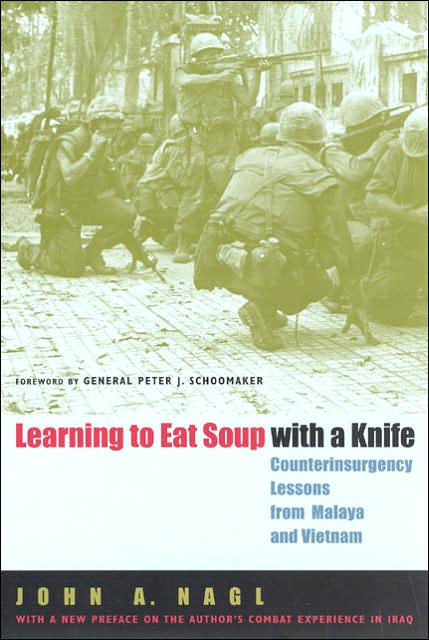
"Learning to Eat Soup With A Knife -Book Review" is now up at Chicago Boyz.
Labels: 20th century, anglosphere, army, asia, book, britain, chicago boyz, COIN, cold war, Communism, john nagl, military, military history, military reform
¶ 6:50 PM 0 comments

"I cannot live without books"
- Thomas Jefferson
First, I'd like to thank Dr. Barnett and Dan of tdaxp for the kind remarks and links the past few days. Both men have often provoked me to new thoughts or reconsidered views and it is nice to know that I can return the favor on occasion.
Tom had a post Sunday entitled " Why the grand strategist/visionary needs the discipline of books" that echoed something I've long believed. Something Lexington Green, in his enviably book-lined home, probably would agree with,
a) First, there's really no substitute for a good "hard" book.
b) Fiction becomes a guilty pleasure.
Perhaps, the physicists and mathematicians among us ( Von, Shane, Wiggins) will put a word in for the elegance of the mathematical equation, but for me, the supremacy of the book reigns without a rival. As I reflect on the evolution of my thinking as a teen and an adult, inevitably there are many books and a handful of people who leap to mind. Many, many, books and very, very, few people.
As much as I love history, the best reading I have done, in terms of determined, sustained, thought, involved philosophy and economics - Aristotle, Plato, Marx, Adam Smith, John Stuart Mill, Keynes, Galbraith, Von Mises, Von Hayek, Nietzsche, Marcus Aurelius, Ayn Rand, Milton Friedman, Machiaveli, Kuhn -because it trained my mind to accept the discipline of formal logic. Logic is invaluable for a rational mind but wisdom is discerning logic's limitations of functioning within paradigms and that the paradigms themselves are tools for the mind to understand a part of reality; and not one of these paradigms is sufficient to encompass the whole. You have to synthesize, learn, adapt - there is no point at which you " rest" or become complacent with your expertise.
The joy is in the journey and not in the destination.
Labels: barnett, book, cognition, economics, education, horizontal thinking, personal, philosophy, recommended reading, tdaxp
¶ 9:27 PM 7 comments

I just finished Caesar: Life of A Colossus by the military historian Adrian Goldsworthy and found it to be a remarkably worthwhile read from which I learned much about Julius Caesar the commander, yet the flanking movements by Gaulish cavalry and Triplex Acies of the Legions do not overwhelm Goldsworthy's portrait of Caesar the man and populares politician.
Goldsworthy succeeds in breathing life into a figure about whom so much cultural and historical commentary has been encrusted, often to the point of distortion. Caesar is a dynamic and charismatic figure in this biography but also a calculating and, at times, overconfident and reckless one. Goldsworthy is sympathetic to his subject but remains critical of Caesar's errors and propaganda while trying to keep all events in their proper 1st century BC context.
The biography does not have quite the same social and cultural richness of the late Roman Republic to be found in Tom Holland's Rubicon ( which was a work of history) but there are gems of information for the reader, nonetheless . Other useful companions to Goldswothy's effort would be Anthony Everett's biographies Cicero and Augustus, especially the former book given the importance of the brilliant but unsteady Marcus Tullius Cicero as Caesar's sometime rival, ally, critic, adviser, enemy and companion.
An excellent read.
ADDENDUM:
"Heather — The Fall of the Roman Empire", "Ward-Perkins — The Fall of Rome and the End of Civilization" by James McCormick at Chicago Boyz
Labels: adrian goldsworthy, ancient history, biography, book, historians, historiography, history, julius caesar, military history, roman empire, war, warriors
¶ 1:03 PM 2 comments

I was perusing historian David Kaiser's blog History Unfolding, when I came across a remarkable claim regarding Richard Nixon, based in part on Robert Dallek's new book, Nixon and Kissinger:Partners in Power:
"Nixon and Kissinger, to begin with, came into office determined to win the Vietnam War. In an odd parallel to the current Administration—which decided that 9/11 totally discredited the Middle East policies of the last forty years—they evidently believed that the whole experience of the Johnson Administration had nothing whatever to teach them. Nixon, who saw himself far superior both to his two immediate predecessors and to any successor on the horizon, was convinced that Johnson had failed to win the war only because of a lack of will, the quality on which he prided himself the most. One omission from Nixon and Kissinger (which is more of a biographical study than a policy history) is any discussion of NSSM-1, a massive study of Vietnam which Kissinger commissioned upon taking office. It concluded that nothing the US had done had significantly weakened the enemy’s ability to fight, and that no agency of the US government could foresee the day when the South Vietnamese alone could deal with the enemy. A bold and rational leader must have concluded that the United States had to scale down its objectives to end the war, but Nixon did not. He and Kissinger spent about a year vainly trying to get the Soviet Union to end the war by pressuring the North Vietnamese, and then (as Nixon publicly admitted) tried to gain an advantage with the kind of “decisive” action which, Nixon thought, Johnson had avoided—the invasion of Cambodia. Meanwhile, political and military considerations (the latter involving the state of the armed forces) impelled Nixon to withdraw troops, but he continued to believe that he could make the North give in to our terms—an independent, non-Communist South Vietnam—by unleashing an all-out bombing attack whenever he chose. And historian Jeffrey Kimball was right: Nixon was determined not to make peace without giving such a campaign a chance, as eventually, in December 1972, he did—at the cost of 15 American B-52s, and without in the least improving the terms that Kissinger had already negotiated."
For readers who are unfamiliar, Dr. Kaiser is a historian of the Vietnam War era, with special expertise in the Kennedy administration. I have not read the Dallek book yet, though I certainly intend to now ( I did anyway but David's post has advanced it well up my reading list) as the assertion conflicts sharply with what has previously been known about Nixon's strategic thinking at the time.
Nixon was one of the first major political figures to (gingerly to be sure) try to put South Vietnam into the context of it's actual geopolitical value to the United States, which was small, in a major speech at Bohemian Grove and then in a Foreign Affairs article " Asia after Vietnam". Much of the discourse Nixon used about the war among his intimates involved his administration's ( or America's) "credibility" or "toughness" in the eyes of Communist adversaries in Hanoi, Beijing and Moscow. Having read innumerable documents and memoirs I'm hard-pressed to believe that Nixon ever thought the Vietnam War was " winnable" and not an albatross that was hindering him from accomplishing his larger strategic goals, especially the China opening. Nixon desperately wanted to avoid outright defeat in Vietnam, certainly, and to use his handling of the war to send signals elsewhere but throwing his administration, heart and soul into winning the war was never on the table.
Nevertheless, Dallek has new material, according to Kaiser, for a new argument. It needs to be scrutinized objectively to see how or if Dallek broadens our understanding of the war and of Richard Nixon's administration. This is how historical truth advances, one document, one argument, one book at a time.
I look forward to reading it.
Labels: book, cold war, david kaiser, historians, historiography, history, nixon, robert dallek, Vietnam War
¶ 10:34 PM 2 comments
I have a review of The Changing Face of War posted at Chicago Boyz.
Labels: 4GW, book, chicago boyz, historians, history, military history, van creveld
¶ 9:14 AM 0 comments
Michael Tanji, the IC veteran at Haft of the Spear, interviewed John Robb about his new book, Brave New War over at Tanji's MSM gig, The SPOT Report ( have to add that to the blogroll...).
"Brave New War Interview (Part I)"
"Brave New War Interview Part II"
NEW! "Brave New War Interview (Part III of III)"
The interview is excellent. Tanji gets beyond the usual superficial questions into the meat of Robb's analytical worldview. A sample:
" TANJI: In The Long Tale of Warfare Emerges you take an Occam's razor through the fundamentals about the size and capability of the insurgency. We can kill with precision and to any scale, but apparently cannot get the basic math right. Is dogma driving us to perform data-free analysis or are we just not preparing our strategists and planners to address complex or asymmetric problems?
ROBB: The problem may be whether or not we operate on best case data or worst case. If you always select the best case data in order to bolster the moral cohesion at home, then you are really lying to yourself -- essentially, breathing your own exhaust. Another reason may be that that our intelligence system can't handle the level of complexity involved within a closed environment (locked down by artificial barriers of secrecy). It's not tapping into the vast pools of talent outside the organization effectively.
TANJI: Let me ask you a question that I get asked a lot: Why no major attack in the US since 9/11? Is it a question of difficulty in setting off systemic cascading failures? If major attacks suffer from diminishing returns and small attacks ratchet up the "tax" on targeted cities, why haven't we seen IEDs on Wall St. or Main St.?
ROBB: Here are a couple of reasons. First is the diminishing returns of symbolic terrorism A big attack like 9/11 is hard to top. Anything less would hurt the al Qaeda brand and fail to return fear to anything near the levels of 9/11. Second, al Qaeda was severely damaged when we invaded Afghanistan. Those resources it had left were spent on staying alive and helping launch the operation in Iraq. Remember, a major reason for 9/11 was to get the US into a guerrilla war in Asia and repeat the experience of Russia's Afghanistan. In terms of systems disruptions, this method has only recently emerged from the experience in Iraq. Not everyone gets it yet, but the insight is spreading quickly in an organic fashion. You could conclude that the attack on Abqaiq and the Golden Mosque were examples of systems disruption (the latter being social systems disruption) that al Qaeda didn't have to project power to the US to accomplish. "
I found the section in BNW on Urban Takedowns problematic as well. I liked Robb's concept of a " terrorism tax" on targeted cities because that jives with a systematic understanding of applying market forces to societal analysis. I think, on the margin for certain important, narrow, questions, this idea works very well.
OTOH, historically, all cities were essentially death traps that could only be sustained by a daily influx of migrants ( usually peasants fleeing rural poverty) that exceeded those dying from disease, violence, fire and malnutrition at a rate that vastly exceeded the toll taken by today's terrorism. Only in advanced states, with the creation of modern sanitation and water systems, public health, police and fire services has this dynamic changed for the better. Many cities in the Gap and a few in the New Core are still in this " feral" state. The point being that as a complex social and economic networks, cities may have greater resilience than we realize, which makes estimating terror effects problematic.
Labels: book, brave new war, haft of the spear, john robb, military, military reform, SPOT, tanji, theory, war, warriors
¶ 9:41 AM 1 comments
Ok, just started the first chapter in each, so I have little to say - but here they are!

Wikinomics

Medici Effect

Wealth of Networks
They have reinvigorated my interest in a currently moribund collaborative project with Dr.Von (hmmm...his blog seems a touch moribund as well- political office must be eating up all his time LOL!) Perhaps, if I can get some serious momentum going on it this summer, he'll hop back on the bandwagon.
Labels: book, business, complex systems, complexity, consilience, creativity, economics, horizontal thinking, medici effect, networks, social networks, theory, wikinomics
¶ 10:18 AM 3 comments
John succeeded though, garnering thoughtful reviews of Brave New War from Dr. Barnett and " The Father of Fourth Generation Warfare", William Lind, both of whom lauded Robb's work ( albeit from starkly different perspectives).
ADDENDUM:
Chet Richards has his review posted now too.
Labels: barnett, book, brave new war, john robb, lind, military, theory, war
¶ 7:31 PM 0 comments
Brave New War by John Robb is a book that was really written for two audiences.
The first is the relatively small number of specialists in military affairs, serious students of geopolitics and bloggers who are already avid readers of Robb’s Global Guerillas site. For them, Brave New War is a systematic and footnoted exposition of the theories of conflict and “dangerous ideas” that Robb discusses daily on his blog. They will be entertained and challenged by the same analysis that makes them return again and again to Global Guerillas to debate John Robb and one another.
The second audience is composed of everyone else. Brave New War is simply going to blow them away.
Brave New War is a tightly written, fast-paced work on the emergent nature of warfare, conflict global society with a decidedly dystopian take. In a mixture of original ideas and synthesis of the works of other cutting edge “thought leaders”, Robb, a platform designer and former mission commander for USAF Counterterrorism operations, draws analogies from the tech world to explain changes in warfare in the age of globalization. Calling the Iraq War “ the modern equivalent of the Spanish Civil War” Robb highlights a robust number of critical concepts in Brave New War that are, in his view, altering international and subnational conflict, including:
Bazaar of Violence
Black Swans
Brittle Security
Dynamc Decentralized Resilience
Emergent Intelligence
Fourth Generation Warfare
Guerilla Entrepreneurs
Global Guerillas
Market-States
Minimalist Platforms
Open-Source Warfare
Plausible Promises
Primary Loyalties
Stigmergic Systems
Superempowered Groups
Systempunkt
The Long Tail of Warfare
Urban Takedowns
Some of these concepts are Robb’s, some belong to others and in Brave New War you will find citations for figures as diverse as William Lind, Chris Anderson, Nicholas Nassim Taleb, Valdis Krebs, Eric S. Raymond, Thomas P.M. Barnett, Albert-Laszlo Barabasi, Philip Bobbitt, Moises Naim and David A. Deptula. One of the great strengths of Brave New War is Robb’s capacity as an analyst and theorist to apply the revelations of research into network theory to warfare, and to conceptualize armed political conflict within the framework of platforms and ecosystems. This gives Robb’s arguments a degree of horizontal “interconnectedness” seldom seen in works on military affairs ( except, as Robb himself points out, in the work of his frequent online sparring partner, Thomas Barnett).
Robb is betting heavily on increasing levels of global instability and systemic breakdown as “feedback” from global guerillas overloads “the system” and disrupts globalization. It is this orientation toward discerning the worst-case scenarios and descent into entropy that will raise hackles amongst some readers, though Robb ultimately predicts a strengthening of systemic resilience and a burst of innovation as a result of these tribulations.
Brave New War is the must read book of 2007.
OTHER REVIEWS:
Haft of The Spear
Simulated Laughter
Futurejacked
Labels: book, brave new war, defense, global guerillas, iraq, john robb, market states, military, national security, networks, theory
¶ 12:00 AM 6 comments