The publisher and the editor-in-chief of the highly regarded Small Wars Journal, respectively Bill Nagl and Dave Dilegge, are doing a public Q&A at noon on Tuesday with the powerhouse The Washington Post. I imagine that Bill Arkin will be involved somewhere as well - but we can hope otherwise. ;o)
Read about the details at the SWJ BLog.
Submit YOUR questions here.
Labels: brave new war, COIN, insurgency, iraq, media, small wars journal, swj blog
¶ 8:37 PM 0 comments


Picked up both of these on a lark on Saturday, as I cruised through Border's with The Son of Zenpundit, who was getting some independent reader level books about Spider-Man fighting -well- some villain or other. The usual suspects.
Any thoughts from readers as to how high these tomes merit being placed on the "Must read" pile ? I'm currently innundated with things to read, so prioritizing is a must.
Labels: book, bush, COIN, foreign policy, history, insurgency, iraq, islamic world, islamist, mideast, war
¶ 7:35 PM 2 comments

" To summarize, we seek to radically change the cultures and political systems for much of the world, to halt foreign revolts and civil wars of which we do not approve, to bring global peace and prosperity, to make friends (even with those states whose rise we seek to restrain), and to “transform” our so far unreformable national security apparatus. Those who thought President Bush was kidding about these learned better in the months following our invasion of Iraq."
- Fabius Maximus
For some time now, an author whose nom de guerre is "Fabius Maximus", after the ancient Roman general of the Punic wars, has been a regular and at times, prolific, contributor to the Boydian and 4GW school oriented Defense & the National Interest. Fabius, who comments here at Zenpundit on occasion, also set off one of the most popular, if heated and controversial, threads at The Small Wars Council, catching the attention of noted COIN strategist Col. David Kilcullen. Kilcullen's theories later became a subject of frequent critique from Fabius in his DNI articles.
While I had hoped to meet Fabius in person at Boyd 2007, he did not attend and I am not privy to his identity or professional background. Fabius' arguments must rise or fall entirely on their own merit and he has been content to engage his critics on this basis at the SWC and elsewhere. Clearly he is a member of the 4GW school and is an admirer of Col. John Boyd, William Lind, Dr. Martin van Creveld and Dr. Chet Richards but has not shrunk from advancing his own ideas or original criticisms.
Recently, Fabius completed his tenth article in a series on America's Long War for DNI and, as Fabius has entertained and enraged members of the community of "reform" defense intellectuals and COIN practitioners, it is timely for us to take stock of his strategic argument:
The Long War Series - from DNI's Fabius Maximus Archive
Part X - One step beyond Lind: what is America’s geopolitical strategy?
Part IX - 4GW at work in a community near you,
Part VIII - How to accurately forecast trends of the Iraq War,
Part VII - Kilcullen explains all you need to know about the Iraq War,
Part VI - The bad news is that Lind’s good news is wrong,
Part V - The Iraq War as a warning for America,
Part IV - Beyond Insurgency: An End to Our War in Iraq,
Part III - Stories or statistics? Read and compare to find the truth!
Part II - News from the Front: America’s military has mastered 4GW!
Part I – America takes another step towards the “Long War,”
I have read the roughly 20,000 words offered here previously and I re-read them for this post. I have also read most of the authors of the original works that Fabius Maximus cites in his series. Therefore, I feel qualified to offer a few observations in regard to the strategic paradigm that this body of work represents and the assumptions, clearly stated as well as implicit, upon which it is built.
Many of the specific analytical criticisms of American policy and performance in Iraq and Afghanistan made by Fabius are incisive, some are rather questionable and a few are brilliant. I encourage you to read his efforts for yourself rather than simply accepting my word for it. What interests me most though, given the scope of the series, are his premises. As I discern them, they are:
That 4GW is the environment in which we find ourselves conducting operations - and doing so quite poorly at that with a military predisposed toward 2GW offensives. Or irrelevantly on the strategic level where we happen to be executing COIN well on the tactical level.
We cannot significantly affect the internal dynamics of alien societies that we understand poorly or not at all, regardless of the carrots or sticks used. We are marginal factors at best.
American war policy is being constructed on the false analogy of the Cold War model.
Al Qaida is more phantom than menace.
War is the wrong conceptual metaphor and the wrong operational-bureaucratic response to the conflict in which we find ourselves.
Our response, which serves bureaucratic and factional interests at homes, undermines our global strategic position and wastes our economic strength.
A better grand strategy for America is nonintervention and reducing friction with the rest of the world. Or failing that, at least bolstering states, any states, rather than collapsing them into failure with military attack or other pressures ( Lind's "Centers of Order vs. Centers of Disorder")
If George Kennan argued for "Containment" of Soviet Communism in his "X" article the best descriptor of the grand strategy of Fabius Maximus might be " Conservancy" - dialing down our kinetic response to terrorism to the surgical level and recognizing this contest as more ideological conflict than war and, in general, recognizing our limitations in attempting to become masters of the universe. Many readers would associate this paradigm with the Left but I believe that to be incorrect. Instead, reflecting a deeply paleoconservative reading of history and American traditions in foreign policy that historian Walter A. McDougal called "Promised Land" and others "city on a hill" and " isolationism".
The virtues of "conservancy" as I interpret Fabius is that it minimizes both costs and future commitments for the United States, leaving us better able to afford to deal with strategic threats to vital national interests, when unanticipated threats arise, as they surely will. It would serve as a reality check on statesmen to pursue fewer, more coherent, simpler, more easily realizable and markedly cheaper objectives, which will have far higher probability of success ( as opposed to say, attacking Iran while engaged in Iraq. Or perhaps invading Russia in winter or fighting a land war in Asia. Some folks around PACOM with a few years ago with uber-journalist Robert Kaplan's ear, thought an unprovoked war with China was a splendid idea). When forced to intervene, our footprint will be light; more like British frontier agents of old or the 55 advisers in El Salvador in the 1980's than the invasion of Iraq. As a nation, our foreign policy would stay on the good side of the diminishing returns curve.
The drawbacks include, in my view: being flatly incorrect about al Qaida's potential to initiate attacks on the operational or strategic level specifically, and about the threat of radical Islamist-Mahdist movements in general, when coupled with increasing capacities to leverage against complex systems ( see John Robb's Brave New War); underestimating the geopolitical ripple effect of the U.S. shifting to a conservancy posture, upending the global security arrangements upon which the calculations of statesmen currently depend. The unanticipated consequences of the latter are large. Within two to three levels of unfolding decision-tree possibilities, any potential response by the U.S. is simply swamped. We benefit by the status quo. Changing our position imposes costs.
I invite Fabius Maximus to respond as he likes and I will publish his remarks here, unedited. Readers are invited to offer their own critique in the comments section.
Labels: 4GW, 5GW, al qaida, COIN, dni, fabius maximus, iraq, islam.insurgency, islamist, john boyd, state failure, strategy, terrorism, war, william lind
¶ 5:58 PM 12 comments
I attended an interdisciplinary-but-history centered conference on Monday that included some presentations by well regarded scholars like David Kyvig and Artemus Ward. However, I was most intrigued by a sociologist who was recounting the evolution of CAPS, which is Chicago's community policing program. In essence, CAPS is COIN doctrine carried out by civil agencies. Anyone who has read John Nagl or David Kilcullen or follows the tenets of the 4GW school, will immediately recognize the premises of CAPS, though my intuition is that the OODA Loop has been much slower with the City of Chicago than it has been even with CENTCOM.
Amusingly, the professor, a younger, urban hipster-type female, reacted with visible anxiety when I pointed out the similarities with counterinsurgency doctrine.
Labels: academia, COIN, historians, ideas, intellectuals, personal
¶ 8:01 PM 8 comments
Eddie ( who credited Abu Muqawama) sent in a link to a Mother Jones issue that has a veritable roundtable of experts commenting on withdrawing from Iraq. I was impressed with their selection and below I highlight links to some of the experts who would be of the most interest to readers here:
Colonel T.X. Hammes
Colonel H.R. McMaster
Lt. Colonel John Nagl
Dr. Andrew Bacevich
Dr. Bary Posen
Dr. John Pike
General Anthony Zinni
Dr. Anthony Cordesman
Dr. Zbigniew Brzezinski
Give it a look.
Labels: 4GW, COIN, eddie, insurgency, iraq, military, mother jones, war
¶ 5:27 PM 0 comments
The most comprehensive, English-language, ideological analysis of Islamist extremist and terror movements yet compiled; assembled by the Combating Terrorism Center at West Point.
Executive Summary (23 page PDF)
Research Compendium (361 page PDF)
Hat tip to Charles Cameron for the title of this ( actually, many) interesting scholarly work and to Right Truth for the URLs.
UPDATE:
Heh. Plagued by basic reading comprehension problems last night. Title corrected. Gracias, Charles!
Labels: al qaida, analytic, COIN, islam.insurgency, islamist, military, military intelligence, national security, strategy, terrorism, tribes, war, warriors
¶ 6:48 PM 0 comments
William Lind had an interesting piece on the weaknesses inherent in decentralized, 4GW insurgencies ( hat tip John Robb). Which in turn, led me to ask myself a question:
How do we know the difference from a state military that has adapted sufficiently to fight 4GW-style warfare effectively from a state military that has moved into waging 5GW decisively ? Where is the demarcation point ?
Labels: 4GW, 5GW, COIN, insurgency, william lind
¶ 6:44 PM 9 comments
The enigmatic M-1 of the lively IO/PSYOPS blog Swedish Meatballs Confidential graced the comment section of the previous post and posed an excellent question:
"Q: Can there per definition exist legitimate* 4GW entities? If so, could you please, at your convenience,name any number of them."
I can attest, from some years of studying diplomatic history, that "Legitimacy" in international relations is a lot like obscenity - hard to define but everybody knows it when they see it. The problem is that scholars, diplomats, jurists and intellectuals tend to see legitimacy most clearly when it happens to accord with their own interests.
For example, Neo-Realist IR theorists, Islamists, Marxist-Leninists, Burkean Conservatives, Lockean classical liberals and Liberal Internationalists will all construct arguments that appeal to the legitimacy, or argue the lack thereof, in certain regimes or institutions. Their premises differ as to the origin of legitimacy but the concept itself is regarded as sound across a wide political spectrum - excepting perhaps the fringe of Gramiscian -postmodernist-deconstructionistic radicals, whose tireless efforts to de-legitimize and dismiss nearly everything in the Western intellectual tradition only emphasizes the importance they really attach to legitimacy (At this point, I'd like to invite Dr. Daniel Nexon of The Duck of Minerva to add anything on academic perceptions of legitimacy, disagree with me or generally put in his well-informed two cents).
That being said, as average people are not afflicted with the abstruse theories of intellectuals, I think the Lockean concept of "consent of the governed" is most useful here in addressing M-1's question. Most people stuck in a conflict zone are going to be pragmatists, interested in the restoration of peace on the best terms possible for themselves. It is for their affinity that the 4GW game is played.
Consent does not require democratic elections. Elections make popular consent visible, quantified and, where society operates under the rule of law, elections are a regular, contractual, but temporary grant of authority from the people to their government. Authority can also be granted implicitly by consensual, popular, deference as with homage given to Shiite maarjas, the King of Thailand, the Pope, the Emperor of Japan and the Supreme Court of the United States, whose powerful judicial role is formidibly augmented by the widespread acceptance of it's moral authority as the legitimate arbiter of the meaning of the Constitution.
4GW entities, like states, can acquire ( and lose) moral authority and thus, political legitimacy, through their actions. We may not find this to be logical or objectively factual when Hezbollah or al Qaida are measured against a theoretical ideal. That however, is irrelevant to most the audience in the conflict zone. What matters is what you are measuring the 4GW entity against in the real world. A corrupt, incompetent, oligarchy? A vibrant, prosperous, liberal democracy? A constitutional monarchy backed by long tradition? A Communist regime? A hated dictator ? A foreign army? What ?
Much like time, legitimacy is entirely relative. The people might yearn for steak but if one side is providing nothing but crumbs and the other promises chicken - and can come across with a drumstick now and again - the side with the chicken wins.
ADDENDUM:
Soob weighs in as well with an appropriately timed taxonomy.
Labels: 4GW, COIN, international law, legitimacy, Soob, Swedish Meatballs Confidential, theory
¶ 7:06 PM 6 comments
I have a number of posts in the works but professional and personal committments are sharply reducing blogging time. Should have some new posts up either later this evening or early tomorrow. Things should hopefully lighten up around Tuesday.
However, I did help spark a cross-blog conversation on 5GW and generations of war theory between ProgressiveHistorians and Dreaming 5GW. Pundita was also kind enough to feature a few remarks of mine that I sent via email. Check out the discussions.
Finally, congrats to A.E. of Simulated Laughter for being the latest to join the impressive stable of writers that Curtis has given a home to at Dreaming 5GW.
Going offline now....over and out!
Labels: 4GW, 5GW, blogging, blogroll, COIN, dreaming 5gw, progressivehistorians, pundita
¶ 11:51 AM 0 comments
Very seldom do I ever lift something from the archives, but I came across a guest-post I did a number of years ago for blogfriend Josh Manchester at his now defunct The Adventures of Chester blog. The basic content of the post has held up fairly well, though some of the original links that supported the data have since vanished ( reminding me that links are really, really, transient but a footnote is forever); most of the economic data came from NIC/CIA.gov PDFs that have been moved or removed from the web, so take that for what it is worth (the dollar figures are more than stale now, regardless):
"BLACK GLOBALIZATION AND SMALL WARS
When Saddam Hussein emptied his prisons prior to the Iraq War it seemed at the time a sign of his regime’s impending doom. Either Saddam’s amnesty was an act of desperation to shore up support among the Iraqi people or his grip on power had so weakened that he had lost control even over elements of his own security apparatus. In actuality, the dictator had made a preemptive asymmetrical strike against American forces by releasing Iraq’s professional criminals whose well-organized networks badly undermined the CPA and today are connecting an otherwise heterogeneous insurgency. Although this move ultimately did Saddam Hussein little good it demonstrated the potential power that “Black Globalization” has to effect the outcome of military interventions, even those of the United States.
It’s rather strange that given our history, American intelligence did not forsee this outcome in Iraq. It was the United States government that used the Mafia of Charles “ Lucky” Luciano to gather naval intelligence, suppress sabotage on the dockyards and enlist the Sicilian Mafia to undermine Mussolini’s rule to soften the island for Allied invasion. WWII however was the age when nation-state control and the exercise of sovereignty and economic autarky were at their zenith and non-state actors like criminal syndicates were peripheral to events.
Today, the strategic situation is vastly different. The relative primacy of nation-state sovereigns has been eroded by globalization that opened their economies and borders to greater flows of “connectivity” and challenges to their political legitimacy mounted by international, transnational and subnational actors. Some of these, the WTO or the internet for example, at least have brought tremendous benefits. Not so the metastasis of transnational criminal networks that constitute black globalization and have an economic reach that in the aggregate, rivals the greatest of regional powers and are centered on a few geographic nexus points. A sampling of annual estimates:
Governmental Corruption $ 500 billion
Global Narcotics trafficking $ 400-500 billion (matching or exceeding U.S. Defense budget)
Conflict Diamond trafficking $ 24 billion/ 10 % world market
Human Trafficking $ 7 billion
Stolen Automobile Smuggling $ 9 billion
Piracy ( maritime) $ 16 billion ( high end estimate)
Even leaving aside minor or hard to estimate contraband markets or legal “ gray “ markets like international arms dealing, these revenues are enough to field armies or acquire the most expensive technology to evade capture or launch asymmetrical attacks on state forces.
Clearly, the days when even a weak state ruler like Ngo Dinh Diem could scattter a criminal organization with a whiff of grapeshot are over. Expeditions into failed Gap states like Somalia or major military invasions of countries like Iraq must take Black Globalization networks into account during strategic planning as they would subnational or even full-fledged state actors. In terms of on the ground, policy, options for U.S. policy makers and commanders for engaging these networks would include:
Alliance ( Luciano Model)
Benign Neutrality ( Transactional Model)
Armed Neutrality ( Deterrence Model)
Active Containment ( Limited military action)
Belligerence (Counterinsurgency model)
Ideally, the U.S. would seek to prevent the Black Globalization network from actively aligning itself with the enemy and avoid direct engagement to suppress the network until the primary mission was accomplished. Imagine the state of Iraq today if the criminal networks were working hand in glove with American and Iraqi troops to root out the insurgency instead to aid the insurgents against coalition forces. Circumstances, however may not always prove to be so simple, corrupt and violent networks being what they are, any negotiated result is at best transient.
A second indirect form of pressure could be exerted on the money laundering aspect of Black Globalization which must at some point attempt to “ clean” their cash flow through or by acquiring legitimate banks and financial markets in Western countries. Strategic financial attack was evidently taken against the major backers of Slobodon Milosevic during the Kosovo War with positive results. Exploiting this avenue might require that the Marines have more than just a few good accountants, a genuine financial intelligence service would be required to maximize effectiveness.
The complexity of small wars is almost enough to make diplomats and generals long for the good, old days of the Warsaw Pact. Almost. "
Labels: best of zenpundit, black globalization, brave new war, COIN, foreign policy, globalization, IC, insurgency, iraq, military, networks, piracy, small wars council, transnational criminal organization
¶ 7:24 PM 4 comments
Great piece by Colonel Kilcullen at SWJ Blog on the "flipping" of Anbar province by the tribal revolt against AQI:
"The implications of the tribal revolt have been somewhat overlooked by the news media and in the public debate in Coalition capitals. In fact, the uprising represents very significant political progress toward reconciliation at the grass-roots level, and major security progress in marginalizing extremists and reducing civilian deaths. It also does much to redress the lack of coalition forces that has hampered previous counterinsurgency approaches, by throwing tens of thousands of local allies into the balance, on our side. For these reasons, the tribal revolt is arguably the most significant change in the Iraqi operating environment for several years. But because it occurred in ways that were neither expected nor accounted for in our “benchmarks” (which were formulated before the uprising began to really develop, and which tend to focus on national legislative developments at the central government and political party level rather than grass-roots changes in the quality of life of ordinary Iraqis) the significance of this development has been overlooked to some extent."
We should run with the grassroots and try to get tolerably effective Iraqi self-government at the local and provincial level and simply cut our losses with the central government. Let it fade into irrelevance as most Iraqis already ignore its edicts anyway.
The opportunity of the democratic elections were blown when the Iraqi power brokers (few of whom could be considered democrats in any meaningful sense and see a truly democratic system as inimical in principle to their own in-group leadership) were permitted to drag out negotiations over forming a government until legitimacy and popular interest generated by the elections eroded. We should have instead, followed the example of the noteworthy "Small Wars" fighter, General Leonard Wood.
The general, who was running occupied Cuba as the military governor in the immediate aftermath of the Spanish-American War, faced a similar situation with the intransigence of wealthy, landed, Cuban elites who filled the legislature who were attempting to outwait Wood by creating a political deadlock until the Americans went home. General Wood, who understood the game being played and the free-for-all that would ensue if American troops left Cuba without a functional government, simply locked the doors of the parliament and his armed soldiers refused to permit anyone to leave until the legislators finished their business and also ratified the unpopular Platt amendment.
The latter effectively made Cuba a protectorate of the United States in name as well as fact but from a realist perspective, it also quashed the possibility of civil war, boosted Cuba's economy and guaranteed a functioning civil government in Havanna for two and a half decades, even if it required a new military intervention. Iraq is not nearly so well off.
ADDENDUM
SWJ BLOG
Glittering Eye
Sic Semper Tyrannis
Global Guerillas
Iraq the Model
Labels: al qaida, COIN, insurgency, iraq, islamist, kilcullen, military, primary loyalties, small wars journal, tribes, war, warriors
¶ 7:32 PM 2 comments
Lt. Colonel John Nagl, author of Learning to Eat Soup With A Knife and and the new Counterinsurgency Field Manual, had a very effective performance on a segment of The Daily Show. Colonel Nagl carried the whole effort off quite deftly.
John Stewart's show reaches an enormous segment of the American population that only tangentially consumes news media information, More than likely, the viewers were hearing things from Nagl about warfare and Iraq for the first time that have been discussed on blogs and at The SWC for years but have been below the media radar. Certainly, host John Stewart seemed engaged in the topic and impressed.
Hat tip to Dave Dilegge of the The Small Wars Journal.
Labels: COIN, iraq, john nagl, media, small wars council, web 2.0
¶ 6:32 AM 2 comments
My friend, Bruce Kesler was gracious enough to offer me a guest posting opportunity on the topic of 4GW at the well-respected group blog Democracy Project. Bruce's only proviso was that the piece should be aimed at the general reader and not the academic specialist or military professional and I have endeavored to comply.
With far more patience than I deserve, Bruce waited for me to finally get my post together and he has put it up this evening:
"4GW Primer"
Much thanks to Bruce Kesler for allowing me to expound on this topic for DP readers!
Labels: 4GW, COIN, Democacy Project, insurgency, kesler, theory, war, william lind
¶ 9:41 PM 2 comments
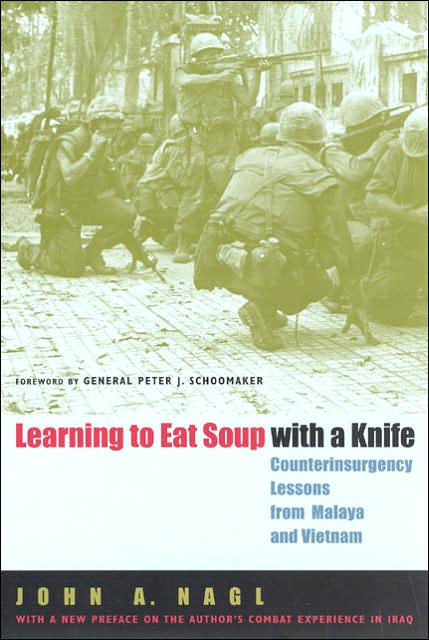
"Learning to Eat Soup With A Knife -Book Review" is now up at Chicago Boyz.
Labels: 20th century, anglosphere, army, asia, book, britain, chicago boyz, COIN, cold war, Communism, john nagl, military, military history, military reform
¶ 6:50 PM 0 comments
[ed. note - entry corrected, my apologies to Colonel McCallister and thanks to Dave for the clarification]
Dave Dilegge, editor of The Small Wars Journal has an excellent post up at The SWJ Blog entitled "COIN in a Tribal Society", relaying the contents of an email from Colonel William (Mac) McCallister (USA Ret.), currently an adivser with II MEF in Iraq. A very rich bibilographic entry, McCallister hits hard at the point of our general failure to communicate our words and deeds in a culturally relevant and comprehensible frame:
"The design and execution of a counterinsurgency campaign in tribal society must reflect the opponent’s cultural realities, his social norms and conventions of war and peacemaking. The fight in Anbar province is a “clash of martial cultures” and reflects two divergent concepts of victory and defeat and “rules of play”. The conventions of war and peace for both sides are based on unique historical and social experience and are expressed in each side’s stylized way of fighting and peacemaking. The central tenet in the design and execution of counterinsurgency operations is that it must take into consideration an opponent’s cultural realities so as to effectively communicate intent.
The study of the “tribal terrain” is a challenge. The reason - comprehensive research materials on Iraqi tribal organization, tribal diplomacy, and the art of tribal war and peacemaking are sparse. The majority of reading materials therefore are general and regional in nature and require “reading between the lines” to gain an appreciation for tribal organizing principles, cultural operating codes, and the tribal art of war and peace. The material is intended to assist the student of the tribal art of war and peace in developing an analytic structure for assessing personal experiences, observations and unit after action reports. The ultimate objective is to assist the warfighter in assessing the effectiveness of counterinsurgency tactics, techniques and procedures (TTPs) and cultural criteria to determine why certain approaches succeed or fail."
I will go one better; the United States government has not come to grips with the need to craft our diplomatic and strategic inititives with a multi-tiered and interactively complex set of audiences in mind. Too often, our leaders are playing primarily to the domestic American audience and then secondarily - and arguably a very distant second - a narrow and westernized foreign elite.
Radical transparency created by the internet and information technologies are breaking down the ability to compartmentalize messages and signals - the amplitude is higher and "broadcasting" can now take place far down the chain with strategic corporals in dusty villages instead of UN ambassadors across polished tables. The rules of the game are changing and we must change with it.
ADDENDUM:
Colonel W. Patrick Lang " How to Work With Tribesmen" (PDF)
David Ronfeldt -"In Search of How Societies Work: Tribes, the First and Forever Form"(PDF)
Labels: COIN, counterinsurgency, dilegge, diplomacy, iraq, radical transparency, small wars journal, swj blog
¶ 6:59 PM 3 comments
Lexington Green asks this question at Chicago Boyz.
Labels: 4GW, America, chicago boyz, COIN, Ic dreaming 5gw, lexington green, strategy, theory, war
¶ 8:01 AM 2 comments
Dr. Chet Richards of DNI has posted the introduction to his forthcoming book, If We Can Keep It. From what I have gathered, this book will be an extension of the radical military analysis Richards began with his previous work, Neither Shall the Sword: Conflict in the Years Ahead . An excerpt:
"Three national myths
The first is that “terrorism” poses the most serious threat to our survival and our way of life. In fact, the physical damage that terrorism does is small in comparison to other threats to our national well-being, and there are means available to reduce it even further. The greatest threat of “terrorism” is the damage we do to ourselves in sincere but misguided attempts to deal with it.
The second national misperception is that we still require a military establishment whose cost exceeds not just that of the next most powerful nation or even the next three, but of all the rest of the world, combined. Most of this expense goes into conventional (non-nuclear) forces that are no longer needed or even useful. The reason for this is not that world brotherhood has broken out, as earlier generations of pacifists mistakenly assumed, but that nuclear weapons have made wars between major powers impossible. States that are not nuclear powers, on the other hand, are either U.S. allies or are far too weak to pose any kind of military threat, and our attempts to use military force against non-state opponents, such as the “terrorists” mentioned in the previous paragraph, have not proven particularly successful.
The third, and perhaps the most dangerous because it seduces us into thinking that we can make military force into a normal tool of policy, is the notion of counterinsurgency theory. The problem is not that insurgencies cannot be defeated, but that proponents of this theory sometimes fail to distinguish between different meanings of the term “insurgency.” Several observers, recognizing this limitation, have proposed classifications. Biddle (2006) distinguishes between “people’s wars,” in which groups try to overthrow the government, and “communal civil wars,” where groups are fighting to avoid genocide. Metz (2007) classifies insurgencies based upon whether a legitimate government exists or can be created. These are both valuable and help explain why some insurgencies succeed where others do not.
....In the specific area of national defense policy, I recommend that the Department of Defense be gradually downsized to roughly the current U.S. Marine Corps plus special operations forces and supporting tactical air. This is more than adequate to deal with any future military threat. Concerning strategic – nuclear – forces, 10,000 weapons are more than we need to preserve the proven doctrine of mutually assured destruction (Blair, 2007a). Some reduction in this arsenal is clearly feasible.
Such a reordering of priorities towards our real problems implies a restructuring of the federal government. We should immediately disband the terrorism bureaucracy, particularly the Transportation Security Administration and its parent, the Department of Homeland Security and should review the roles and functions of the other agencies and departments.
Over time, as the Defense Department assumes its natural size, as has already happened with most of our European allies (Bacevich, 2006), intelligence will assume a more important function. Although military operations in the future will be rare, it becomes more important than ever that they be perceived by our friends and allies as justified, and when they do occur, they must be rapid, daring, and successful. Achieving this standard requires a step-function improvement in the integration of intelligence, diplomacy, and operations, so it will make sense to consolidate these functions in a single body where the controlling function is intelligence."
Read the entire introduction here.
It would appear that Richards, whose analytical framework is deeply rooted in the ideas of John Boyd, is throwing the 4GW hat into the ring of grand strategy, remediating a frequent criticism that 4GW thinkers are focused primarily upon tactical conflict and the destructive rather than constructive levels of strategic thinking. It will no doubt be an interesting and thought-provoking book that will stampede an entire herd of sacred cows beloved by defense intellectuals off of a cliff. That alone will make it a useful read.
My questions ( and Richards may very well answer them in his forthcoming book) raised by If We Can Keep It, would hinge on several variables:
* The utility of nuclear deterrence, upon which Richards' strategic transformation seems to depend, in an era when significant power (WMD capacity) appears to be devolving to progressively smaller ( and potentially less accountable, predictable and deterrable) substate and non-state networks. The history of nuclear deterrence and accompanying theory represents a large and complex literature with such thinkers as Brodie, Wohlstetter, Kahn, Kissinger and others who never satisfactorily arrived at answers to the conundrum presented by nuclear weapons.
Eisenhower-Dulles " massive retaliation" and "brinksmanship" put a brake on defense spending ( as Ike intended) but it was a very risky and blunt instrument. The idea that Washington would "trade New York for Paris" with the Soviets was never entirely a credible one. Nor did America's massive nuclear arsenal prevent Nasser from closing the Suez or Ho Chi Minh from subverting Saigon or even deter Khrushchev from his nuclear gamble in Cuba (in fact, our lopsided nuclear advantage probably was an incentive in Khrushchev's eyes to gain parity on the cheap).
* Steady-state assumptions about nation-state behavior in the international arena if conventional American power projection capacity was drastically reduced to levels proportionate to Western Europe. This is a major point to consider when offering a non-interventionist alternative to current strategy - American military power is the focal point of most regional security systems ( or opposition to them). To my mind, statesmen calculate their actions and plan their military expenditures based upon assumptions of American hegemony, welcome or not. The inability to even get to the starting block for military competition with the U.S. - we must think not just in terms of annual military budgets but in the colossal sunk costs of establishing a military-industrial base - is inhibiting regional arms races to a degree. Remove American preeminence from the equation and foreign statesmen are going to arrive at different calculations regarding their interests and security.
I look forward to reading it and entertaining Dr. Richards' argument in full.
Labels: 21st century, 4GW, America, chet richards, COIN, defense, deterrence, dni, foreign policy, insurgency, john boyd, military reform, national security, nuclear, small wars council, strategy, theory, war
¶ 7:01 PM 5 comments

* image and title shamelessly "liberated" from the multidisciplinarily creative Dan of tdaxp who previously posted an excellent series by the same name.
Two articles with diametrically opposed worldviews of American intervention overseas.The path to error lies in the simplification of both approaches:
"Africa Command: The Americans Have Landed" in Esquire by Dr. Thomas P.M. Barnett
(This article is currently only available in dead tree format)
"Rethinking Insurgency" (PDF) at Strategic Studies Institute by Dr. Steven Metz (hat tip to Danger Room)
Tom Barnett's Esquire article on the newly created AFRICOM is one of his best pieces in "journalist" mode and it demonstrated the dire need for establishing true ( and not primarily "kinetic") "operational jointness" in interagency cooperation in Africa. This means accepting the inherent complexity of the Gap and answering with synergistic connectivity to globalization in order to engage in societal-building and state-building .
AFRICOM

Dr. Metz also accepts the complexity and interconnectivy of globalization but prescribes defusing conflicts by disengagement, accepting the co-option of aggrieved insurgencies into the national power structure even when they are resolutely hostile to American interests. A graceful retreat does less damage, in Metz's view, than would sustained conflict fueled by American aid enhancing the power of states to resist insurgencies.
Unsurprisingly, I am in favor of Barnett's approach but recognize that it is best employed judiciously, with an economy of force and minimalist platforms where aid gives the biggest bang for the buck. Likewise, while I see the Metz approach, if raised to a general rule, as a prescription for strategic erosion of American primacy and the decline of globalization, used with discretion, it is a useful "means-test" for evaluating the strategic importance of failing states and avoiding of the waste of American blood and treasure.
Malawi is not as important as Pakistan, even if al Qaida can be found in both countries. That doesn't mean ignoring Malawi but that we engage it differently than we do Pakistan.
ADDENDUM:
Steve DeAngelis is also discussing AFRICOM at ERMB
Labels: 4GW, barnett, COIN, counterinsurgency, insurgency, national security, PNM, resilience, SSI, state building, state failure, steven metz, strategy, system administration, tdaxp, theory, war
¶ 7:56 PM 0 comments
Colonel Austin Bay's op-ed "The bottom line is, U.S. needs a 650,000-troop Army" in The Houston Chronicle ( hat tip to Rob Thornton at SWC):
"Let's return to 1990, just before Saddam Hussein invaded Kuwait. The U.S. Army had around 750,000 soldiers on active duty; the U.S. Marine Corps had 197,000 Marines. That same year, the U.S. population broke 250 million. Today, the U.S. population is slightly over 300 million.
That "old future" occurred during the final phases of the Cold War. Department of Defense budgeteers had already begun paring Cold War force structure. Though the Soviet Union hadn't officially dissolved, cost-cutters identified Cold War air wings and armored divisions as expensive legacies.
Desert Storm briefly delayed the planned decline in strength. Based on "the near-term future" the Defense and Congress envisioned, the United States didn't need Cold War troop levels. However, by 1995, peacekeeping commitments began stressing the personnel system. Then, the United States entered the Balkans, and hasn't quite left yet.
The Army asked for a 30,000 troop "plus up" in the fiscal year 1997 budget request to meet those personnel requirements. It was denied.The Clinton administration began using the reserves as an operational force rather than as a strategic, war-winning reserve.The Bush administration continued to do this after 9/11, nudging Army end strength from around 480,000 in 2001 to approximately 515,000 today.
While that's arguably close to the 30,000 "missing" since 1996, it's a far cry from the forces on hand on Aug. 2, 1990, when Saddam Hussein's tanks were on the move. It's also proved to be inadequate to support Iraq, Afghanistan, peacekeeping operations and emergency contingencies"
Read the rest here. I recall when we had 300,000 soldiers in West Germany alone. It wasn't all that long ago.
I'm inclined to agree that DoD and USG resources can be much better allocated to permit a significant increase on boots on the ground; the tasks assigned to the new boots though, is the critical variable. Not the boots themselves.
The spear needs more "point" and far less "butt".
Labels: army, austin bay, COIN, defense, foreign policy, military, military reform
¶ 7:32 AM 5 comments
Fabius Maximus offers a contrarian argument at DNI -" The Iraq insurgency has ended, which opens a path to peace". I found this to be one of FM's most interesting pieces, which should be read in full; I will comment on several points that intrigued me in particular:
"Having a bureaucracy, capital, constitution, and seat at the UN does not make a government. Governments have specific characteristics. The more of these they possess, the stronger and more durable they are. The most important attributes:
Control of armed forces, or even monopoly of armed force in its borders.
The ability to levy and collect taxes.
An administrative mechanism to execute its policies.
Territory in which it is the dominant political entity.
Control of borders.
Legitimacy (not love) in the eyes of its people.
The national “government” of Iraq has, by most reports, none of these. It lives on oil revenue and US funding. Its ministries are controlled by ethnic and religious groups, parceled out as patronage and run for their “owners” benefit. The only territory it controls is the Green Zone, by the grace of the Coalition’s armed forces."
Defining or determining the "legitimacy" of states is one of the stickiest questions in international relations and one in which statesmen, political scientists, historians and international law experts lack a consensus. De jure recognition of other states is a small substantive component but a large diplomatic one and it can matter. Having the consent of the governed, implicitly by primary loyalty or explicitly through an electoral process is critical but it can quickly be frittered away through incompetence and weakness.
"What were the Iraq elections? An expression of hope by its people, or an ignorant or delusional attempt at nation-building by America. Perhaps both.
Either way, it was a step on a path to nowhere. Athenian democracy and the Roman republic were built on a foundation of internal political machinery by which the leaders’ decisions were translated into actions. Iraq lacked that after our invasion, and we constructed the government with no supporting bureaucratic mechanisms. Voting does not magically call the necessary apparatus into existence.
The only effective political apparatus in Iraq exists at the local level. Much of that is done by the most basic form of government: only those commanding armed men have a vote."
The democratic vote in Iraq was a historically important moment, Fabius underestimates the import. He is however, quite correct, that the moment was not capitalized upon nor did the administration even attempt to prepare the interim Iraqi government to do so. Most of the political momentum was lost and democracy as a value was depreciated in the long and mostly pointless wrangling among Iraqi parties that followed. Where was General Leonard Wood when we needed him ?
Fabius also offers some advice:
"Beyond that, there are two possible ways we can help.
First, to secure public spaces in Iraq’s major cities – a form of static defense. No longer attackers, clear to all as only temporary helpers, we might transform from targets to neutral guardians.
Second, even more important, we can secure Iraq’s borders, especially with Iran. Iraq has no Army, probably by our design to maximize their dependence on us. In this role we can relocate our forces out of harm’s way (except as needed as above). Unlike the dreams of neocons, this is probably not a long-term arrangement. If Iraq survives, eventually it will build a real army and tell us to leave.
This plan gives us a soft exit path, no matter what happens in Iraq."
Some of this is quite sage but I'm hard pressed to see how the first part in particular is going to be different in the functional military sense from what General Petraeus is doing with the COIN surge. Different intent on FM's part, certainly, but actions will be similar, if not identical.
Much to read in that piece.
Labels: COIN, dni, fabius maximus, insurgency, iraq
¶ 6:37 PM 1 comments