ZenPundit
Tuesday, August 07, 2007
THE STRATEGIC THOUGHT DEFICIT
Dr. Barnett, opining yesterday on the recent NYT op-ed on Kennan:
"The dearth of strategic thinking reaches a new low, or maybe this is just a Kennan scholar pre-hawking his new book.
Now we get the out-of-time argument that containment is the answer on radical Islam.
It's not much of an argument, but rather a decent rehashing of Kennan's thinking on the Sovs. The problem here, of course, is that al-Qaida doesn't translate well to an authoritarian empire already in existence.
Another problem, which I flayed at length in PNM, is that global historical forces are moving in a direction very different from that of the late 1940s and early 1950s. We're not in some bilat standoff of camps with little dynamic interchange between them. We're watching a consolidation period unfold following a massive expansion of globalization, one that's simultaneously accompanied by its further expansion thanks to the huge resource draw from rising Asia. "
We have a severe shortage of Kennans these days. While of course, there was only one Kennan writing the Long Telegram there were also the Stimsons, Marshalls, Achesons, Nitzes, Forrestals, Vandenbergs, Lovetts, Dulles', McCloys, Wohlstetters, Kahns and many others who came before and after Kennan who made their own contributions to the development of the Containment strategy. Our diplomatic and national security bench was deep in those days and often, these statesmen brought real experience in international finance, logistics and linguistics to the table ( Wohlstetter and Kahn were the cutting edge of the academic -strategist wave that replaced the Wall Street and Railroad company lawyer generation).
Today, we see most of our big picture and thinkers outside of government and often academia as well, writing books, giving speeches or building private sector companies. Tellingly, the most innovative policy of Bush's second term was developed not by a White House aide or a Cabinet secretary but by General David Petraeus - and his counterinsurgency strategy for Iraq was only accepted by the powers that be out of political and military desperation. The Democrats are no better, having had essentially no new policy ideas in almost two generations and a deep desire to ignore the existence of foreign policy altogether.
In part, this is a generational problem. Not only are the Boomers an amazingly self-centered lot, endlessly obsessing on ( and trying to re-live) the political traumas of their now distant youth, but the statesmen among them cut their teeth on the Cold War, bipolar, pre-Globalization, rigidly hierarchical world and are, for the most part, unwilling to revisit their anachronistic assumptions. There are exceptions but these people are usually outliers in some way, personally or professionally.
We may need to construct our defenses for the 21st century by retooling civil society to become more resilient, adaptive and dynamic - for the short term, our governing class may be a lost cause.
Labels: 20th century, 21st century, barnett, diplomacy, foreign policy, george kennan, history, national security, society, strategy
¶ 7:18 PM 11 comments
Friday, August 03, 2007
REVIEWING LEARNING TO EAT SOUP WITH A KNIFE
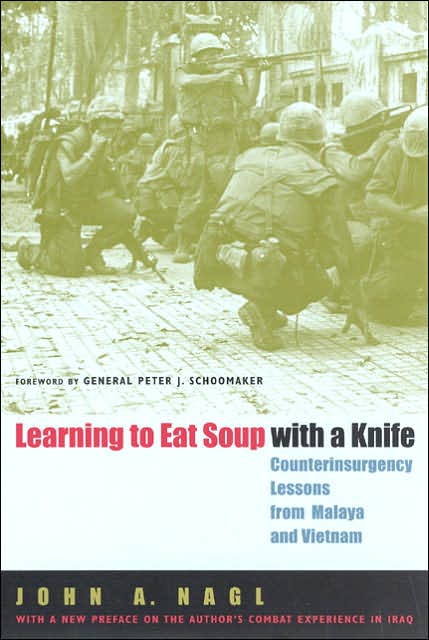
"Learning to Eat Soup With A Knife -Book Review" is now up at Chicago Boyz.
"Learning to Eat Soup With A Knife -Book Review" is now up at Chicago Boyz.
Labels: 20th century, anglosphere, army, asia, book, britain, chicago boyz, COIN, cold war, Communism, john nagl, military, military history, military reform
¶ 6:50 PM 0 comments
Saturday, March 24, 2007
THE STRONG MEN OF ASIA
Having spent a great deal of time considering creativity and insight, I'm generally convinced that we benefit cognitively and on an emotive-psychological level from novelty, even if that novelty is to a small degree. Sort of like garnering measurable aerobic benefits from modest daily walking, every little bit helps. You don't have to go from a microbiology lab one day to spelunking the next in order to give your brain some stimulus.
Therefore, I decided to shift my usual reading attention from matters of Western history and military affairs to read in succession, the biographies of three seminal 20th century dictators, all of whom ruled Asian nations but impacted the history of the world. It is a good shifting of gears for me, as the last heavy fare of reading Asian history and politics was back in the early nineties.

First up, is Chiang Kai-Shek: China's Generalissimo and the Nation He Lost by Jonathan Fenby, who gives a critical reappraisal. While we are all accustomed to the standard scholarly historical criticism of Chiang Kai-Shek and the Kuomintang which is heavily influenced by the politics of academic Marxism, Fenby, a British journalist who is a longtime writer and editor for The Economist magazine and The Observer, (so far as I have read) gives a hard-eyed, pragmatic, thoroughly detailed, flavor that Alan Schom gave to his masterful deconstruction of Napoleon Bonaparte.

Number two will be the critically acclaimed The Unknown Story of Mao by Jung Chang and Jon Halliday, which like the Fenby book is an act of idol-smashing. All the moreso since Mao ZeDong, unlike his rival Chiang, retains an aging cadre of Leftist admirers both at home and in the West.

I intend to finish with the highly regarded Ho Chi Minh: A Life by former diplomat and Penn State historian William J. Duiker.Duiker himself, served in the American embassy in Saigon during the Vietnam war, which adds a poignant edge to his historical research.
Anyone out there who has read any or all of these books, feel free to chime in.
Having spent a great deal of time considering creativity and insight, I'm generally convinced that we benefit cognitively and on an emotive-psychological level from novelty, even if that novelty is to a small degree. Sort of like garnering measurable aerobic benefits from modest daily walking, every little bit helps. You don't have to go from a microbiology lab one day to spelunking the next in order to give your brain some stimulus.
Therefore, I decided to shift my usual reading attention from matters of Western history and military affairs to read in succession, the biographies of three seminal 20th century dictators, all of whom ruled Asian nations but impacted the history of the world. It is a good shifting of gears for me, as the last heavy fare of reading Asian history and politics was back in the early nineties.
First up, is Chiang Kai-Shek: China's Generalissimo and the Nation He Lost by Jonathan Fenby, who gives a critical reappraisal. While we are all accustomed to the standard scholarly historical criticism of Chiang Kai-Shek and the Kuomintang which is heavily influenced by the politics of academic Marxism, Fenby, a British journalist who is a longtime writer and editor for The Economist magazine and The Observer, (so far as I have read) gives a hard-eyed, pragmatic, thoroughly detailed, flavor that Alan Schom gave to his masterful deconstruction of Napoleon Bonaparte.
Number two will be the critically acclaimed The Unknown Story of Mao by Jung Chang and Jon Halliday, which like the Fenby book is an act of idol-smashing. All the moreso since Mao ZeDong, unlike his rival Chiang, retains an aging cadre of Leftist admirers both at home and in the West.
I intend to finish with the highly regarded Ho Chi Minh: A Life by former diplomat and Penn State historian William J. Duiker.Duiker himself, served in the American embassy in Saigon during the Vietnam war, which adds a poignant edge to his historical research.
Anyone out there who has read any or all of these books, feel free to chime in.
Labels: 20th century, asia, biography, chiang kai-shek, china, Communism, dictator, history, Ho Chi Minh, Kuomintang, Mao ZeDong, Vietnam, Vietnam War
¶ 7:46 PM 0 comments