Colonel Frans Osinga, PhD, who gave a tour de force lecture at Boyd 2007, managed to prevail upon his publisher to sell a paperback version of Science, Strategy and War:The Strategic Theory of John Boyd at a price non-billionaires could afford.
I will be reviewing Science, Strategy and War in December and - tentatively - organizing a roundtable discussion at Chicago Boyz, most likely after Christmas. If you are a blogger, academic or a current or former member of the armed services and are interested in participating, send me an email at zenpundit@hotmail.com.
Labels: 4GW, boyd 2007, ideas, intellectuals, john boyd, military, military history, military reform, science, strategy, theory, war, warriors
¶ 7:05 PM 2 comments

Is not that the military dictator, General Pervez Musharraf has imposed martial law. Much like Poland under Jaruzelski or the recent crackdown in Burma, martial law in Pakistan was not a transition from one kind of state to another but rather a shift from the hypocrisy of a velvet glove to the honesty of an iron fist. Pakistan is no more a dictatorship today than it was a month earlier.
Pakistanis, it must be said, are not universally outraged by dictatorship per se. The wily and ruthless General Zia ul- Haq was a fairly popular figure in his day. Wild-eyed deobandi fanatics, opposed to Musharraf's regime, long for a Sharia-state tyranny that would be far more brutal and incompetent than is the current government in Islamabad. Nor is the growing corruption of the army in Pakistan the central problem; Benazir Bhutto's party, the democratic faction, once looted government coffers with gusto while wrecking the economy. Her father, once Prime Minister but later executed by Zia, was a notable menace to the concept of good governance.
Pakistan's central problem is a crisis of legitimacy. Nationalism is a waning force these days and even anti-Indian feeling is sustained by a marriage of nationalism with Islamist radicalism. Once, a Pakistani leader could declare that Pakistani's " would eat grass" to make their country the nuclear equal of Hindu India. No more. Musharraf's fear of "national suicide" did not rouse his countrymen to his side and there are some, even in the army, who would hold up jihad above the nation. Well above.
Without nationalism or state competence, people fall back on primary loyalties. Pakistan has no intrinsic reason to exist unless it can be welded together in men's minds.
Labels: dictator, islamic world, islamist, military, pakistan, state building, state failure, terrorism
¶ 8:04 PM 6 comments
Eddie ( who credited Abu Muqawama) sent in a link to a Mother Jones issue that has a veritable roundtable of experts commenting on withdrawing from Iraq. I was impressed with their selection and below I highlight links to some of the experts who would be of the most interest to readers here:
Colonel T.X. Hammes
Colonel H.R. McMaster
Lt. Colonel John Nagl
Dr. Andrew Bacevich
Dr. Bary Posen
Dr. John Pike
General Anthony Zinni
Dr. Anthony Cordesman
Dr. Zbigniew Brzezinski
Give it a look.
Labels: 4GW, COIN, eddie, insurgency, iraq, military, mother jones, war
¶ 5:27 PM 0 comments
The most comprehensive, English-language, ideological analysis of Islamist extremist and terror movements yet compiled; assembled by the Combating Terrorism Center at West Point.
Executive Summary (23 page PDF)
Research Compendium (361 page PDF)
Hat tip to Charles Cameron for the title of this ( actually, many) interesting scholarly work and to Right Truth for the URLs.
UPDATE:
Heh. Plagued by basic reading comprehension problems last night. Title corrected. Gracias, Charles!
Labels: al qaida, analytic, COIN, islam.insurgency, islamist, military, military intelligence, national security, strategy, terrorism, tribes, war, warriors
¶ 6:48 PM 0 comments
Very seldom do I ever lift something from the archives, but I came across a guest-post I did a number of years ago for blogfriend Josh Manchester at his now defunct The Adventures of Chester blog. The basic content of the post has held up fairly well, though some of the original links that supported the data have since vanished ( reminding me that links are really, really, transient but a footnote is forever); most of the economic data came from NIC/CIA.gov PDFs that have been moved or removed from the web, so take that for what it is worth (the dollar figures are more than stale now, regardless):
"BLACK GLOBALIZATION AND SMALL WARS
When Saddam Hussein emptied his prisons prior to the Iraq War it seemed at the time a sign of his regime’s impending doom. Either Saddam’s amnesty was an act of desperation to shore up support among the Iraqi people or his grip on power had so weakened that he had lost control even over elements of his own security apparatus. In actuality, the dictator had made a preemptive asymmetrical strike against American forces by releasing Iraq’s professional criminals whose well-organized networks badly undermined the CPA and today are connecting an otherwise heterogeneous insurgency. Although this move ultimately did Saddam Hussein little good it demonstrated the potential power that “Black Globalization” has to effect the outcome of military interventions, even those of the United States.
It’s rather strange that given our history, American intelligence did not forsee this outcome in Iraq. It was the United States government that used the Mafia of Charles “ Lucky” Luciano to gather naval intelligence, suppress sabotage on the dockyards and enlist the Sicilian Mafia to undermine Mussolini’s rule to soften the island for Allied invasion. WWII however was the age when nation-state control and the exercise of sovereignty and economic autarky were at their zenith and non-state actors like criminal syndicates were peripheral to events.
Today, the strategic situation is vastly different. The relative primacy of nation-state sovereigns has been eroded by globalization that opened their economies and borders to greater flows of “connectivity” and challenges to their political legitimacy mounted by international, transnational and subnational actors. Some of these, the WTO or the internet for example, at least have brought tremendous benefits. Not so the metastasis of transnational criminal networks that constitute black globalization and have an economic reach that in the aggregate, rivals the greatest of regional powers and are centered on a few geographic nexus points. A sampling of annual estimates:
Governmental Corruption $ 500 billion
Global Narcotics trafficking $ 400-500 billion (matching or exceeding U.S. Defense budget)
Conflict Diamond trafficking $ 24 billion/ 10 % world market
Human Trafficking $ 7 billion
Stolen Automobile Smuggling $ 9 billion
Piracy ( maritime) $ 16 billion ( high end estimate)
Even leaving aside minor or hard to estimate contraband markets or legal “ gray “ markets like international arms dealing, these revenues are enough to field armies or acquire the most expensive technology to evade capture or launch asymmetrical attacks on state forces.
Clearly, the days when even a weak state ruler like Ngo Dinh Diem could scattter a criminal organization with a whiff of grapeshot are over. Expeditions into failed Gap states like Somalia or major military invasions of countries like Iraq must take Black Globalization networks into account during strategic planning as they would subnational or even full-fledged state actors. In terms of on the ground, policy, options for U.S. policy makers and commanders for engaging these networks would include:
Alliance ( Luciano Model)
Benign Neutrality ( Transactional Model)
Armed Neutrality ( Deterrence Model)
Active Containment ( Limited military action)
Belligerence (Counterinsurgency model)
Ideally, the U.S. would seek to prevent the Black Globalization network from actively aligning itself with the enemy and avoid direct engagement to suppress the network until the primary mission was accomplished. Imagine the state of Iraq today if the criminal networks were working hand in glove with American and Iraqi troops to root out the insurgency instead to aid the insurgents against coalition forces. Circumstances, however may not always prove to be so simple, corrupt and violent networks being what they are, any negotiated result is at best transient.
A second indirect form of pressure could be exerted on the money laundering aspect of Black Globalization which must at some point attempt to “ clean” their cash flow through or by acquiring legitimate banks and financial markets in Western countries. Strategic financial attack was evidently taken against the major backers of Slobodon Milosevic during the Kosovo War with positive results. Exploiting this avenue might require that the Marines have more than just a few good accountants, a genuine financial intelligence service would be required to maximize effectiveness.
The complexity of small wars is almost enough to make diplomats and generals long for the good, old days of the Warsaw Pact. Almost. "
Labels: best of zenpundit, black globalization, brave new war, COIN, foreign policy, globalization, IC, insurgency, iraq, military, networks, piracy, small wars council, transnational criminal organization
¶ 7:24 PM 4 comments
Great piece by Colonel Kilcullen at SWJ Blog on the "flipping" of Anbar province by the tribal revolt against AQI:
"The implications of the tribal revolt have been somewhat overlooked by the news media and in the public debate in Coalition capitals. In fact, the uprising represents very significant political progress toward reconciliation at the grass-roots level, and major security progress in marginalizing extremists and reducing civilian deaths. It also does much to redress the lack of coalition forces that has hampered previous counterinsurgency approaches, by throwing tens of thousands of local allies into the balance, on our side. For these reasons, the tribal revolt is arguably the most significant change in the Iraqi operating environment for several years. But because it occurred in ways that were neither expected nor accounted for in our “benchmarks” (which were formulated before the uprising began to really develop, and which tend to focus on national legislative developments at the central government and political party level rather than grass-roots changes in the quality of life of ordinary Iraqis) the significance of this development has been overlooked to some extent."
We should run with the grassroots and try to get tolerably effective Iraqi self-government at the local and provincial level and simply cut our losses with the central government. Let it fade into irrelevance as most Iraqis already ignore its edicts anyway.
The opportunity of the democratic elections were blown when the Iraqi power brokers (few of whom could be considered democrats in any meaningful sense and see a truly democratic system as inimical in principle to their own in-group leadership) were permitted to drag out negotiations over forming a government until legitimacy and popular interest generated by the elections eroded. We should have instead, followed the example of the noteworthy "Small Wars" fighter, General Leonard Wood.
The general, who was running occupied Cuba as the military governor in the immediate aftermath of the Spanish-American War, faced a similar situation with the intransigence of wealthy, landed, Cuban elites who filled the legislature who were attempting to outwait Wood by creating a political deadlock until the Americans went home. General Wood, who understood the game being played and the free-for-all that would ensue if American troops left Cuba without a functional government, simply locked the doors of the parliament and his armed soldiers refused to permit anyone to leave until the legislators finished their business and also ratified the unpopular Platt amendment.
The latter effectively made Cuba a protectorate of the United States in name as well as fact but from a realist perspective, it also quashed the possibility of civil war, boosted Cuba's economy and guaranteed a functioning civil government in Havanna for two and a half decades, even if it required a new military intervention. Iraq is not nearly so well off.
ADDENDUM
SWJ BLOG
Glittering Eye
Sic Semper Tyrannis
Global Guerillas
Iraq the Model
Labels: al qaida, COIN, insurgency, iraq, islamist, kilcullen, military, primary loyalties, small wars journal, tribes, war, warriors
¶ 7:32 PM 2 comments
Via Politics In The Zeros (Hat tip), I learn that netwar theorists Dr. John Arquilla and David Ronfeldt have revisited their 1999 essay "The Promise of Noopolitik" with an updated postrscript. An excerpt:
"As America’s soft power rises and falls, so do the prospects for noöpolitik. And right now, America’s soft power is unusually questionable. America has long stood for vital ideals — freedom, equality, opportunity. America has also stood for ethical ways of doing things: competing openly and fairly, working in concert with partners, seeking the common good, respecting others’ rights, and resorting to war only after exhausting non–military options. By doing so, America built its legitimacy and credibility as a global power in the twentieth century. But lately, due to assorted sorry matters this decade (some but not all involving the war in Iraq), leaders and publics around the world have become increasingly doubtful that America is deeply dedicated to the ideals and practices it professes. U.S. public diplomacy is on the defensive more than ever before. Oddly, China is said to be more effective at soft–power appeals and techniques "
Labels: brave new war, david ronfeldt, ideas, john arquilla, military, network theory, Politics in the Zeros
¶ 2:53 PM 2 comments
"It shall be the policy of this Nation to regard any nuclear missile launched from Cuba against any nation in the Western Hemisphere as an attack by the Soviet Union on the United States, requiring a full retaliatory response upon the Soviet Union."
- John F. Kennedy, President of the United States
"Acquiring weapons for the defense of Muslims is a religious duty. If I have indeed acquired these weapons, then I thank God for enabling me to do so. And if I seek to acquire these weapons, I am carrying out a duty. It would be a sin for Muslims not to try to possess the weapons that would prevent the infidels from inflicting harm on Muslims."
-Osama bin Laden, "amir" of al Qaida
Both the Soviet Union and the United States amassed immense nuclear arsenals during the Cold War of approximately 50,000 warheads of various sizes and a range of systems with which to deliver these terrifying weapons. A number of other second and third tier states later joined "the nuclear club", seeking a hedge against regional enemies or desiring the totemic status in international relations brought by possession of nuclear arms.
None of these states, not even Israel which is reputed to have up to 200 nuclear bombs, ever developed a nuclear weapons capability that remotely matched that of the superpowers. A number of nuclear-capable states have either eschewed building nuclear weapons (Germany, Japan, Taiwan) or have been persuaded to disarm those that they had inherited or assembled ( Belarus, Ukraine, Kazakhstan and South Africa).
So lopsided are the throw-weight ratios between countries with small yield or primitive atomic weapons and the stockpiles retained by the U.S. and Russia that most of the nuclear club have arsenals that are useful only for deterring a military attack from their immediate non-nuclear neighbors or a nuclear peer. Pakistan's nuclear status was of no help in warding off American demands after 9/11; had Islamabad attempted to brandish, much less use, nuclear weapons in defense of their Taliban clients, it would have surely invited Pakistan's immediate destruction.
Cheryl Rofer of Whirledview, had a post "The Necessity of the U.S. Nuclear Deterrent: A White Paper" that analyzed a recent quasi-official document “White Paper on the Necessity of the U. S. Nuclear Deterrent” authored by a cluster of national security VIPs, including several past CIA directors and current advisers to the US Strategic Command. The paper summarizes many obvious points about American nuclear deterrence and calls for a " debate". Cheryl found the paper to be lacking:
"No real threat assessment is offered, just vaguely threatening words about Russia, China, North Korea and Iran. For a group of folks trying to move out of the Cold War mindset, that’s an interesting ordering of countries.
....Is the white paper saying that US nuclear policy is only about deterrence? Nothing about the Nuclear Nonproliferation Treaty and its obligations? Nothing about the uselessness of deterrence against mobile subnational groups with no territory to defend? The only thing that is important to our allies is US security assurances, backed up by the threat of nuclear warfare?
....This white paper is stuck in the the Cold War, circa 1969. "
I think the white paper authors are correct that the perceived credibility of American nuclear guarantees dampen down potential nuclear arms races among third parties, notably in Northern Asia. Cheryl however, is correct on the larger point that the analytical assumptions of the paper are shot through with Cold War legacy mentalities.
Arguably, the white paper does not even match the Cold War era in terms of nuanced thinking. In 1958, in Nuclear Weapons and Foreign Policy, Henry Kissinger wrote:
"It is the task of strategic doctrine to strike a balance between the physical and the psychological aspects of deterrence, between the desire to pose a maximum threat and the reality that no threat is stronger than the belief of the opponent that it will in fact be used. A strategy which poses alternatives that policy-makers are unwilling to confront will induce either inaction or improvisation. A strategy which establishes a superior balance between power and will may then gain a crucial advantage, because it permits initiative and shifts to the other side the risks inherent in making countermoves" (Kissinger, 175)
CKR aptly pointed out the obvious alternative of non-state and subnational actors with nuclear weapons that the white paper's authors were " unwilling to confront" in their state-centric focus.
Here are a few others that would relate to the state of American deterrence, enhancing or undermining it:
* Potential, novel, weaponization of of aspects of nuclear particle research outside classic uranium 235 and plutonium bombs.
* The need for more effective controls and tracking of trade in esoteric, dual-use, technologies of weaponization that make nuclear devices useful militarily. Increasing transparency level of same.
*Identifying non-nuclear technologies that could result in weapons of a comparable order of magnitude of destruction or loss of life as with low-level nuclear weapons.
* Strengthening and expanding the inspections regime under which NPT signatories are permitted access to nuclear technology for peaceful purposes. Addition of automatic penalties if NPT signatories are caught cheating, subject to removal or waiver by the UNSC ( putting the burden on the accused proliferator to come clean instead of on the IAEA or UNSC states to get any meaningful sanctions applied).
* De-escalating the potential for future conflict between nuclear and nuclear capable states by instituting new regional diplomatic and security structures.
* International nuclear convention regarding the security of nuclear materials and command and control by the nuclear weapons states.
* Moral-political-legal campaigns that degrade the credibility of American deterrence by ratcheting upward the "unthinkability" of nuclear weapons use, thus tempting potential adversaries to risk the very brinksmanship scenarios ( war, apocalyptic terrorism) that would make the use of nuclear weapons possible or likely.
* Avoiding "nuclear weapons deflation" as an unintended consequence of arms control. Striking a balance between reducing large American and Russian arsenals and unduly increasing the military value of small ones and the temptation to increase them in order to reach "parity" with America and Russia ( "linkage" for all nuclear club arsenals). Or worse, the temptation to sell or use them.
* Removal of strategic nuclear materials from the global black market by vastly accelerating certified destruction or reprocessing of obsolete national stocks.
* Developing new models of deterrence that would be concurrently perceived as credible by states, non-state actors and subnational/ transnational networks who may all be within an interdependent nexus of responsibility for a catastrophic WMD attack.
* Identifying and categorizing non-state network threats to American security with potential WMD capacity.
* Understanding the parameters of the possible in terms of private networks and WMD capabilities, through intellectually honest red team exercises.
* Examining the balance of utility between emphasizing clarity and uncertainty in American nuclear response and deterrence policy in a multi-polar and non-state actor era.
Many of my variables are not new but they are of at least more recent vintage and of a broader horizon than what the white paper has considered. I'm interested in hearing your thoughts as well.
Labels: 21st century, al qaida, America, arms control, CKR, deterrence, diplomacy, military, networks, nuclear, terrorism, war, whirledview, youtube
¶ 12:38 PM 7 comments
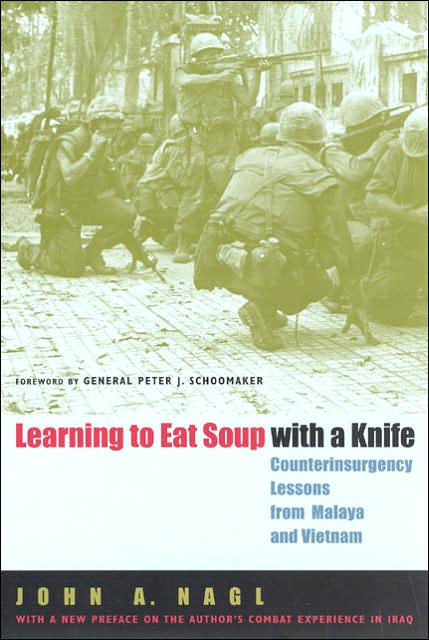
"Learning to Eat Soup With A Knife -Book Review" is now up at Chicago Boyz.
Labels: 20th century, anglosphere, army, asia, book, britain, chicago boyz, COIN, cold war, Communism, john nagl, military, military history, military reform
¶ 6:50 PM 0 comments
An interesting paper about an obscure military classic of the Byzantine Empire (hat tip to TROUFION )
Labels: byzantium, classics, history, military, military history, small wars council, theory, war
¶ 10:03 AM 0 comments
Michael Tanji, the IC veteran at Haft of the Spear, interviewed John Robb about his new book, Brave New War over at Tanji's MSM gig, The SPOT Report ( have to add that to the blogroll...).
"Brave New War Interview (Part I)"
"Brave New War Interview Part II"
NEW! "Brave New War Interview (Part III of III)"
The interview is excellent. Tanji gets beyond the usual superficial questions into the meat of Robb's analytical worldview. A sample:
" TANJI: In The Long Tale of Warfare Emerges you take an Occam's razor through the fundamentals about the size and capability of the insurgency. We can kill with precision and to any scale, but apparently cannot get the basic math right. Is dogma driving us to perform data-free analysis or are we just not preparing our strategists and planners to address complex or asymmetric problems?
ROBB: The problem may be whether or not we operate on best case data or worst case. If you always select the best case data in order to bolster the moral cohesion at home, then you are really lying to yourself -- essentially, breathing your own exhaust. Another reason may be that that our intelligence system can't handle the level of complexity involved within a closed environment (locked down by artificial barriers of secrecy). It's not tapping into the vast pools of talent outside the organization effectively.
TANJI: Let me ask you a question that I get asked a lot: Why no major attack in the US since 9/11? Is it a question of difficulty in setting off systemic cascading failures? If major attacks suffer from diminishing returns and small attacks ratchet up the "tax" on targeted cities, why haven't we seen IEDs on Wall St. or Main St.?
ROBB: Here are a couple of reasons. First is the diminishing returns of symbolic terrorism A big attack like 9/11 is hard to top. Anything less would hurt the al Qaeda brand and fail to return fear to anything near the levels of 9/11. Second, al Qaeda was severely damaged when we invaded Afghanistan. Those resources it had left were spent on staying alive and helping launch the operation in Iraq. Remember, a major reason for 9/11 was to get the US into a guerrilla war in Asia and repeat the experience of Russia's Afghanistan. In terms of systems disruptions, this method has only recently emerged from the experience in Iraq. Not everyone gets it yet, but the insight is spreading quickly in an organic fashion. You could conclude that the attack on Abqaiq and the Golden Mosque were examples of systems disruption (the latter being social systems disruption) that al Qaeda didn't have to project power to the US to accomplish. "
I found the section in BNW on Urban Takedowns problematic as well. I liked Robb's concept of a " terrorism tax" on targeted cities because that jives with a systematic understanding of applying market forces to societal analysis. I think, on the margin for certain important, narrow, questions, this idea works very well.
OTOH, historically, all cities were essentially death traps that could only be sustained by a daily influx of migrants ( usually peasants fleeing rural poverty) that exceeded those dying from disease, violence, fire and malnutrition at a rate that vastly exceeded the toll taken by today's terrorism. Only in advanced states, with the creation of modern sanitation and water systems, public health, police and fire services has this dynamic changed for the better. Many cities in the Gap and a few in the New Core are still in this " feral" state. The point being that as a complex social and economic networks, cities may have greater resilience than we realize, which makes estimating terror effects problematic.
Labels: book, brave new war, haft of the spear, john robb, military, military reform, SPOT, tanji, theory, war, warriors
¶ 9:41 AM 1 comments
Fabius Maximus critiques American generalship in his trademark style:
"The Core Competence of America’s Military LeadersThird in a series about a serious threat to America"
There's a number of provocative arguments in FM's latest piece but I wanted to highlight this one in particular:
"The events surrounding the fall of Iraq’s capital are difficult to imagine, even after four years have passed. US forces again proved invincible on the field of battle. They rolled up to Baghdad, occupied it and waited for orders. Then the capitol fell into disorder, with looting and burning of key infrastructure.
Apparently the Pentagon’s senior generals – the best-educated generals ever to lead an Army – failed to prepare for one of history’s most common scenarios. As a result they read reports from their field commanders and watched as victory tipped over to what might become a crushing defeat. Perhaps for the next war our top generals’ briefing books should include DVD’s of War and Peace and Gone with the Wind. Watching the burning of Moscow and Atlanta might remind them to plan for this contingency.
It’s not yet clear why and how this occurred, except in one respect. Our military is a full member of 21st Century American society – no separate military culture here – and its top leaders produce excuses suitable for a Superpower, featuring the new American mantra: “It’s not our fault.” An expert at RAND said it well:
While it can be argued that U.S. military planners could not have been expected to anticipate the emergence of an insurgency any more than they could have foreseen the widespread disorders, looting, and random violence that followed the fall of Baghdad, that is precisely the nub of the problem. The fact that military planners apparently didn’t consider the possibility that sustained and organized resistance could gather momentum and transform itself into an insurgency reflects a pathology that has long affected governments and militaries everywhere…
Bruce Hoffman, “Insurgency and Counterinsurgency in Iraq”, RAND (2004)
RAND’s sponsors likely appreciated the diplomatic phrasing “while it can be argued”. Much nicer than suggesting that our generals should have foreseen the scenario that has dominated post-WW-II wars, guerrilla warfare against foreign occupiers."
In the article, FM refers to American generals as being akin to corporate CEO's. The personnel system of the U.S. military, in which zero defects and lavish ( bordering upon ludicrous) praise from your immediate superior is necessary for promotion under an "up or out" system, weeds out creative and divergent thinkers, candid speakers, risk-takers and even mild non-conformists. What is left is a finely honed and homogenous administrative class attuned to institutional norms and a received professional culture. A system that creates a surplus of first-rate political generals like Al Haig and Colin Powell but not Pattons, Grants or Lees. A few slip through, but how many ? And of these few, how many will have a chance at field command ?
Incentives must be geared to promote those who exhibit behaviors that tend to win wars on the battlefield rather than bureaucratic skirmishes in Washington.
Labels: defen, dni, fabius maximus, military, military reform, war, warriors
¶ 7:31 PM 6 comments
Colonel Austin Bay's op-ed "The bottom line is, U.S. needs a 650,000-troop Army" in The Houston Chronicle ( hat tip to Rob Thornton at SWC):
"Let's return to 1990, just before Saddam Hussein invaded Kuwait. The U.S. Army had around 750,000 soldiers on active duty; the U.S. Marine Corps had 197,000 Marines. That same year, the U.S. population broke 250 million. Today, the U.S. population is slightly over 300 million.
That "old future" occurred during the final phases of the Cold War. Department of Defense budgeteers had already begun paring Cold War force structure. Though the Soviet Union hadn't officially dissolved, cost-cutters identified Cold War air wings and armored divisions as expensive legacies.
Desert Storm briefly delayed the planned decline in strength. Based on "the near-term future" the Defense and Congress envisioned, the United States didn't need Cold War troop levels. However, by 1995, peacekeeping commitments began stressing the personnel system. Then, the United States entered the Balkans, and hasn't quite left yet.
The Army asked for a 30,000 troop "plus up" in the fiscal year 1997 budget request to meet those personnel requirements. It was denied.The Clinton administration began using the reserves as an operational force rather than as a strategic, war-winning reserve.The Bush administration continued to do this after 9/11, nudging Army end strength from around 480,000 in 2001 to approximately 515,000 today.
While that's arguably close to the 30,000 "missing" since 1996, it's a far cry from the forces on hand on Aug. 2, 1990, when Saddam Hussein's tanks were on the move. It's also proved to be inadequate to support Iraq, Afghanistan, peacekeeping operations and emergency contingencies"
Read the rest here. I recall when we had 300,000 soldiers in West Germany alone. It wasn't all that long ago.
I'm inclined to agree that DoD and USG resources can be much better allocated to permit a significant increase on boots on the ground; the tasks assigned to the new boots though, is the critical variable. Not the boots themselves.
The spear needs more "point" and far less "butt".
Labels: army, austin bay, COIN, defense, foreign policy, military, military reform
¶ 7:32 AM 5 comments
It's rather nice to see the esoteric theory topics I kick around here in conjunction with sites like The Small Wars Council, DNI, Tom Barnett and John Robb's blogs and the circle of related bloggers, are penetrating the mainstream press. Some recent examples:
William Lind in UPI
Max Boot citing the Small Wars Journal
"War without limits" by Christopher Shea in the Boston Globe (hat tip to Dr.Ralph Luker)
Thomas Barnett's frequent appearances in columns by David Ignatius going back several years
This is a good thing. While there is a healthy tendency in our online alternative defense thinking community to disagree, at times caustically, there is a shared consensus that the current structure, strategy and appropriations process for America's armed forces are ill-suited to the challenges facing the United States.
Change is required and change will only come when the ideas that we have been batting around on blogs, discussion boards and ( in a few instances ) books, penetrates the mass media and gets into the minds of the political class and the voting public. Maximizing attention on the ideas, rather than being distracted by infighting or loose cannon comments, is the route we need to go.
Labels: barnett, dni, john robb, max boot, media, military, military reform, small wars council, small wars journal, strategy, war, william lind
¶ 9:10 AM 2 comments
Excellent! Thanks to the kind offices of Dr. Chet Richards, I'll be attending the Boyd Conference come July. Looks to be a stellar program of presenters on the ideas of Colonel John Boyd and 4GW theory, from whom I expect to learn a great deal.
Labels: 4GW, brave new war, chet richards, dni, john boyd, military, strategy
¶ 4:12 PM 5 comments

Carl Schmitt was one of those brilliant German intellectuals who, in the anti-democratic traditions of elite European authoritarianism and illiberalism, lent their prestige and moral authority to Fascism. Like his contemporary, the philosopher Martin Heidegger, Schmitt became an enthusiastic Nazi and an academic bully. Unlike Heidegger, who in his malice or dotage fellated the radical New Left, Schmitt never recanted his National Socialist past.
That being said, Schmitt's deep learning and insights about the state, the struggle for power and war should not be ignored lightly because of his wicked politics any more than we should eschew learning from the writings of Mao ZeDong, Franz Fanon or Sayyid Qtub. Only a fool ignores the ideas of the enemy.
With that caveat, I recommend Schmitt's " The Theory of The Partisan".
A major hat tip to my friend and fellow blogger Marc Schulman who I suspect unearthed this link in his own research into Alexandre Kojeve.
Labels: europe, history, insurgency, intellectuals, military, philosophy, schulman, theory, totalitarianism, war
¶ 8:04 PM 2 comments
John succeeded though, garnering thoughtful reviews of Brave New War from Dr. Barnett and " The Father of Fourth Generation Warfare", William Lind, both of whom lauded Robb's work ( albeit from starkly different perspectives).
ADDENDUM:
Chet Richards has his review posted now too.
Labels: barnett, book, brave new war, john robb, lind, military, theory, war
¶ 7:31 PM 0 comments

Colonel Thomas X. Hammes, author of the critically acclaimed The Sling and The Stone, opines on the nature of 5GW at DNI.
" Fourth Generation Warfare Evolves, Fifth Emerges " (PDF)
After surveying the evolution of 4GW, Hammes errs on the side of caution while speculating on the possible form that 5GW might take. Like John Robb, Hammes sees the potential for superempowered groups motivated by primary loyalties; as with Fred Ikle, the proliferation of potentially deadly dual-use technologies figures significantly. Like Chet Richards and Peter Singer, Hammes is interested in the growing role of PMCs.
In terms of alternative defense thought, Hammes has put up a solid, consensus-building, article. I think however, we may be reaching the stage where we need to try and envision the unexpected, in terms of the evolution of 5GW. Extrapolating linear trajectories from current military practice has been a fertile field for 4GW theory and for visualizing 5GW . I worry however that we ("we" meaning broadly all those think and care about such matters) are unwisely crafting a box of expectations for ourselves. Narrowly framing our premises inevitably creates a lacuna of inattention to other variables.
Perhaps, we need to consider a stage of scenario exercises mixing military theorists with experts from radically different domains, perhaps alongside some horizontal thinking visionaries, futurists and science fiction writers
ADDENDUM:
*ARHERRING* has extended commentary on Hammes at Dreaming 5GW ( Thank you for the correction, Curtis. Apologies to Arherring for my mistake).
Labels: 4GW, 5GW, dni, hammes, horizontal thinking, military, theory, war
¶ 9:38 AM 3 comments
When I was in my twenties, I studied a fair amount of economics and economic history. One concept that stuck with me was that of "Countervailing Power" which came from the book American Capitalism, by the famous liberal Keynesian economist John Kenneth Galbraith. While Galbraith was interested in how bargaining could be leveraged by non-economic factors, "countervailing power" has great utility as a concept in terms of disciplining the mind to explore contraindicative examples. This is one reason I tend to feature a range of views here that I sometimes agree with only in part, just a little bit or even not at all. Arguments are improved only by competition and criticism, not from being sheltered from them.
In that spirit, Shane Deichman of IATGR offered a robust critique of the article by LTC Paul Yingling and my question regarding military reform in my comment section; it was too good to leave there. Deichman himself has considerable military experience with the U.S. Marine Corps and the U.S. Joint Forces Command and I reproduce his insightful remarks below:
"Before we consider "reforming" the system, I think it is useful to first note some facts about our system. For more than 30 years (nearly an entire career for some), we've had an all-volunteer military with high standards for admission. America has probably invested more proportionally in its military (Leviathan) than any other all-volunteer military force in history (this is conjecture on my part, based on what Tom Barnett's mentor Art Cebrowski would call "Data Free Analysis" :-).
So, with an all-volunteer force in a $10T+/yr GDP nation with a low (<5%) unemployment rate, you get some interesting dynamics. "Careerism" is one of them.
I am not a Personnelist, but I know of many who have written extensively on the concept (most notably my good friend Don Vandergriff, a fine Tanker who was outspoken and revered by his troops but whose career was deep-sixed by a vindictive CO). Don has written much on personnel reform, training and the "culture wars" in the DoD; a link to one of his monographs on D-N-I is here:
"Culture Wars"
Without getting too long-winded, I believe that there is a fundamental lack of accountability within the Pentagon. Not only in budgets (ask anyone in OSD if they REALLY know where all the money goes; they don't), but also in performance.
Paul's idea of implementing 360-degree profiles merits consideration (I did a couple myself as a middle manager at U.S. Joint Forces Command, and commented on several others). That might be a good place to start enhancing a culture of accountability within all ranks.
But there is no "silver bullet", especially in a system as complex as the U.S. military. I think Paul would have been more effective had he focused on the civilian leaders' roles in the "failures" he cites.
Fundamentally, I believe the system is sound. Every soldier/sailor/airman/Marine and guardsman -- enlisted, NCO, and officer alike -- as well as every civilian employee of the U.S. Government swore an oath to uphold and defend the Constitution of the United States against all enemies, foreign AND DOMESTIC. And we all took that oath freely, without any mental reservation nor purpose of evasion.
Accountability begins inside. And sometimes we all need to be reminded of our promises.
It's a good thing that we have an all-volunteer military. And it's a good thing that we have civilian oversight of the warmaking capacity of our nation. And it's a good thing that we have a Legislative Branch that holds the purse strings. Separation of powers works.
The framers of the U.S. Constitution deliberately split the powers across the branches of the government to protect our individual freedoms. We wanted weak government in the early days of the Republic, and I submit that we still want it today.
As a final bit of "Data Free Analysis", consider the fate that befell the Roman empire after the creation of the Praetorian Guard. The "new elite" lost touch with their roots, with their sense of personal integrity and service to the republic. And that may be the direction that our own Republic goes if we continue to indulge a paucity of personal accountability within ALL ranks of leadership. "
Well said. I still believe Yingling has put his finger on a systemic problem but Shane's caveats are the proper kind of countervailing considerations in seeking a solution.
ADDENDUM:
Shane's fellow director at Enterra, Tom Barnett, also posted on Col. Yingling and the Generals
Labels: iatgr, military, shane deichman, war, warriors
¶ 7:06 PM 5 comments

The SWJ Blog is developing very nicely in terms of steadily drawing high quality contributors. The latest examples are Dr. Robert J. Bunker ( Non-State Threats and Future Wars) and John P. Sullivan ( Center for Advanced Studies on Terrorism). They have a post up entitled:
"Iraq & the Americas: 3 GEN Gangs Lessons and Prospects"
"Gangs and Iraqi insurgents, militias, and other non-state groups share common origins based on tribalism, and therefore, it is expected that they will exhibit similar structures and behaviors. It is our belief that further insight into Iraq’s present situation and future prospects may be derived from a perspective utilizing 3rd generation gang (3 GEN Gangs) studies which present lessons learned from the emergence and spread of gangs within the United States, and other parts of the world, over roughly the last four decades. (1) Basically, from a 3 GEN Gangs perspective, three generations of gangs have been found to exist: turf based, drug based, and mercenary based. The first generation gangs, comprising the vast majority, focus on protecting their turf. These gangs, the least developed of the three generational forms, provide both protection and identity to their members and little more. While some drug dealing is evident, it tends with these gangs to be a sideline activity.
....From a 3 GEN Gangs perspective, Iraq has been essentially overrun by 3rd generation gangs and their criminal-soldier equivalents. This is reminiscent of the nightmare scenario for the US already starting to develop in Central and South America (and, to a lesser extent, within the US) with the emergence, growth, and expansion of Mara Salvatrucha (MS-13) and other Maras. In many ways, the ‘Gangs of Iraq’ are a prelude to the ‘Gangs of the Americas’ that we will be increasingly facing in the Western Hemisphere."
This brings to mind the analysis of RAND scholar, David Ronfeldt in his excellent working paper " In Search of How Societies Work: Tribes - The First And Forever Form ".
"
Labels: 3 gen gangs, criminals, david ronfeldt, gangs, insurgency, iraq, john p. sullivan, military, robert j. bunker, swj blog, theory, tribes, war, warriors
¶ 6:44 PM 3 comments