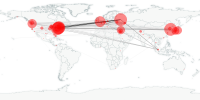
Is not that the military dictator, General Pervez Musharraf has imposed martial law. Much like Poland under Jaruzelski or the recent crackdown in Burma, martial law in Pakistan was not a transition from one kind of state to another but rather a shift from the hypocrisy of a velvet glove to the honesty of an iron fist. Pakistan is no more a dictatorship today than it was a month earlier.
Pakistanis, it must be said, are not universally outraged by dictatorship per se. The wily and ruthless General Zia ul- Haq was a fairly popular figure in his day. Wild-eyed deobandi fanatics, opposed to Musharraf's regime, long for a Sharia-state tyranny that would be far more brutal and incompetent than is the current government in Islamabad. Nor is the growing corruption of the army in Pakistan the central problem; Benazir Bhutto's party, the democratic faction, once looted government coffers with gusto while wrecking the economy. Her father, once Prime Minister but later executed by Zia, was a notable menace to the concept of good governance.
Pakistan's central problem is a crisis of legitimacy. Nationalism is a waning force these days and even anti-Indian feeling is sustained by a marriage of nationalism with Islamist radicalism. Once, a Pakistani leader could declare that Pakistani's " would eat grass" to make their country the nuclear equal of Hindu India. No more. Musharraf's fear of "national suicide" did not rouse his countrymen to his side and there are some, even in the army, who would hold up jihad above the nation. Well above.
Without nationalism or state competence, people fall back on primary loyalties. Pakistan has no intrinsic reason to exist unless it can be welded together in men's minds.
Labels: dictator, islamic world, islamist, military, pakistan, state building, state failure, terrorism
¶ 8:04 PM 6 comments
Wolf Pangloss has a series of interesting posts on 4GW and information operations that readers might care to consider in light of the discussion that has ensued in the comments section of the post on the strategic analysis of Fabius Maximus. Wolf's posts are:
Democracies at 4GWar
4GW Jihad and the role of the World Media
Conflict Map of the Counterjihad
Media Cheerleaders for Despair
Labels: 4GW, al qaida, insurgency, islamist, strategy, terrorism, theory, war, wolf pangloss
¶ 8:12 PM 7 comments

" To summarize, we seek to radically change the cultures and political systems for much of the world, to halt foreign revolts and civil wars of which we do not approve, to bring global peace and prosperity, to make friends (even with those states whose rise we seek to restrain), and to “transform” our so far unreformable national security apparatus. Those who thought President Bush was kidding about these learned better in the months following our invasion of Iraq."
- Fabius Maximus
For some time now, an author whose nom de guerre is "Fabius Maximus", after the ancient Roman general of the Punic wars, has been a regular and at times, prolific, contributor to the Boydian and 4GW school oriented Defense & the National Interest. Fabius, who comments here at Zenpundit on occasion, also set off one of the most popular, if heated and controversial, threads at The Small Wars Council, catching the attention of noted COIN strategist Col. David Kilcullen. Kilcullen's theories later became a subject of frequent critique from Fabius in his DNI articles.
While I had hoped to meet Fabius in person at Boyd 2007, he did not attend and I am not privy to his identity or professional background. Fabius' arguments must rise or fall entirely on their own merit and he has been content to engage his critics on this basis at the SWC and elsewhere. Clearly he is a member of the 4GW school and is an admirer of Col. John Boyd, William Lind, Dr. Martin van Creveld and Dr. Chet Richards but has not shrunk from advancing his own ideas or original criticisms.
Recently, Fabius completed his tenth article in a series on America's Long War for DNI and, as Fabius has entertained and enraged members of the community of "reform" defense intellectuals and COIN practitioners, it is timely for us to take stock of his strategic argument:
The Long War Series - from DNI's Fabius Maximus Archive
Part X - One step beyond Lind: what is America’s geopolitical strategy?
Part IX - 4GW at work in a community near you,
Part VIII - How to accurately forecast trends of the Iraq War,
Part VII - Kilcullen explains all you need to know about the Iraq War,
Part VI - The bad news is that Lind’s good news is wrong,
Part V - The Iraq War as a warning for America,
Part IV - Beyond Insurgency: An End to Our War in Iraq,
Part III - Stories or statistics? Read and compare to find the truth!
Part II - News from the Front: America’s military has mastered 4GW!
Part I – America takes another step towards the “Long War,”
I have read the roughly 20,000 words offered here previously and I re-read them for this post. I have also read most of the authors of the original works that Fabius Maximus cites in his series. Therefore, I feel qualified to offer a few observations in regard to the strategic paradigm that this body of work represents and the assumptions, clearly stated as well as implicit, upon which it is built.
Many of the specific analytical criticisms of American policy and performance in Iraq and Afghanistan made by Fabius are incisive, some are rather questionable and a few are brilliant. I encourage you to read his efforts for yourself rather than simply accepting my word for it. What interests me most though, given the scope of the series, are his premises. As I discern them, they are:
That 4GW is the environment in which we find ourselves conducting operations - and doing so quite poorly at that with a military predisposed toward 2GW offensives. Or irrelevantly on the strategic level where we happen to be executing COIN well on the tactical level.
We cannot significantly affect the internal dynamics of alien societies that we understand poorly or not at all, regardless of the carrots or sticks used. We are marginal factors at best.
American war policy is being constructed on the false analogy of the Cold War model.
Al Qaida is more phantom than menace.
War is the wrong conceptual metaphor and the wrong operational-bureaucratic response to the conflict in which we find ourselves.
Our response, which serves bureaucratic and factional interests at homes, undermines our global strategic position and wastes our economic strength.
A better grand strategy for America is nonintervention and reducing friction with the rest of the world. Or failing that, at least bolstering states, any states, rather than collapsing them into failure with military attack or other pressures ( Lind's "Centers of Order vs. Centers of Disorder")
If George Kennan argued for "Containment" of Soviet Communism in his "X" article the best descriptor of the grand strategy of Fabius Maximus might be " Conservancy" - dialing down our kinetic response to terrorism to the surgical level and recognizing this contest as more ideological conflict than war and, in general, recognizing our limitations in attempting to become masters of the universe. Many readers would associate this paradigm with the Left but I believe that to be incorrect. Instead, reflecting a deeply paleoconservative reading of history and American traditions in foreign policy that historian Walter A. McDougal called "Promised Land" and others "city on a hill" and " isolationism".
The virtues of "conservancy" as I interpret Fabius is that it minimizes both costs and future commitments for the United States, leaving us better able to afford to deal with strategic threats to vital national interests, when unanticipated threats arise, as they surely will. It would serve as a reality check on statesmen to pursue fewer, more coherent, simpler, more easily realizable and markedly cheaper objectives, which will have far higher probability of success ( as opposed to say, attacking Iran while engaged in Iraq. Or perhaps invading Russia in winter or fighting a land war in Asia. Some folks around PACOM with a few years ago with uber-journalist Robert Kaplan's ear, thought an unprovoked war with China was a splendid idea). When forced to intervene, our footprint will be light; more like British frontier agents of old or the 55 advisers in El Salvador in the 1980's than the invasion of Iraq. As a nation, our foreign policy would stay on the good side of the diminishing returns curve.
The drawbacks include, in my view: being flatly incorrect about al Qaida's potential to initiate attacks on the operational or strategic level specifically, and about the threat of radical Islamist-Mahdist movements in general, when coupled with increasing capacities to leverage against complex systems ( see John Robb's Brave New War); underestimating the geopolitical ripple effect of the U.S. shifting to a conservancy posture, upending the global security arrangements upon which the calculations of statesmen currently depend. The unanticipated consequences of the latter are large. Within two to three levels of unfolding decision-tree possibilities, any potential response by the U.S. is simply swamped. We benefit by the status quo. Changing our position imposes costs.
I invite Fabius Maximus to respond as he likes and I will publish his remarks here, unedited. Readers are invited to offer their own critique in the comments section.
Labels: 4GW, 5GW, al qaida, COIN, dni, fabius maximus, iraq, islam.insurgency, islamist, john boyd, state failure, strategy, terrorism, war, william lind
¶ 5:58 PM 12 comments
The most comprehensive, English-language, ideological analysis of Islamist extremist and terror movements yet compiled; assembled by the Combating Terrorism Center at West Point.
Executive Summary (23 page PDF)
Research Compendium (361 page PDF)
Hat tip to Charles Cameron for the title of this ( actually, many) interesting scholarly work and to Right Truth for the URLs.
UPDATE:
Heh. Plagued by basic reading comprehension problems last night. Title corrected. Gracias, Charles!
Labels: al qaida, analytic, COIN, islam.insurgency, islamist, military, military intelligence, national security, strategy, terrorism, tribes, war, warriors
¶ 6:48 PM 0 comments

In memory of those who died 11 September, 2001.
Special thanks to the soldiers, sailors, airmen and officers of our intelligence community currently serving in harm's way in the long war and, most of all, to those who will never return. America is in your debt.
Labels: 9/11, al qaida, terrorism
¶ 7:17 PM 0 comments

Steve Guerra, convicted FALN supporter, top Illinois state government official and protege of Congressman Luis Gutierrez (D-Il).
Hyperbolic charges are thrown with great regularity and unfairness in American politics. Character assassination is a form of art and negative campaigning is the norm. Most of the time, it's a useful rule of thumb to take whatever perjoratives are commonly used with a grain of salt. And then there are the exceptions that are so absurd as to make the usual slander an understatement.

Illinois Governor Rod Blagojevich - who hired Steve Guerra as his $ 120,000 a year deputy
The Chicago Sun-Times on Saturday ran a front page expose on Steve Guerra, a top official in the administration of Democratic Governor Rod Blagojevich, who was hired despite having gone to prison for refusing to testify before a Federal grand jury about what he knew regarding a terror bombing campaign carried out by the Puerto Rican terrorist group, the FALN. The revelation has caused an uproar among the family members of the victims of the FALN terrorists and only slightly less outrage among Illinois Democrats and Republicans in the legislature who were already unhappy with Gov. Blagojevich.
Why would Governor Blagojevich, currently floundering even among his own Democratic supporters, take a risk and hire a sinister figure like Guerra, a felon who obstructed a murder investigation of one of the FALN's victims with his refusal to testify ? Two reasons:
First, Illinois politics is replete with shadowy tough guys, mobbed-up businessmen and fixers with criminal pasts who cracked a few skulls here and there in their youth. Such folks, who like Mr. Guerra, often appear to lack a neck, are not rare here. From, Taylor Street in Chicago to Cicero to Rosemont to small towns in the collar counties, you have lots of people in both political parties involved in retail politics who are "connected". Granted, they usually mean to men nicknamed "Big Tuna" or " the Clown", and not to Marxist terror groups, but chances were that if Guerra had kept a low profile, no one living in a glass house themselves was going to be seen pitching stones any time soon.

Congressman Luis Gutierrez (D-Il) - a history of pulling strings for convicted FALN terrorists
Secondly, Guerra is a close, personal, friend of far-left but Daley machine-backed, Congressman Luis Gutierrez of Chicago. Representative Gutierrez has made constituent services to imprisoned FALN members something of a minor hobby during his years in Congress. It was also Gutierrez who helped persuade President Clinton to grant clemency to FALN terrorists convicted of bombmaking, sedition, robbery, conspiracy and other lesser charges. By hiring Guerra, the struggling Governor Blagojevich was reinforcing a political connection to an influential figure in the Daley machine and Chicago's Puerto Rican community.
The remarkable aspect of this episode is not that in this day and age, an American politician would knowingly hire or assist an individual with strong ties to a terrorist group but that the moral state of politics in Illinois is so low, that hiring Guerra raised no eyebrows among party insiders in Springfield.
At least until the story hit page one.
Labels: chicago, politics, terrorism
¶ 2:45 PM 5 comments

What to make of Osama Bin Laden sounding less like a radical Salafist in his recent video than the infantile Sean Penn on a hysterical political rant, throwing in an homage to Noam Chomsky and global warming ? Well, government sources are pointing "Azzam the American", the young Californian convert, Adam Yahiye Gadahn as the origin of the more childish rhetoric that seems to be ripped from the memes of the Lefty Wingnut blogosphere.
In my opinion, that is a stupid interpretation. If it comes from our intelligence agencies, and not some staffer at the White House, all the worse for us.
First of all, such an analysis gives far too much emphasis to the role of Gadahn, a relatively juvenile character. Al Qaida does not lack members with the ability to read English or surf the internet. The radical Islamist-terrorist community have long monitored American websites, particularly those related to military and intelligence circles; one of their favorite theorists appears to be none other than William Lind! Gadahn's help in video production is a triviality, not a primary concern.
Secondly, the hodgepodge nature of the speech with Bin Laden zooming from Sarkozy to tax rates is indicative of an intentional raising of the noise to signal ratio. Much of this verbiage appears to me to be - well - irrelevant crap. It attracts media attention while distracting observers from two of the more ominous elements present in bin Laden's speech - his continuing fascination with the atomic bombings of Hiroshima and Nagasaki and the call to embrace Islam. The latter being a religious duty for pious Muslims prior to the unleashing of war and ruin upon an enemy; a call once uttered by the generals of Arab caliphs and Turkish sultans half a millennium ago, before the sacking of infidel cities by Muslim armies.
The Germans just rolled up a major al Qaida cell days before an attack was to take place. Perhaps we should be looking at potential problems just a little bit harder ourselves.
Labels: 9/11, al qaida, analytic, bin laden, IO, terrorism
¶ 4:15 PM 6 comments

Eric Martin who blogs at TIA and American Footprints has a guest-post at The Newshoggers entitled "Guest Post - Who's Killing The Clerics Of Najaf? ". An excerpt:
"The situation in Najaf for Iraq's premier Grand Ayatollah, Ali al-Sistani,
has been growing rather precarious as of late:
Four aides to Iraqi Grand Ayatollah Ali al-Sistani have been killed in Al-Najaf over the past two months, raising many questions as to the safety of Iraq's supreme Shi'ite leader and the motives of the perpetrators of the attacks.
According to media reports, aides to Iraq's three other grand ayatollahs have also been threatened. "The assassination operations are organized and big resources are allocated [to carry them out], which makes it difficult to accuse any local side of being behind" the attacks, the assistant director of the office of Muhammad Bahr al-Ulum, Muwaffaq Ali, told the London-based "Al-Hayat" this week.
This is a story that I have been attempting to track over at my other blogospheric venues, but it is an opaque tale of shifting political intrigue that defies easy analysis. For example, it is still unclear which party (or parties) has been behind this series of assassinations, and to what purpose (or purposes). The first two or three killings were thought to be the work of Moqtada al-Sadr's forces - which is completely plausible in at least one of those cases (especially given the history between Sadr's forces and the target in the third killing). But this is speculation, and by no means a given. Such uncertainty is quite remarkable given the stakes involved (and the fact that, generally speaking, parties seeking to send a message in such a manner want the targeted group to know who the sender was). "
Read the whole thing.
Labels: 4GW, 5GW, eric martin, insurgency, iraq, islamist, newshoggers, shia, sistani, terrorism
¶ 8:18 PM 5 comments
Here's the news story.
The SWJ Blog links to the IG Report executive summary. (PDF)
Here are a few reactions ( originally, I planned a wide spectrum of blogospheric opinion but found too much of it to be simpleminded, partisan, blather, so I stuck with the available informed commentary):
Haft of the Spear:
"They are basically saying that not only were parts of the system broken, anyone with half a wit should have been able to see that and take action (or at least raise an alarm). That no one bothered says that either leadership was not all it was cracked up to be, or that the way the system treats squeaky wheels is such that no one - witless or not - thought raising a stink was worth the risk. Stupidity and fear, fortunately, are not excuses."
Sic Semper Tyrannis:
" The CIA like the DIA failed miserably to penetrate the apparatus of the takfiri jihadi networks. Such penetrations would have enabled the US to anticipate coming jihadi actions.
Once again it will be said that penetrating these groups is "too hard to do." Rubbish. I know better. Why were these groups not penetrated?
Timidity. Fear of Risks, Bureaucratic inertia. Poor leadership at the top in all the significant organizations. Has anything changed? I doubt it. If it had, bin Laden would be dead by now."
When a system is fundamentally broken you do not need to simply look for loose bolts or missing parts or even a new mechanic ( though firing an old one might be a useful message to send to their replacement) - what you do is find some engineers and a drawing board.
Labels: al qaida, CIA, defense, foreign policy, IC, intelligence, national security, terrorism
¶ 8:19 PM 2 comments

When Robert Gates, the current Secretary of Defense, retired from government service after the end of the first Bush administration, he wrote a memoir , From the Shadows, in which he described the no-nonsense, George Schultz as " the toughest Secretary of State I ever knew" who " saw no contradiction" in bleeding the Soviets in one part of the world while negotiating with them in another. Secretary Schultz, whose opinion of the CIA on a 1 to 10 scale hovered in the negative integers, was not nearly as complimentary to Robert Gates in his own, ponderously unreadable, memoirs, but that is a story for another day.
I bring this anecdote of a less complex era up because of the furor over the Bush administration classifying the Pasdaran ( the Iranian Revolutionary Guards Corps) as a terrorist organization in order to take action against those business enterprises that are connected to the Pasdaran. The objections to this move appear to be two-fold: first, that it hypothetically puts American military personnel at risk of maltreatment and, secondly, that it could disrupt negotiations with Iran on a range of bilateral and international issues, most importantly, Iraq.
The critics are incorrect. It is a move a quarter-century overdue.
In the first instance, correctly identifying the Pasdaran as a state sponsor of international terrorism, which as a matter of historical record, it clearly is, does not prevent treating it's uniformed personnel as POWs in case of an armed conflict between Iran and the United States. The Pasdaran, by contrast, has already tortured two Americans to death - Beirut CIA station chief William Buckley and USMC Colonel William Higgins - at a time of peace between Iran and the United States.
Cry me no river of tears for Pasdaran agents in Iraq being held captive by the U.S. military or who are being whacked in some alleyway by Sunni tribals in our employ. The Iranians knew the risks, from the inception, of the rules they chose to operate under, violating the most basic precepts of international law. It did not have to be that way - even the CIA and the KGB came to a rough modus vivendi during the Cold War that prevented most escalatory incidents - Teheran though has chosen to play rough. Let them enjoy the bed they have made for themselves.
Secondly, until we have an agreement with Iran we do not have any agreement and the regime should be squeezed at every point until we do. I'm all for negotiating in earnest, making the realistic, even generous, concessions that we can easily afford, finding areas of common interest and ( eventually) normalizing relations. We should scrupulously keep our word and demonstrate to the Iranians through actions that we will deliver exactly what we promise. But until that point in time, Teheran should get no favors, no breathing space, no economic freebies of any kind until we come to an arrangement.
The leadership of Iran is a nasty and brutal group. Within that circle, Ahmadinejad represents some of the regime's worst elements but, as a whole, the Iranians do not seem irrational, simply adversarial. We can cut a deal with them but we should proceed without any illusions.
IRGC STORY LINKS:
Thomas P.M. Barnett
The Newshoggers
Counterterrorism Blog
The Glittering Eye
Pundita
Right Wing Nuthouse
Labels: bush, diplomacy, foreign policy, international law, iran, mideast, terrorism
¶ 8:30 PM 5 comments
New article in The City Journal by John Robb.
John is in the important post-publication stage of proselytizing his work and worldview which he introduces well to City Journal readers. As someone more familiar with Global Guerillas, I especially liked John's neat summative explanation of networks, tight coupling and cascading effects in a social-political-economic-infrastructural complex system.
Network theory is one of the key concepts for the intelligent public to understand for the 21st century.
Labels: 4GW, complex systems, complexity, global guerillas, john robb, network theory, networks, social networks, terrorism
¶ 8:35 AM 0 comments
"It shall be the policy of this Nation to regard any nuclear missile launched from Cuba against any nation in the Western Hemisphere as an attack by the Soviet Union on the United States, requiring a full retaliatory response upon the Soviet Union."
- John F. Kennedy, President of the United States
"Acquiring weapons for the defense of Muslims is a religious duty. If I have indeed acquired these weapons, then I thank God for enabling me to do so. And if I seek to acquire these weapons, I am carrying out a duty. It would be a sin for Muslims not to try to possess the weapons that would prevent the infidels from inflicting harm on Muslims."
-Osama bin Laden, "amir" of al Qaida
Both the Soviet Union and the United States amassed immense nuclear arsenals during the Cold War of approximately 50,000 warheads of various sizes and a range of systems with which to deliver these terrifying weapons. A number of other second and third tier states later joined "the nuclear club", seeking a hedge against regional enemies or desiring the totemic status in international relations brought by possession of nuclear arms.
None of these states, not even Israel which is reputed to have up to 200 nuclear bombs, ever developed a nuclear weapons capability that remotely matched that of the superpowers. A number of nuclear-capable states have either eschewed building nuclear weapons (Germany, Japan, Taiwan) or have been persuaded to disarm those that they had inherited or assembled ( Belarus, Ukraine, Kazakhstan and South Africa).
So lopsided are the throw-weight ratios between countries with small yield or primitive atomic weapons and the stockpiles retained by the U.S. and Russia that most of the nuclear club have arsenals that are useful only for deterring a military attack from their immediate non-nuclear neighbors or a nuclear peer. Pakistan's nuclear status was of no help in warding off American demands after 9/11; had Islamabad attempted to brandish, much less use, nuclear weapons in defense of their Taliban clients, it would have surely invited Pakistan's immediate destruction.
Cheryl Rofer of Whirledview, had a post "The Necessity of the U.S. Nuclear Deterrent: A White Paper" that analyzed a recent quasi-official document “White Paper on the Necessity of the U. S. Nuclear Deterrent” authored by a cluster of national security VIPs, including several past CIA directors and current advisers to the US Strategic Command. The paper summarizes many obvious points about American nuclear deterrence and calls for a " debate". Cheryl found the paper to be lacking:
"No real threat assessment is offered, just vaguely threatening words about Russia, China, North Korea and Iran. For a group of folks trying to move out of the Cold War mindset, that’s an interesting ordering of countries.
....Is the white paper saying that US nuclear policy is only about deterrence? Nothing about the Nuclear Nonproliferation Treaty and its obligations? Nothing about the uselessness of deterrence against mobile subnational groups with no territory to defend? The only thing that is important to our allies is US security assurances, backed up by the threat of nuclear warfare?
....This white paper is stuck in the the Cold War, circa 1969. "
I think the white paper authors are correct that the perceived credibility of American nuclear guarantees dampen down potential nuclear arms races among third parties, notably in Northern Asia. Cheryl however, is correct on the larger point that the analytical assumptions of the paper are shot through with Cold War legacy mentalities.
Arguably, the white paper does not even match the Cold War era in terms of nuanced thinking. In 1958, in Nuclear Weapons and Foreign Policy, Henry Kissinger wrote:
"It is the task of strategic doctrine to strike a balance between the physical and the psychological aspects of deterrence, between the desire to pose a maximum threat and the reality that no threat is stronger than the belief of the opponent that it will in fact be used. A strategy which poses alternatives that policy-makers are unwilling to confront will induce either inaction or improvisation. A strategy which establishes a superior balance between power and will may then gain a crucial advantage, because it permits initiative and shifts to the other side the risks inherent in making countermoves" (Kissinger, 175)
CKR aptly pointed out the obvious alternative of non-state and subnational actors with nuclear weapons that the white paper's authors were " unwilling to confront" in their state-centric focus.
Here are a few others that would relate to the state of American deterrence, enhancing or undermining it:
* Potential, novel, weaponization of of aspects of nuclear particle research outside classic uranium 235 and plutonium bombs.
* The need for more effective controls and tracking of trade in esoteric, dual-use, technologies of weaponization that make nuclear devices useful militarily. Increasing transparency level of same.
*Identifying non-nuclear technologies that could result in weapons of a comparable order of magnitude of destruction or loss of life as with low-level nuclear weapons.
* Strengthening and expanding the inspections regime under which NPT signatories are permitted access to nuclear technology for peaceful purposes. Addition of automatic penalties if NPT signatories are caught cheating, subject to removal or waiver by the UNSC ( putting the burden on the accused proliferator to come clean instead of on the IAEA or UNSC states to get any meaningful sanctions applied).
* De-escalating the potential for future conflict between nuclear and nuclear capable states by instituting new regional diplomatic and security structures.
* International nuclear convention regarding the security of nuclear materials and command and control by the nuclear weapons states.
* Moral-political-legal campaigns that degrade the credibility of American deterrence by ratcheting upward the "unthinkability" of nuclear weapons use, thus tempting potential adversaries to risk the very brinksmanship scenarios ( war, apocalyptic terrorism) that would make the use of nuclear weapons possible or likely.
* Avoiding "nuclear weapons deflation" as an unintended consequence of arms control. Striking a balance between reducing large American and Russian arsenals and unduly increasing the military value of small ones and the temptation to increase them in order to reach "parity" with America and Russia ( "linkage" for all nuclear club arsenals). Or worse, the temptation to sell or use them.
* Removal of strategic nuclear materials from the global black market by vastly accelerating certified destruction or reprocessing of obsolete national stocks.
* Developing new models of deterrence that would be concurrently perceived as credible by states, non-state actors and subnational/ transnational networks who may all be within an interdependent nexus of responsibility for a catastrophic WMD attack.
* Identifying and categorizing non-state network threats to American security with potential WMD capacity.
* Understanding the parameters of the possible in terms of private networks and WMD capabilities, through intellectually honest red team exercises.
* Examining the balance of utility between emphasizing clarity and uncertainty in American nuclear response and deterrence policy in a multi-polar and non-state actor era.
Many of my variables are not new but they are of at least more recent vintage and of a broader horizon than what the white paper has considered. I'm interested in hearing your thoughts as well.
Labels: 21st century, al qaida, America, arms control, CKR, deterrence, diplomacy, military, networks, nuclear, terrorism, war, whirledview, youtube
¶ 12:38 PM 7 comments

Dave Schuler has a superb examination about Governor Bill Richardson's major foreign policy essay in the Harvard International Review.
I can applaud the serious effort by Richardson, a former high level diplomat, to address foreign policy in a thoughtful way, even though I agree with Dave that many of Richardson's proposed solutions do not logically address the strategic trends he identifies ( thought they probably appeal to regular, middle-class, Democratic activists if not the wackiest of the wingnuts).
Labels: 2008, bill richardson, diplomacy, foreign policy, glittering eye, international law, national security, terrorism, war
¶ 8:58 AM 0 comments

"...eventually, the application of our military power will mirror the dominant threat to a significant degree. In other words, we morph into a military of superempowered individuals fighting wars against superempowred individuals"
- Vice-Admiral Arthur K. Cebrowski and Dr. Thomas P.M. Barnett (1)
"First, very few people would be needed to carry out the attack. A single individual could spread a nationwide pandemic using a highly contagious virus. A two person team would be sufficient to deploy and detonate a couple of nuclear weapons"
- Dr. Fred C. Ikle, Annihilation From Within
"In fact, we may have seen the the first of 5GW in the anthrax and ricin attacks on Capitol Hill. To date, neither has been solved. Apparently a small group, perhaps an individual, decided to take on the power of the United States."
- Colonel T.X. Hammes, The Sling and the Stone
"Over time, perhaps as little as in twenty years, and as the leverage provided by technology increases, this threshold will finally reach its culmination - with the ability of one man to declare war on the world and win."
- John Robb, Brave New War
To a paraphrase Karl Marx, a specter is haunting general staffs, intelligence agencies and statesmen the world over, the coming of the superempowered individual. No one quite knows what form the superempowered individual will take, but the devolution of increasingly powerful and versatile technologies at continually descending costs into the hands of individuals, coupled with the increasing interdependency of complex systems due to globalization, make their arrival all but inevitable.
As it stands now, the world is but one self-sacrificing genetic microbiologist away from a superempowered suicide bomber riding international air routes to a new black plague. However, the advancing edge of technology is the province of scientists and imaginative futurists, and even they are unable to predict how emerging technology will be employed for novel uses the inventors never intended. Therefore, I will leave speculating on the means of plausible superempowered warfare to others who are better qualified but human nature, being a more reliable variable, may be within our grasp to comprehend.
Defining Superempowerment:
Superempowered individuals are not mere terrorists with bigger, badder, car bombs. Imad Fayez Mugniyah and even Timothy McVeigh, who carried out thev Oklahoma City bombing in what must have been a very small and insular cell of extremists, are not the models despite their impressive accomplishments at mass murder. Nor are the great monster-rulers of the past like Adolf Hitler or Joseph Stalin who were State-empowered leaders acting through the vast governmental apparatus of the nation-state. To qualify as a superempowered individual, the actor must be able to initiate a destructive event, fundamentally with their own resources, that cascades systemically on a national, regional or global scale. They must be able to credibly, "declare war on the world". Who could or would desire to do such a thing?
The Psychology of the Superempowered Individual:
A useful prototype for the coming superempowered individual, though he never achieved or intended a systemic level of mass carnage, would be the Unabomber, Dr. Theodore "Ted" Kaczynski, a brilliant but mentally disturbed mathematician turned radical environmentalist and terrorist. Kaczynski, who spent years in relative penury in a wooden shack, possessing minimal financial resources, nevertheless managed to elude the FBI for seventeen years while carrying out an intermittant bombing campaign. Ultimately, Kaczynski's terrorism resulted in the showcasing of his weird,anti-technology, ideology ( the "Unabomber Manifesto") in the two premier media outlets of the American Establishment, The New York Times and The Washington Post, and subsequently his message went on to permeate much of the global media. While Kaczyinski's body count and record of mayhem were relatively modest, considered in terms of a cost-to-benefit ratio and information operations, he might be the most successful terrorist of modern times.
Kaczynski demonstrated four characteristics that are likely to be shared with superempowered individuals:
a) "Lone Wolf" actor
b) Superior Intelligence
c) Opportunity for leveraging Complex Systems
d) Profound alienation, isolation or societal disconnection
Kaczinski's work as a student and professional academic in higher mathematics were regarded as highly impressive by his mentor and colleagues and reputedly his IQ was rated between 160 and 170 ( 2). While there is considerable debate among psychometricians about quantifying the upper limits of human intelligence, whatever the scale used, Kaczynski's mental capacity would safely fall within the upper 0.5 % of the population and represents an outlier of ability. Most likely, the Unabomber's level of IQ substantially exceeds what would be required to operate as a superempowered individual and the population base for such actors would be the upper 5 %; those people capable of understanding, calculating or estimating the probable outcome of multiple interacting variables.
According to testimony from family members and associates, Kaczynski suffered from emotional and social deficits relative to his unusual intellectual gifts and has been described variously as clinically paranoiac or schizophrenic by psychiatrists and psychologists. Kaczynski's psychological profile reports his social alienation from his peers starting even before the onset of adolescence (3). By the time of his terrorist career, Kaczynski was writing vitriolic letters to family members, accusing them of abuse and harrassment and his immediate social network was virtually non-existent. Mental or emotional disturbance, especially forms of clinical depression, coincides with unusually high levels of productive creativity, while the unusual sensitivity of profoundly gifted individuals can make them ripe for disappointment(4).
Complex systems provide the opportunity or environment for superempowered individuals to initiate system perturbations or cascading effects that ripple across multiple systems, including the political, economic and physical. Kaczynski's manifesto (as well as his targeting of airlines and technologists) clearly indicated that he grasped, however warped his agenda, the concept of interacting systems and downstream effects. Intelligence and will are not enough; the actor must have or conspire to gain access to a "choke point" from which he can, in jujitsu fashion, leverage the connectivity of a complex system against itself.
Alienation is a useful psychological precursor to cultivating a lack of empathy and devaluation, dehumanization and demonization of intended categories of victims. Adolf Hitler's earliest recorded anti-semitic diatribe comes in a letter written in 1919, giving the future Fuhrer two decades to steel himself before taking concrete steps to enact " the Final Solution". The doctoral dissertations of Pol Pot's collaborators, Hou Yuon and Khieu Samphan, laid out the basis of Khmer Rouge policy way back in 1955. It may be that such long term "mental rehearsals" are required to desensitize or justify the execution of systemic violence and that we would see such a pattern in the lives of superempowered individuals.
What Can Be Done?:
In terms of defense against superempowered individuals, the best option is engineering resilience and redundancy into all our critical systems and platforms, physical as well as social and political. We must with determination, lower our societal vulnerability to catastrophic attack so that back-up systems and third order contingencies " short-circuit" the attack of a superempowered individual on our power, economic, communication and governmental networks. Tom Barnett, John Robb and most of all Steve DeAngelis , have all been preaching the gospel of resilience but the Federal government has yet to make this a priority .
Secondly, (and frankly, I'm not certain how this should be best implemented) we need to address reconnecting mildly disturbed but very talented ( and thus, potentially, exceptionally dangerous) people to wider social support and mental health networks before they wander irrevocably into the isolated realm of delusional violence. Rarely, if ever, do people just "snap" and commit heinous atrocities out of the blue. Instead, there is a prior pattern of drifting away, of eccentric and increasingly belligerent behavior over time until the individual, in isolated rage, mounts toward a crisis and lashes out at the world.
Unfortunately, a superempowered individual will do more than simply barricade himself in his house or shoot up a work place. Instead, he will try to take a good chunk of society with him and will have the capability to do so. We have a window of opportunity now to create strategies to deal with these eventualities and it should not be wasted.
Footnotes:
1. Barnett, Thomas P.M. and Cebrowski, Arthur K. " The American Way of War", Transformation Trends, January 2003.
2. Time.com Community Transcript " The Unabomber Trial" November 12 1997
3. Johnson, Sally C. "Psychological Evaluation of Theodore Kaczynski"
4. Simonton, Dean Keith "Are Genius and Madness Related? Contemporary Answers to an Ancient Question", Psychiatric Times. June 2005 Vol. XXII Issue 7
ADDITIONAL LINKS:
Tom Barnett:
"My own personal 5GW dream"
John Robb:
"Lots of discussion of what 5GW is"
Shlok Vaidya:
"What Should Superempowered Individuals Do?"
"5GW And Beyond"
tdaxp:
"Dreaming 5th Generation War"
Zenpundit:
"THE SUPER EMPOWERED INDIVIDUAL"
"REVIEWING THE DELETED SCENE ON SYSTEM PERTURBATION - PART II. "
Glittering Eye:
"Zenpundit on the Super-Empowered Individual"
Dreaming 5GW :
"Rule-sets, System Perturbations and 5GW"
"Barnettian 5GW"
Wolf Pangloss:
"Fifth Generation Warfare: Conspiracy and Shadow Government"
Labels: 4GW, 5GW, global guerillas, superempowered individuals, terrorism
¶ 1:35 AM 12 comments

A fascinating economics paper sent to me by Fabius Maximus (hat tip accorded) that took me a few days to get to reading. Wish I had looked at it earlier:
"An-arrgh-chy: The Law and economics of Pirate Organizations" (PDF) by Dr. Peter T. Leeson
Peterson argues that historical pirates, far from being Hobbesian outlaws, governed themselves with rule-sets that minimized conflict and maximized cooperation and profit ( albeit at the expense of civilized seafaring states). Looking at broad principles of functionality, Leeson's work is applicable to other violent non-state actors - Latin American drug cartels, 4GW insurgencies and terror networks, warlord and sectarian militias, Bunker's 3 Gen gangs, TOC groups like Chinese Triads and Russian mafiya and so on.
This argument struck a chord with me on two points. First, it mirrors the historical experience of traditional Russian banditry where robber chieftains ruled over there fellows according to "Thieves Law", something Solzhenitsyn discusses at length in The Gulag Archipelago.
Secondly, network theory research indicates that small systems that seem chaotic or "noisy" actually develop emergent rule-sets that bring the system into an orderly pattern, even if the rules and patterns are very simple ones. A pirate ship, even a fleet, much like a terrorist network, is simply a small, complex, social network. Rules accepted on a consensual basis cut down on " noise" and allow the network to become more efficient.
A must read.
Labels: economics, fabius maximus, navy, network theory, networks, non-state actors, piracy, social networks, terrorism, theory, transnational criminal organization
¶ 7:25 PM 2 comments
Blogfriend Cheryl Rofer, an expert in nuclear issues with field experience, had an exceptionally intriguing post up the other day at Whirledview entitled " A Rough Nuclear Threat Assessment for the United States". While I encourage you to read her post in full first here are her assessments (bold text) along with my responses(normal text):
"Finding 1. No serious immediate threat.There is no country in the world that seriously threatens a nuclear attack on the United States. Further, the probability that a terrorist organization has usable nuclear weapons is extremely low. The most serious current threat of a nuclear explosion in the United States arises from accidents resulting from the continuing alert status of US and Russian nuclear-tipped missiles."
I would tend to agree with the following caveats:
Radiological bomb attacks or terrorist attacks on American nuclear facilities such as power plants in the hopes of sparking an " American Chernobyl" are respectively more and marginally more likely than "extremely low". Add in the possible downstream negative effects of terrorists liberating nuclear materials from poorly guarded Russian installations as well. We are also at risk for secondary environmental effects of nuclear weapons uses by third parties ( ex. India-Pakistan).
All of these are of far lower significance though than a state-based nuclear first strike against the United States or its forces overseas.
"Finding 2. Threats in the 2-5 year range are extremely low. Most can be managed by US actions.Relations with Russia are deteriorating. Relations with China are good, except for some friction in the area of trade. An agreement has been reached with North Korea on denuclearization. Iran is unlikely to have nuclear weapons within this time frame. Pakistan’s current instability presents a concern that action against the government might put nuclear weapons in the hands of radical Islamic groups. Russia continues to improve its nuclear weapons security.
There are a number of ways to improve relations with Russia, including delaying construction of antimissile installations in Poland and the Czech Republic. Because Iran is unlikely to have nuclear weapons within this time frame, there is time for negotiation. The instability in Pakistan is the most unpredictable and uncontrollable of the threats in this time frame. We have to hope that rumors are true that the United States has been helping Pakistan to “safe” its nuclear weapons with permissive action links that keep unauthorized people from using them."
I agree here as well, also seeing Pakistan as the potentially most dangerous wild card. State stability in Iran should not, however, be overestimated, given the decentralization of Iran's nuclear weapons and power programs. Too many items ripe for the picking by prospective factions, terrorists or transnational criminal syndicates if Iran's state falters.
"Finding 3. Threats in the 5-20 year range are much less predictable, but remain low.With intelligent diplomacy and some steps back from the more warlike policies of the Bush administration, such as preventive warfare (which step may have already been taken), good relations can be maintained with other nuclear powers. In a similar vein, progress should be possible with North Korea and Iran toward non nuclear weapon status. Instability in Pakistan and friction between Pakistan and India are probably the biggest threats of nuclear war or nuclear weapons becoming available to subnational groups. Regional conflicts could encourage other states (say Brazil and Argentina) to consider a path to nuclear weapons, but the probability of such conflicts seems likely to remain low.
Let’s just stop here for a moment and take a breath. This is a very different threat assessment from anything that might have been done during the Cold War. In fact, it surprised me when I saw it all written down this way. But if we stick to verifiable threats with reasonable probability, I think this is the way it has to come out."
I depart here from Cheryl. In my view, the degree of uncertainty is too high given the length of the time frame and the systemic instability (current and potential) of a number of nuclear armed states. Moreover, proliferation ( and sequence/timing of proliferation) changes the dynamic by altering the nuclear postures of interested states. A nuclear Iran changes Saudi Arabia's attitude toward non-proliferation while a nuclear armed Japan does not. Each additional new nuclear weapons state increases the probability of accident, loss, covert sale or use. I would rate the danger as rising toward "moderate" the further you go in terms of out-years.
A great post by Cheryl.
Labels: defense, deterrence, foreign policy, futurism, national security, nuclear, risk, terrorism, war, whirledview
¶ 8:34 PM 5 comments
This article is sensationalistic but useful, showing the effects of a small " shoe bomb" on an airliner like the one used by bumbling malcontent and al Qaida adherent, convicted terrorist Richard Reid.
I am no engineer or pilot, so I'm willing to be corrected by those with expertise, but it occurs to me that a large part of the problem is that our passenger aircraft have deliberately been designed to be unsurvivable, because this saves pennies on the dollar, rather than to be resilient. Planes are not always by nature fragile; B-24's during WWII or the more modern A-10's could take devastating hits and remain airborne.
Much like not highjacker-proofing the doors of the cabin to protect the pilots, I suspect there are many known elements that could be engineered into passenger aircraft design that corporate executives and FAA officials intentionally choose not to require. Then there measures yet undiscovered, some possibly inexpensive or cost-reducing, that we will not find until we try.
I'm not advocating flying around in Abrams tanks with wings but in putting a greater effort toward thinking in terms of resilience when we sit down at drawing boards, instead of lamenting what was not done, after the fact.
Labels: complex systems, planes, resilience, terrorism
¶ 8:49 AM 1 comments
If you are a regular reader of Dave Schuler at The Glittering Eye , then you know that he is a dog aficianado who raises them for show and for specialized training. Naturally, the contamination and recall of pet food was a story he had been following with a considered care that I have not. Dave has put forth an intriguing thought experiment however "Wargaming an attack on the food supply":
"Although we have an entire enormous expensive facility within DHS ostensibly devoted to the subject of biodefense including agro-terrorism, the National Biodefense Analysis and Countermeasures Center, to my eyes much of what’s available in open source form on this subejct seems very rudimentary.
Much of it deals with something along the lines of an industrial sabotage model—risk assessment is done from the point of view of companies trying to prevent damage to their facilities. Useful as that may be I don’t think that it really corresponds to what we might actually experience, which presumably would conform more to a product tampering model.
Here’s how I think that a real attack against our food supply might be likely to unfold.
*a toxin or pathogen would be introduced into a basic food item either via a producer, distributor, or manufacturer
*the item would be packaged and distributed throughout the country
*the retail products would be purchased by consumers
*individual cases of injury or death would begin to appear
*complaints would be made to retailers and/or brand name vendors
*at some point relevant government agencies would become engaged
*there would be a scramble for causes and sources
*conflicts between agencies would emerge
*at some point the toxin or pathogen would be identified, its source might be identified, and a solution put into place
Some number of lives would have been lost, resources consumed in pursuing the problem, and the ultimate solution would bring that process under control but the objective of the attack would already have been accomplished: there would be a diminution of confidence in government, society, and other people.
A modern economy and modern society operates on trust."
Dave has much more, of which you can read the rest, here.
If you recall the infamous anthrax letters, Dave is outlining a hypothetical 4GW style systempunkt test of our bureaucratic response capacity, which I am sad to say, remains obtuse and palsied in the face of the non-obvious.
Labels: 4GW, glittering eye, scenario, terrorism
¶ 6:01 PM 2 comments
Collounsbury is on to something important.
Labels: aqoul, islamist, lounsbury, suicide bombing, terrorism
¶ 7:37 PM 0 comments