The publisher and the editor-in-chief of the highly regarded Small Wars Journal, respectively Bill Nagl and Dave Dilegge, are doing a public Q&A at noon on Tuesday with the powerhouse The Washington Post. I imagine that Bill Arkin will be involved somewhere as well - but we can hope otherwise. ;o)
Read about the details at the SWJ BLog.
Submit YOUR questions here.
Labels: brave new war, COIN, insurgency, iraq, media, small wars journal, swj blog
¶ 8:37 PM 0 comments


Picked up both of these on a lark on Saturday, as I cruised through Border's with The Son of Zenpundit, who was getting some independent reader level books about Spider-Man fighting -well- some villain or other. The usual suspects.
Any thoughts from readers as to how high these tomes merit being placed on the "Must read" pile ? I'm currently innundated with things to read, so prioritizing is a must.
Labels: book, bush, COIN, foreign policy, history, insurgency, iraq, islamic world, islamist, mideast, war
¶ 7:35 PM 2 comments

" To summarize, we seek to radically change the cultures and political systems for much of the world, to halt foreign revolts and civil wars of which we do not approve, to bring global peace and prosperity, to make friends (even with those states whose rise we seek to restrain), and to “transform” our so far unreformable national security apparatus. Those who thought President Bush was kidding about these learned better in the months following our invasion of Iraq."
- Fabius Maximus
For some time now, an author whose nom de guerre is "Fabius Maximus", after the ancient Roman general of the Punic wars, has been a regular and at times, prolific, contributor to the Boydian and 4GW school oriented Defense & the National Interest. Fabius, who comments here at Zenpundit on occasion, also set off one of the most popular, if heated and controversial, threads at The Small Wars Council, catching the attention of noted COIN strategist Col. David Kilcullen. Kilcullen's theories later became a subject of frequent critique from Fabius in his DNI articles.
While I had hoped to meet Fabius in person at Boyd 2007, he did not attend and I am not privy to his identity or professional background. Fabius' arguments must rise or fall entirely on their own merit and he has been content to engage his critics on this basis at the SWC and elsewhere. Clearly he is a member of the 4GW school and is an admirer of Col. John Boyd, William Lind, Dr. Martin van Creveld and Dr. Chet Richards but has not shrunk from advancing his own ideas or original criticisms.
Recently, Fabius completed his tenth article in a series on America's Long War for DNI and, as Fabius has entertained and enraged members of the community of "reform" defense intellectuals and COIN practitioners, it is timely for us to take stock of his strategic argument:
The Long War Series - from DNI's Fabius Maximus Archive
Part X - One step beyond Lind: what is America’s geopolitical strategy?
Part IX - 4GW at work in a community near you,
Part VIII - How to accurately forecast trends of the Iraq War,
Part VII - Kilcullen explains all you need to know about the Iraq War,
Part VI - The bad news is that Lind’s good news is wrong,
Part V - The Iraq War as a warning for America,
Part IV - Beyond Insurgency: An End to Our War in Iraq,
Part III - Stories or statistics? Read and compare to find the truth!
Part II - News from the Front: America’s military has mastered 4GW!
Part I – America takes another step towards the “Long War,”
I have read the roughly 20,000 words offered here previously and I re-read them for this post. I have also read most of the authors of the original works that Fabius Maximus cites in his series. Therefore, I feel qualified to offer a few observations in regard to the strategic paradigm that this body of work represents and the assumptions, clearly stated as well as implicit, upon which it is built.
Many of the specific analytical criticisms of American policy and performance in Iraq and Afghanistan made by Fabius are incisive, some are rather questionable and a few are brilliant. I encourage you to read his efforts for yourself rather than simply accepting my word for it. What interests me most though, given the scope of the series, are his premises. As I discern them, they are:
That 4GW is the environment in which we find ourselves conducting operations - and doing so quite poorly at that with a military predisposed toward 2GW offensives. Or irrelevantly on the strategic level where we happen to be executing COIN well on the tactical level.
We cannot significantly affect the internal dynamics of alien societies that we understand poorly or not at all, regardless of the carrots or sticks used. We are marginal factors at best.
American war policy is being constructed on the false analogy of the Cold War model.
Al Qaida is more phantom than menace.
War is the wrong conceptual metaphor and the wrong operational-bureaucratic response to the conflict in which we find ourselves.
Our response, which serves bureaucratic and factional interests at homes, undermines our global strategic position and wastes our economic strength.
A better grand strategy for America is nonintervention and reducing friction with the rest of the world. Or failing that, at least bolstering states, any states, rather than collapsing them into failure with military attack or other pressures ( Lind's "Centers of Order vs. Centers of Disorder")
If George Kennan argued for "Containment" of Soviet Communism in his "X" article the best descriptor of the grand strategy of Fabius Maximus might be " Conservancy" - dialing down our kinetic response to terrorism to the surgical level and recognizing this contest as more ideological conflict than war and, in general, recognizing our limitations in attempting to become masters of the universe. Many readers would associate this paradigm with the Left but I believe that to be incorrect. Instead, reflecting a deeply paleoconservative reading of history and American traditions in foreign policy that historian Walter A. McDougal called "Promised Land" and others "city on a hill" and " isolationism".
The virtues of "conservancy" as I interpret Fabius is that it minimizes both costs and future commitments for the United States, leaving us better able to afford to deal with strategic threats to vital national interests, when unanticipated threats arise, as they surely will. It would serve as a reality check on statesmen to pursue fewer, more coherent, simpler, more easily realizable and markedly cheaper objectives, which will have far higher probability of success ( as opposed to say, attacking Iran while engaged in Iraq. Or perhaps invading Russia in winter or fighting a land war in Asia. Some folks around PACOM with a few years ago with uber-journalist Robert Kaplan's ear, thought an unprovoked war with China was a splendid idea). When forced to intervene, our footprint will be light; more like British frontier agents of old or the 55 advisers in El Salvador in the 1980's than the invasion of Iraq. As a nation, our foreign policy would stay on the good side of the diminishing returns curve.
The drawbacks include, in my view: being flatly incorrect about al Qaida's potential to initiate attacks on the operational or strategic level specifically, and about the threat of radical Islamist-Mahdist movements in general, when coupled with increasing capacities to leverage against complex systems ( see John Robb's Brave New War); underestimating the geopolitical ripple effect of the U.S. shifting to a conservancy posture, upending the global security arrangements upon which the calculations of statesmen currently depend. The unanticipated consequences of the latter are large. Within two to three levels of unfolding decision-tree possibilities, any potential response by the U.S. is simply swamped. We benefit by the status quo. Changing our position imposes costs.
I invite Fabius Maximus to respond as he likes and I will publish his remarks here, unedited. Readers are invited to offer their own critique in the comments section.
Labels: 4GW, 5GW, al qaida, COIN, dni, fabius maximus, iraq, islam.insurgency, islamist, john boyd, state failure, strategy, terrorism, war, william lind
¶ 5:58 PM 12 comments
Eddie ( who credited Abu Muqawama) sent in a link to a Mother Jones issue that has a veritable roundtable of experts commenting on withdrawing from Iraq. I was impressed with their selection and below I highlight links to some of the experts who would be of the most interest to readers here:
Colonel T.X. Hammes
Colonel H.R. McMaster
Lt. Colonel John Nagl
Dr. Andrew Bacevich
Dr. Bary Posen
Dr. John Pike
General Anthony Zinni
Dr. Anthony Cordesman
Dr. Zbigniew Brzezinski
Give it a look.
Labels: 4GW, COIN, eddie, insurgency, iraq, military, mother jones, war
¶ 5:27 PM 0 comments
Very seldom do I ever lift something from the archives, but I came across a guest-post I did a number of years ago for blogfriend Josh Manchester at his now defunct The Adventures of Chester blog. The basic content of the post has held up fairly well, though some of the original links that supported the data have since vanished ( reminding me that links are really, really, transient but a footnote is forever); most of the economic data came from NIC/CIA.gov PDFs that have been moved or removed from the web, so take that for what it is worth (the dollar figures are more than stale now, regardless):
"BLACK GLOBALIZATION AND SMALL WARS
When Saddam Hussein emptied his prisons prior to the Iraq War it seemed at the time a sign of his regime’s impending doom. Either Saddam’s amnesty was an act of desperation to shore up support among the Iraqi people or his grip on power had so weakened that he had lost control even over elements of his own security apparatus. In actuality, the dictator had made a preemptive asymmetrical strike against American forces by releasing Iraq’s professional criminals whose well-organized networks badly undermined the CPA and today are connecting an otherwise heterogeneous insurgency. Although this move ultimately did Saddam Hussein little good it demonstrated the potential power that “Black Globalization” has to effect the outcome of military interventions, even those of the United States.
It’s rather strange that given our history, American intelligence did not forsee this outcome in Iraq. It was the United States government that used the Mafia of Charles “ Lucky” Luciano to gather naval intelligence, suppress sabotage on the dockyards and enlist the Sicilian Mafia to undermine Mussolini’s rule to soften the island for Allied invasion. WWII however was the age when nation-state control and the exercise of sovereignty and economic autarky were at their zenith and non-state actors like criminal syndicates were peripheral to events.
Today, the strategic situation is vastly different. The relative primacy of nation-state sovereigns has been eroded by globalization that opened their economies and borders to greater flows of “connectivity” and challenges to their political legitimacy mounted by international, transnational and subnational actors. Some of these, the WTO or the internet for example, at least have brought tremendous benefits. Not so the metastasis of transnational criminal networks that constitute black globalization and have an economic reach that in the aggregate, rivals the greatest of regional powers and are centered on a few geographic nexus points. A sampling of annual estimates:
Governmental Corruption $ 500 billion
Global Narcotics trafficking $ 400-500 billion (matching or exceeding U.S. Defense budget)
Conflict Diamond trafficking $ 24 billion/ 10 % world market
Human Trafficking $ 7 billion
Stolen Automobile Smuggling $ 9 billion
Piracy ( maritime) $ 16 billion ( high end estimate)
Even leaving aside minor or hard to estimate contraband markets or legal “ gray “ markets like international arms dealing, these revenues are enough to field armies or acquire the most expensive technology to evade capture or launch asymmetrical attacks on state forces.
Clearly, the days when even a weak state ruler like Ngo Dinh Diem could scattter a criminal organization with a whiff of grapeshot are over. Expeditions into failed Gap states like Somalia or major military invasions of countries like Iraq must take Black Globalization networks into account during strategic planning as they would subnational or even full-fledged state actors. In terms of on the ground, policy, options for U.S. policy makers and commanders for engaging these networks would include:
Alliance ( Luciano Model)
Benign Neutrality ( Transactional Model)
Armed Neutrality ( Deterrence Model)
Active Containment ( Limited military action)
Belligerence (Counterinsurgency model)
Ideally, the U.S. would seek to prevent the Black Globalization network from actively aligning itself with the enemy and avoid direct engagement to suppress the network until the primary mission was accomplished. Imagine the state of Iraq today if the criminal networks were working hand in glove with American and Iraqi troops to root out the insurgency instead to aid the insurgents against coalition forces. Circumstances, however may not always prove to be so simple, corrupt and violent networks being what they are, any negotiated result is at best transient.
A second indirect form of pressure could be exerted on the money laundering aspect of Black Globalization which must at some point attempt to “ clean” their cash flow through or by acquiring legitimate banks and financial markets in Western countries. Strategic financial attack was evidently taken against the major backers of Slobodon Milosevic during the Kosovo War with positive results. Exploiting this avenue might require that the Marines have more than just a few good accountants, a genuine financial intelligence service would be required to maximize effectiveness.
The complexity of small wars is almost enough to make diplomats and generals long for the good, old days of the Warsaw Pact. Almost. "
Labels: best of zenpundit, black globalization, brave new war, COIN, foreign policy, globalization, IC, insurgency, iraq, military, networks, piracy, small wars council, transnational criminal organization
¶ 7:24 PM 4 comments
Great piece by Colonel Kilcullen at SWJ Blog on the "flipping" of Anbar province by the tribal revolt against AQI:
"The implications of the tribal revolt have been somewhat overlooked by the news media and in the public debate in Coalition capitals. In fact, the uprising represents very significant political progress toward reconciliation at the grass-roots level, and major security progress in marginalizing extremists and reducing civilian deaths. It also does much to redress the lack of coalition forces that has hampered previous counterinsurgency approaches, by throwing tens of thousands of local allies into the balance, on our side. For these reasons, the tribal revolt is arguably the most significant change in the Iraqi operating environment for several years. But because it occurred in ways that were neither expected nor accounted for in our “benchmarks” (which were formulated before the uprising began to really develop, and which tend to focus on national legislative developments at the central government and political party level rather than grass-roots changes in the quality of life of ordinary Iraqis) the significance of this development has been overlooked to some extent."
We should run with the grassroots and try to get tolerably effective Iraqi self-government at the local and provincial level and simply cut our losses with the central government. Let it fade into irrelevance as most Iraqis already ignore its edicts anyway.
The opportunity of the democratic elections were blown when the Iraqi power brokers (few of whom could be considered democrats in any meaningful sense and see a truly democratic system as inimical in principle to their own in-group leadership) were permitted to drag out negotiations over forming a government until legitimacy and popular interest generated by the elections eroded. We should have instead, followed the example of the noteworthy "Small Wars" fighter, General Leonard Wood.
The general, who was running occupied Cuba as the military governor in the immediate aftermath of the Spanish-American War, faced a similar situation with the intransigence of wealthy, landed, Cuban elites who filled the legislature who were attempting to outwait Wood by creating a political deadlock until the Americans went home. General Wood, who understood the game being played and the free-for-all that would ensue if American troops left Cuba without a functional government, simply locked the doors of the parliament and his armed soldiers refused to permit anyone to leave until the legislators finished their business and also ratified the unpopular Platt amendment.
The latter effectively made Cuba a protectorate of the United States in name as well as fact but from a realist perspective, it also quashed the possibility of civil war, boosted Cuba's economy and guaranteed a functioning civil government in Havanna for two and a half decades, even if it required a new military intervention. Iraq is not nearly so well off.
ADDENDUM
SWJ BLOG
Glittering Eye
Sic Semper Tyrannis
Global Guerillas
Iraq the Model
Labels: al qaida, COIN, insurgency, iraq, islamist, kilcullen, military, primary loyalties, small wars journal, tribes, war, warriors
¶ 7:32 PM 2 comments
Lt. Colonel John Nagl, author of Learning to Eat Soup With A Knife and and the new Counterinsurgency Field Manual, had a very effective performance on a segment of The Daily Show. Colonel Nagl carried the whole effort off quite deftly.
John Stewart's show reaches an enormous segment of the American population that only tangentially consumes news media information, More than likely, the viewers were hearing things from Nagl about warfare and Iraq for the first time that have been discussed on blogs and at The SWC for years but have been below the media radar. Certainly, host John Stewart seemed engaged in the topic and impressed.
Hat tip to Dave Dilegge of the The Small Wars Journal.
Labels: COIN, iraq, john nagl, media, small wars council, web 2.0
¶ 6:32 AM 2 comments

Eric Martin who blogs at TIA and American Footprints has a guest-post at The Newshoggers entitled "Guest Post - Who's Killing The Clerics Of Najaf? ". An excerpt:
"The situation in Najaf for Iraq's premier Grand Ayatollah, Ali al-Sistani,
has been growing rather precarious as of late:
Four aides to Iraqi Grand Ayatollah Ali al-Sistani have been killed in Al-Najaf over the past two months, raising many questions as to the safety of Iraq's supreme Shi'ite leader and the motives of the perpetrators of the attacks.
According to media reports, aides to Iraq's three other grand ayatollahs have also been threatened. "The assassination operations are organized and big resources are allocated [to carry them out], which makes it difficult to accuse any local side of being behind" the attacks, the assistant director of the office of Muhammad Bahr al-Ulum, Muwaffaq Ali, told the London-based "Al-Hayat" this week.
This is a story that I have been attempting to track over at my other blogospheric venues, but it is an opaque tale of shifting political intrigue that defies easy analysis. For example, it is still unclear which party (or parties) has been behind this series of assassinations, and to what purpose (or purposes). The first two or three killings were thought to be the work of Moqtada al-Sadr's forces - which is completely plausible in at least one of those cases (especially given the history between Sadr's forces and the target in the third killing). But this is speculation, and by no means a given. Such uncertainty is quite remarkable given the stakes involved (and the fact that, generally speaking, parties seeking to send a message in such a manner want the targeted group to know who the sender was). "
Read the whole thing.
Labels: 4GW, 5GW, eric martin, insurgency, iraq, islamist, newshoggers, shia, sistani, terrorism
¶ 8:18 PM 5 comments
Beltway based Pundita observes:
"The US is fighting a war in a region where we've been very hostile to two countries bordering the war zone. Pundita is of the mind that the top priority is to win the war, and for that we need all the help we can get.
Right now Syria's government is overwhelmed with looking after refugees from Iraq. So I would try offering Syria considerable help in exchange for vigilance with foreign travelers.
When it comes to asking Iran and Syria for help with Iraq, I see too much halfhearted trying from the US, then waving of hands and saying, 'See, they won't deal.' Try harder."
I agree. Iran and Syria are nasty regimes whose actions we must often oppose but where they are willing to cut some fair deals we should get down to business. Freezing Castro in the diplomatic equivalent of absolute zero has only served to help preserve his Communist- caudillo regime until the dictator's old age while irritating most of our allies and trading partners. Do we really want a 92 year old Bashar Assad still in power someday ?
Labels: diplomacy, foreign policy, iran, iraq, mideast, pundita, strategy, syria
¶ 9:55 AM 3 comments
Steve DeAngelis of ERMB has journeyed to the autonomous Kurdistan region of Iraq a second time on Enterra business. He's had several posts reflecting on his experiences working in " the other Iraq" or about the Mideast in general.
Probing the Edges of Globalization
Lessons from the Edge of Globalization: Part 2, Day 1
Labor Reform in the Middle East ( Dubai focus)
Islamic Finance
Kurdistan's clan-based rulers and Peshmerga leaders have been exceptionally deft players in the aftermath of the invasion of Iraq, managing to have excellent relations with the United States, Iran and ( allegedly on the quiet) Israel. Quite a neat trifecta. Only Turkey remains a serious problem, deeply fearful of Kurdish revanchism, PKK terrorism and having assumed the role of protector of the Turcoman minority in Iraq ( ironically, reprising the posture that imperial Russia once assumed toward Orthodox Christians in the Ottoman Empire that the Sublime Porte found so offensive).
To be a state or not to be a state, a choice the Kurds must make. One of the few things most countries can agree on is that international borders are no longer up for grabs via the use of force - Europe's peace was built on the permanence of German borders and the Europeans are not going to reopen that topic, even in principle. The road to sovereignty, independence and NATO membership for Kurdistan runs only through Ankara but it requires strategic choices not seen in Mesopotamia since 1919.
Labels: barnett, deangelis, enterra, international law, iraq, kurdistan, mideast, turkey
¶ 8:29 PM 0 comments
At some point it would be nice if the reality of how our government treats American veterans matched the rhetoric politicians like to employ about the value of their service.
Hat tip to eddie.
Labels: brave new war, government, iraq, veterans
¶ 8:49 AM 0 comments
[ed. note - entry corrected, my apologies to Colonel McCallister and thanks to Dave for the clarification]
Dave Dilegge, editor of The Small Wars Journal has an excellent post up at The SWJ Blog entitled "COIN in a Tribal Society", relaying the contents of an email from Colonel William (Mac) McCallister (USA Ret.), currently an adivser with II MEF in Iraq. A very rich bibilographic entry, McCallister hits hard at the point of our general failure to communicate our words and deeds in a culturally relevant and comprehensible frame:
"The design and execution of a counterinsurgency campaign in tribal society must reflect the opponent’s cultural realities, his social norms and conventions of war and peacemaking. The fight in Anbar province is a “clash of martial cultures” and reflects two divergent concepts of victory and defeat and “rules of play”. The conventions of war and peace for both sides are based on unique historical and social experience and are expressed in each side’s stylized way of fighting and peacemaking. The central tenet in the design and execution of counterinsurgency operations is that it must take into consideration an opponent’s cultural realities so as to effectively communicate intent.
The study of the “tribal terrain” is a challenge. The reason - comprehensive research materials on Iraqi tribal organization, tribal diplomacy, and the art of tribal war and peacemaking are sparse. The majority of reading materials therefore are general and regional in nature and require “reading between the lines” to gain an appreciation for tribal organizing principles, cultural operating codes, and the tribal art of war and peace. The material is intended to assist the student of the tribal art of war and peace in developing an analytic structure for assessing personal experiences, observations and unit after action reports. The ultimate objective is to assist the warfighter in assessing the effectiveness of counterinsurgency tactics, techniques and procedures (TTPs) and cultural criteria to determine why certain approaches succeed or fail."
I will go one better; the United States government has not come to grips with the need to craft our diplomatic and strategic inititives with a multi-tiered and interactively complex set of audiences in mind. Too often, our leaders are playing primarily to the domestic American audience and then secondarily - and arguably a very distant second - a narrow and westernized foreign elite.
Radical transparency created by the internet and information technologies are breaking down the ability to compartmentalize messages and signals - the amplitude is higher and "broadcasting" can now take place far down the chain with strategic corporals in dusty villages instead of UN ambassadors across polished tables. The rules of the game are changing and we must change with it.
ADDENDUM:
Colonel W. Patrick Lang " How to Work With Tribesmen" (PDF)
David Ronfeldt -"In Search of How Societies Work: Tribes, the First and Forever Form"(PDF)
Labels: COIN, counterinsurgency, dilegge, diplomacy, iraq, radical transparency, small wars journal, swj blog
¶ 6:59 PM 3 comments
Former UN Ambassador Bill Richardson just suggested to Tim Russert that all American troops should be withdrawn from Iraq in 2007 and that security for the U.S. Embassy in Baghdad be placed in Iraqi hands. Right. The embassy would be overrun in about five minutes if that happened. Does the Democratic Party really ache to relive the hostage crisis of their youth ?
I realize that the worst of the delusional screamers now dominate the Democratic primary process but an experienced international diplomat like Richardson should really try to preserve his intellectual credibility. Richardson isn't going to win the nomination but he just might be a Secretary of State or Defense, and, as such, he shouldn't be saying really dumb things like this on television.
Labels: 2008, bill richardson, democratic party, foreign policy, iraq, media, tim russert
¶ 8:14 AM 9 comments
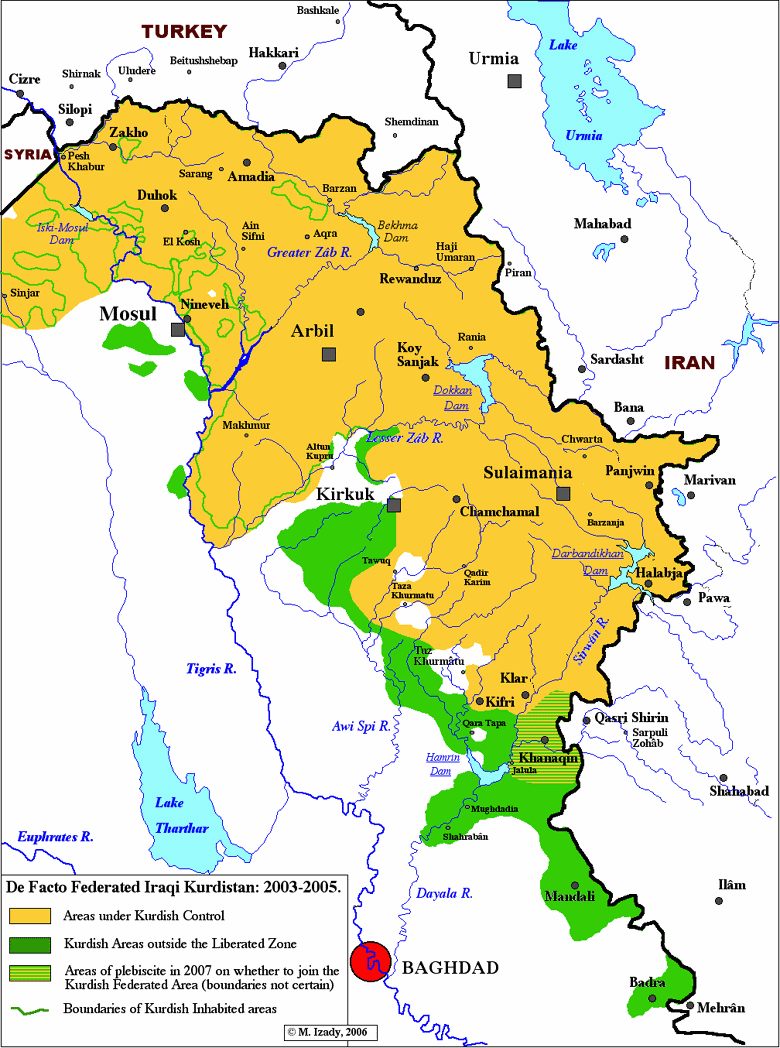
Steve DeAngelis of ERMB has been posting from (and about) Kurdistan in Iraq the past week while on a visit for Enterra Solutions. Collectively, Steve's posts provide in- depth, on-site, analysis of Kurdistan's present and future prospects with an emphasis on regional and global economic integration, security and systemic resilience; here they are in chronological order:
1. An Overview of Kurdistan
2. Resilience in Kurdistan
3. 3 days in Iraq from the Syrian/Turkish border to the Iranian border
4. Lessons from the Edge of Globalization: 3 days in Iraq from the Syrian/Turkish Border to the Iranian Border
5. Security in Kurdistan
(There were also several other Iraq-related posts "Interagency Feuding Over Iraq Reconstruction" and " Coffee for the Troops")
It would be difficult for me to briefly summarize in a mere paragraph what DeAngelis has impressively written about Kurdistan being on the " Edge of Globalization" in roughly 6000 words. Therefore, I'm going to pick out a number of select excerpts that give the feel of the sum of Steve's observations, followed by my commentary:
"We then headed further west to the border crossing checkpoint with Turkey. We entered a small U.S. military post on the border and saw how this border is managed. Completely full trucks, stretching for miles into Turkey loaded with any product you can imagine are seeking to deliver their products to buyers in Iraq. However, on the opposite side of the border another story unfolds. There is a two week wait (yes, I said two weeks!) for trucks coming from Iraq to cross into Turkey. Along the road are makeshift housing facilities equipped with satellite dishes that drivers can use during their two-week wait along a dusty and dirty road that moves trucks from one holding pen to another as they creep up to the border inspection stations in Iraq and then to their equivalent inspection stations in Turkey....
I'd be curious to know how much of this Turkish inefficiency is explicable due to legitimate security issues with the PKK, how much is due to local corruption, understaffing and incompetence and how much is calculated policy on the part of Ankara to choke Kurdish economic growth.
....Virtually all of the trucks crossing back into Turkey from Iraq are completely empty. If there were robust manufacturing and other commercial business operations in Iraq, these trucks would be full of products to be sold in Turkey and to the rest of the world as they transit through Turkey’s ports. The only kind of trucks that do cross fully loaded are 3,000 gallon tankers filled with Iraqi oil destined for a Turkish power generation facility just over the border. The electricity produced by the plant is sold back to the Iraqi’s at western market rates. What this obviously says is that Iraq has the raw materials but does not possess the production capability to turn oil into electricity and as such pays a tremendous financial and strategic price for this lack of capacity. The net result of this border crossing reality is a Current Account trade imbalance of almost 100% between Turkey and Iraq"
Steve is correct that this ad hoc mercantilist trade scenario is problematic for Kurdistan. Historically, nations that are raw commodity exporters, regardless whether it was cotton, rubber, oil, strategic minerals or foodstuffs end up in a unfavorable position vis-a-vis value-added production trading partners or merchant capital states. This applies whether we are discussing Ptolemaic Egypt and ancient Rome or the Gulf states today and the Core.
One caveat on the negative trade balance issue for Kurdistan would be the financial flows of Black Globalization. Lacking orderly markets and effective governance, ordinary Iraqis rely upon the black market for access to desired luxuries as well as necessities such as medicines or spare parts for machinery. Controlling a long border with Turkey, Iran ans Syria gives Kurdish actors the ability to become middlemen in the flow of goods and money which does not show up on the legal balance sheet. Ultimately, Barzani and Talabani's regional Kurdish government must bring this trade above ground and normalize the economic relationships ( include taxes and customs duties).
"The Peshmerga welcomed U.S. forces and fought side-by-side with them in the effort to overthrow Saddam Hussein. It is estimated that there are between 80,000 and 100,000 active Peshmerga in Kurdistan. As the attached picture of a Peshmerga soldier taken near Dohuk shows (click to enlarge), the Peshmerga are a modern and well-equipped fighting force. The Peshmerga also allow women to serve. This tradition began when the Peshmerga were a guerilla force fighting to make the Kurdish area of Iraq a safe haven. Women also fought alongside coalition forces at the beginning of the current conflict. The attached picture shows female Peshmerga celebrating the fall of Kirkuk. "
The Peshmerga have been a coherent military force(s) far longer than I have been alive. Or Steve Deangelis for that matter. Or probably any of my readers. (The ferocious and mercurial Mustafa Barzani, sire of Massoud Barzani, the Kurdish president and KPD chieftain, was once the darling of American conservatives who hated Henry Kissinger. And long before that, tribal lord Barzani was the protege of... Joseph Stalin ! History has made the Kurds the ultimate realists). Former CIA field operative in Kurdistan Robert Baer put the Peshmerga fighting credibly toe to toe with Saddam Hussein's best Republican Guard divisions during the 1990's. That ain't hay folks. Even in the 1990's decline the Republican Guard was heavily armed and well-trained, despite being hamstrung by Saddam's increasing paranoia.
The Peshmerga are perfectly suited for 4GW warfare as they combine tight military discipline, clan networks and strong primary loyalties with concurrent conventional and guerilla warfare skills. They also benefit from American patronage and a leadership that has proven unusually adept at presenting an image and engaging in politics in the international arena.
"Another new friend, Subbas Sircar, who is the regional vice president of AIG for the Middle east, Mediterranean and South Asia, had an interesting morning meeting with local bankers. They are seeking to expand and strengthen local banks as I discussed earlier. This group craved exposure to current international banking best practices, core banking information technology and know-how that would allow them to connect to the global banking industry as well as the training and education that would allow staff members to raise themselves up to a minimal level of maturity so they can foster commerce in their region. This experience with bankers in Sulaimaniyah and in Erbil, along with the telecommunications companies seeking the same capability in their industry, are proof positive of the need for Development-in-a-Box™."I think Steve is identifying a critical tipping point for Kurdistan. Leapfrogging the bazaari mentality to create a financial structure that inspires enough confidence to attract and sustain legitimate foreign investment and diversify Kurdish reliance on Turkish capital and American aid would be a milestone. This probably would not mean " best practices" in the sense of Chase Manhattan so much as " best enough practices" relative to the region. " Good enough" is what gets a healthy level of local economic growth going. " Best" can wait for the day the Republic of Kurdistan applies for admission to the WTO and the EU.
Today, Kurdistan is a nation with a virtual state shepherding its interests. More than Hezbollah in Southern Lebanon, the regional government in Kurdistan is less than Taiwan. But like Taipei, the Barzani-Talabani regional government seeks to negotiate or leverage de jure status and the full sovereignty of statehood over the virulent objections of a powerful neighbor and a nervous American patron. Economic development and integration with other global power centers ( EU, China, India, Japan, Russia) will be the key for the Kurds to create a scenario where Ankara can swallow - however bitterly, even with with ironclad security guarantees - Kurdish independence, because it will be in Turkey's economic best interests to do so.
LINKS:
"Kurdistan Rebalancing the Middle-East" and "Iraq Travel Guide" by Chirol
"The Kurdistan Problem: Part I ", "The Kurdistan Problem: Part II", "The Kurdistan Problem: Part III" by midtowing at ProgressiveHistorians"Response to Virtual Nations Will Shape World Order or Disorder" by Adrienne Redd
"The Rise of the Virtual StateWealth and Power in the Coming Century" by Richard Rosecrance
"Market-state vs. Virtual State" by John Robb
Labels: connectivity, core, deangelis, foreign policy, gap, iraq, kurdistan, military contractor, PNM, resilience, state building, virtual states
¶ 12:00 AM 3 comments

The SWJ Blog is developing very nicely in terms of steadily drawing high quality contributors. The latest examples are Dr. Robert J. Bunker ( Non-State Threats and Future Wars) and John P. Sullivan ( Center for Advanced Studies on Terrorism). They have a post up entitled:
"Iraq & the Americas: 3 GEN Gangs Lessons and Prospects"
"Gangs and Iraqi insurgents, militias, and other non-state groups share common origins based on tribalism, and therefore, it is expected that they will exhibit similar structures and behaviors. It is our belief that further insight into Iraq’s present situation and future prospects may be derived from a perspective utilizing 3rd generation gang (3 GEN Gangs) studies which present lessons learned from the emergence and spread of gangs within the United States, and other parts of the world, over roughly the last four decades. (1) Basically, from a 3 GEN Gangs perspective, three generations of gangs have been found to exist: turf based, drug based, and mercenary based. The first generation gangs, comprising the vast majority, focus on protecting their turf. These gangs, the least developed of the three generational forms, provide both protection and identity to their members and little more. While some drug dealing is evident, it tends with these gangs to be a sideline activity.
....From a 3 GEN Gangs perspective, Iraq has been essentially overrun by 3rd generation gangs and their criminal-soldier equivalents. This is reminiscent of the nightmare scenario for the US already starting to develop in Central and South America (and, to a lesser extent, within the US) with the emergence, growth, and expansion of Mara Salvatrucha (MS-13) and other Maras. In many ways, the ‘Gangs of Iraq’ are a prelude to the ‘Gangs of the Americas’ that we will be increasingly facing in the Western Hemisphere."
This brings to mind the analysis of RAND scholar, David Ronfeldt in his excellent working paper " In Search of How Societies Work: Tribes - The First And Forever Form ".
"
Labels: 3 gen gangs, criminals, david ronfeldt, gangs, insurgency, iraq, john p. sullivan, military, robert j. bunker, swj blog, theory, tribes, war, warriors
¶ 6:44 PM 3 comments
Brave New War by John Robb is a book that was really written for two audiences.
The first is the relatively small number of specialists in military affairs, serious students of geopolitics and bloggers who are already avid readers of Robb’s Global Guerillas site. For them, Brave New War is a systematic and footnoted exposition of the theories of conflict and “dangerous ideas” that Robb discusses daily on his blog. They will be entertained and challenged by the same analysis that makes them return again and again to Global Guerillas to debate John Robb and one another.
The second audience is composed of everyone else. Brave New War is simply going to blow them away.
Brave New War is a tightly written, fast-paced work on the emergent nature of warfare, conflict global society with a decidedly dystopian take. In a mixture of original ideas and synthesis of the works of other cutting edge “thought leaders”, Robb, a platform designer and former mission commander for USAF Counterterrorism operations, draws analogies from the tech world to explain changes in warfare in the age of globalization. Calling the Iraq War “ the modern equivalent of the Spanish Civil War” Robb highlights a robust number of critical concepts in Brave New War that are, in his view, altering international and subnational conflict, including:
Bazaar of Violence
Black Swans
Brittle Security
Dynamc Decentralized Resilience
Emergent Intelligence
Fourth Generation Warfare
Guerilla Entrepreneurs
Global Guerillas
Market-States
Minimalist Platforms
Open-Source Warfare
Plausible Promises
Primary Loyalties
Stigmergic Systems
Superempowered Groups
Systempunkt
The Long Tail of Warfare
Urban Takedowns
Some of these concepts are Robb’s, some belong to others and in Brave New War you will find citations for figures as diverse as William Lind, Chris Anderson, Nicholas Nassim Taleb, Valdis Krebs, Eric S. Raymond, Thomas P.M. Barnett, Albert-Laszlo Barabasi, Philip Bobbitt, Moises Naim and David A. Deptula. One of the great strengths of Brave New War is Robb’s capacity as an analyst and theorist to apply the revelations of research into network theory to warfare, and to conceptualize armed political conflict within the framework of platforms and ecosystems. This gives Robb’s arguments a degree of horizontal “interconnectedness” seldom seen in works on military affairs ( except, as Robb himself points out, in the work of his frequent online sparring partner, Thomas Barnett).
Robb is betting heavily on increasing levels of global instability and systemic breakdown as “feedback” from global guerillas overloads “the system” and disrupts globalization. It is this orientation toward discerning the worst-case scenarios and descent into entropy that will raise hackles amongst some readers, though Robb ultimately predicts a strengthening of systemic resilience and a burst of innovation as a result of these tribulations.
Brave New War is the must read book of 2007.
OTHER REVIEWS:
Haft of The Spear
Simulated Laughter
Futurejacked
Labels: book, brave new war, defense, global guerillas, iraq, john robb, market states, military, national security, networks, theory
¶ 12:00 AM 6 comments
This article is a shot heard round the world:
"A failure in Generalship" by LTC Paul Yingling.
WaPo has picked it up here "Army Officer Accuses Generals of 'Intellectual and Moral Failures'"
The Small Wars Council is discussing it here.
How much you want to bet that this article has crossed the desk of Secretary Gates ? And it should.
Required reading.
ADDENDUM:
SWJ Blog - "A Failure in Generalship"
Interview with LTC Paul Yingling Combined Arms Research Library ( thanks, Lex !)
Thomas P.M. Barnett -" New Officers"
Labels: iraq, military, strategy swj
¶ 7:45 AM 11 comments
Fabius Maximus offers a contrarian argument at DNI -" The Iraq insurgency has ended, which opens a path to peace". I found this to be one of FM's most interesting pieces, which should be read in full; I will comment on several points that intrigued me in particular:
"Having a bureaucracy, capital, constitution, and seat at the UN does not make a government. Governments have specific characteristics. The more of these they possess, the stronger and more durable they are. The most important attributes:
Control of armed forces, or even monopoly of armed force in its borders.
The ability to levy and collect taxes.
An administrative mechanism to execute its policies.
Territory in which it is the dominant political entity.
Control of borders.
Legitimacy (not love) in the eyes of its people.
The national “government” of Iraq has, by most reports, none of these. It lives on oil revenue and US funding. Its ministries are controlled by ethnic and religious groups, parceled out as patronage and run for their “owners” benefit. The only territory it controls is the Green Zone, by the grace of the Coalition’s armed forces."
Defining or determining the "legitimacy" of states is one of the stickiest questions in international relations and one in which statesmen, political scientists, historians and international law experts lack a consensus. De jure recognition of other states is a small substantive component but a large diplomatic one and it can matter. Having the consent of the governed, implicitly by primary loyalty or explicitly through an electoral process is critical but it can quickly be frittered away through incompetence and weakness.
"What were the Iraq elections? An expression of hope by its people, or an ignorant or delusional attempt at nation-building by America. Perhaps both.
Either way, it was a step on a path to nowhere. Athenian democracy and the Roman republic were built on a foundation of internal political machinery by which the leaders’ decisions were translated into actions. Iraq lacked that after our invasion, and we constructed the government with no supporting bureaucratic mechanisms. Voting does not magically call the necessary apparatus into existence.
The only effective political apparatus in Iraq exists at the local level. Much of that is done by the most basic form of government: only those commanding armed men have a vote."
The democratic vote in Iraq was a historically important moment, Fabius underestimates the import. He is however, quite correct, that the moment was not capitalized upon nor did the administration even attempt to prepare the interim Iraqi government to do so. Most of the political momentum was lost and democracy as a value was depreciated in the long and mostly pointless wrangling among Iraqi parties that followed. Where was General Leonard Wood when we needed him ?
Fabius also offers some advice:
"Beyond that, there are two possible ways we can help.
First, to secure public spaces in Iraq’s major cities – a form of static defense. No longer attackers, clear to all as only temporary helpers, we might transform from targets to neutral guardians.
Second, even more important, we can secure Iraq’s borders, especially with Iran. Iraq has no Army, probably by our design to maximize their dependence on us. In this role we can relocate our forces out of harm’s way (except as needed as above). Unlike the dreams of neocons, this is probably not a long-term arrangement. If Iraq survives, eventually it will build a real army and tell us to leave.
This plan gives us a soft exit path, no matter what happens in Iraq."
Some of this is quite sage but I'm hard pressed to see how the first part in particular is going to be different in the functional military sense from what General Petraeus is doing with the COIN surge. Different intent on FM's part, certainly, but actions will be similar, if not identical.
Much to read in that piece.
Labels: COIN, dni, fabius maximus, insurgency, iraq
¶ 6:37 PM 1 comments
On very rare occasions, I reproduce a post from another blog in toto. After hearing from Dave Dilegge, editor of the Small Wars Journal, this is one of those times. The following was posted today at the SWJ Blog by Dr. Dave Kilcullen, an Australian lieutenant colonel, expert on irregular warfare, anthropologist and currently a special adviser on counterinsurgency to the Department of State. Kilcullen takes issue with reporting from The Guardian:
"Guardian article misrepresents the advisers' view
Today’s Guardian article (“Military Chiefs Give US Six Months to Win Iraq War”) misrepresents the Baghdad advisers. So much so, it makes me doubt the reliability of the single, unidentified source responsible for much of the article’s reporting.
I hope SWJ colleagues will forgive this more "personal" post than usual, but as Senior Counterinsurgency Adviser I have a duty to set the record straight on this.
There is a real country called Iraq, where a real war is going on, with real progress but very real challenges. We are not going to "win the war" in six months -- nor would anyone expect to. But the Guardian seems to be describing some completely different, (possibly mythical) country, and some imaginary group of harried and depressed advisers bearing no resemblance to reality. As counterinsurgency professionals, we take a fact-based approach and we are well aware of the extremely demanding task we face. That makes us cautious realists -- but we are far from pessimists, as the Guardian's anonymous source seems to imply.
The article is littered with inaccuracies:
• the “advisers” are not bunkered down in the Green Zone, but in another location, and frequently out on the ground.
• the article (incorrectly) describes me as a serving military officer – I’m a civilian diplomat, as any source truly familiar with the team's thinking would be well aware.
• while recognizing the severity of the challenge, the team's mood is far from pessimistic. Success will take months or years, not weeks or days, and although early signs are somewhat encouraging it's really far too early to say how things will play out. The war has been going for four years, the new strategy for less than four weeks. Give it time.
• the State department is not failing to meet its personnel targets. On the contrary, more than 90 % of civilian positions in Iraq are filled, and we will grow to 20 Provincial Reconstruction Teams soon.
• the coalition is far from disintegrating – British redeployment from the South reflects improved security, not lack of will, and the same day the British announced their move the Australians announced a force increase in both Iraq and Afghanistan.
• The plan is not “unclear” or “constantly changing” – we all know exactly what the plan is. The article seems to be mistaking the freedom and agility which have been granted to us, allowing us to respond dynamically to a dynamic situation, for vacillation.
Yes, of course, there are still car bombings. But several recent bombings have been Sunni-on-Sunni, rather than sectarian, with extremists targeting moderates to discourage them from cooperating with the government. That means sectarian violence, overall, is down, and that extremists are worried they are losing support from their base – both good things, despite the appalling violence against innocents we have come to expect from these extremists.
And yes, there is a risk that home-front political will might collapse just as we are getting things right on the ground. Given some commentators’ overall negativity, one suspects that their efforts may directed to precisely that end. You may not like the President, you may be unhappy about the war. But whose side are you on? The Iraqis trusted us, and this is their fight. They deserve our support.
Buried in the article, though, are some references to real-world progress:
• Progress has been made on oil-wealth sharing legislation – a major development
• Joint operations are beginning in Baghdad, and are going well so far
• Iraqi community leaders are reporting somewhat improved morale and public confidence among the civilian population, though this is tempered by previously unmet expectations
• Numbers of political murders have fallen (precipitously) since the operation began, though these are still too high in absolute terms
• Iraqi forces are turning up, and performing well, though not always at 100% strength
• In al-Anbar, tribal leaders have realized extremists have nothing to offer them – a huge development, as influential community leaders have "flipped" from AQ's side to support the Iraqi government
• Regional diplomatic efforts, including with Iran and Syria, are apparently underway
Unfortunately most of these developments are buried in the last paragraph of a long article.
The Guardian is entitled to its own view of the war, and reasonable people can differ on these issues. But the Guardian’s view is not ours, and the anonymous source misrepresents our views. It is really too soon to tell how things will play out, though early signs are encouraging so far, and the advisers as a group remain cautious realists, not pessimists."
Well said.
Labels: dilegge, guardian, iraq, kilcullen, small wars journal, swj blog
¶ 7:24 PM 3 comments
Colonel W. Patrick Lang, a former DIA analyst and current TV talking head on Mideast issues, has a second blog, The Athanaeum, devoted to the humanities and the sciences. On it he has posted a select bibliography on Iraq, Insurgency and Islam.
I have simply added it to my future " must read" list, though I was most pleased to note that I have several of the Colonel's recommendations on my bookshelf already. For the military theorist set, there are a number of titles of interest as well.
Labels: athanaeum, counterinsurgency, iraq, islam.insurgency, lang, mideast, military, sic semper tyrannis
¶ 11:44 PM 0 comments