Picked up both of these on a lark on Saturday, as I cruised through Border's with The Son of Zenpundit, who was getting some independent reader level books about Spider-Man fighting -well- some villain or other. The usual suspects.
Any thoughts from readers as to how high these tomes merit being placed on the "Must read" pile ? I'm currently innundated with things to read, so prioritizing is a must.
Labels: book, bush, COIN, foreign policy, history, insurgency, iraq, islamic world, islamist, mideast, war
¶ 7:35 PM 2 comments
Jedburgh of The Small Wars Council posted Arab Insight, Fall 2007 (PDF) which has the theme "Do We Hate America? The Arab Response". Definitely worth a look.
Labels: arab world, islamic world, islamist, mideast, small wars council
¶ 7:20 PM 0 comments
If the Bush administration really wants to cripple Iran, instead of planning an EBO attack or using IO scare stories about nuclear weapons, we should simply encourage Iran to adopt Ahmadinejad's economic program.
Labels: ahmadinejad, brave new war, bush, iran, lounsbury, mideast
¶ 8:33 PM 0 comments
Beltway based Pundita observes:
"The US is fighting a war in a region where we've been very hostile to two countries bordering the war zone. Pundita is of the mind that the top priority is to win the war, and for that we need all the help we can get.
Right now Syria's government is overwhelmed with looking after refugees from Iraq. So I would try offering Syria considerable help in exchange for vigilance with foreign travelers.
When it comes to asking Iran and Syria for help with Iraq, I see too much halfhearted trying from the US, then waving of hands and saying, 'See, they won't deal.' Try harder."
I agree. Iran and Syria are nasty regimes whose actions we must often oppose but where they are willing to cut some fair deals we should get down to business. Freezing Castro in the diplomatic equivalent of absolute zero has only served to help preserve his Communist- caudillo regime until the dictator's old age while irritating most of our allies and trading partners. Do we really want a 92 year old Bashar Assad still in power someday ?
Labels: diplomacy, foreign policy, iran, iraq, mideast, pundita, strategy, syria
¶ 9:55 AM 3 comments
A set of papers from The Washington Institute for Near East Policy entitled "Deterring the Ayatollahs: Complications in Applying Cold War Strategy to Iran".
Hat tip to Jedburgh of The Small Wars Council.
Labels: deterrence, diplomacy, foreign policy, iran, mideast, national security, nuclear, small wars council, strategy
¶ 8:00 PM 0 comments

When Robert Gates, the current Secretary of Defense, retired from government service after the end of the first Bush administration, he wrote a memoir , From the Shadows, in which he described the no-nonsense, George Schultz as " the toughest Secretary of State I ever knew" who " saw no contradiction" in bleeding the Soviets in one part of the world while negotiating with them in another. Secretary Schultz, whose opinion of the CIA on a 1 to 10 scale hovered in the negative integers, was not nearly as complimentary to Robert Gates in his own, ponderously unreadable, memoirs, but that is a story for another day.
I bring this anecdote of a less complex era up because of the furor over the Bush administration classifying the Pasdaran ( the Iranian Revolutionary Guards Corps) as a terrorist organization in order to take action against those business enterprises that are connected to the Pasdaran. The objections to this move appear to be two-fold: first, that it hypothetically puts American military personnel at risk of maltreatment and, secondly, that it could disrupt negotiations with Iran on a range of bilateral and international issues, most importantly, Iraq.
The critics are incorrect. It is a move a quarter-century overdue.
In the first instance, correctly identifying the Pasdaran as a state sponsor of international terrorism, which as a matter of historical record, it clearly is, does not prevent treating it's uniformed personnel as POWs in case of an armed conflict between Iran and the United States. The Pasdaran, by contrast, has already tortured two Americans to death - Beirut CIA station chief William Buckley and USMC Colonel William Higgins - at a time of peace between Iran and the United States.
Cry me no river of tears for Pasdaran agents in Iraq being held captive by the U.S. military or who are being whacked in some alleyway by Sunni tribals in our employ. The Iranians knew the risks, from the inception, of the rules they chose to operate under, violating the most basic precepts of international law. It did not have to be that way - even the CIA and the KGB came to a rough modus vivendi during the Cold War that prevented most escalatory incidents - Teheran though has chosen to play rough. Let them enjoy the bed they have made for themselves.
Secondly, until we have an agreement with Iran we do not have any agreement and the regime should be squeezed at every point until we do. I'm all for negotiating in earnest, making the realistic, even generous, concessions that we can easily afford, finding areas of common interest and ( eventually) normalizing relations. We should scrupulously keep our word and demonstrate to the Iranians through actions that we will deliver exactly what we promise. But until that point in time, Teheran should get no favors, no breathing space, no economic freebies of any kind until we come to an arrangement.
The leadership of Iran is a nasty and brutal group. Within that circle, Ahmadinejad represents some of the regime's worst elements but, as a whole, the Iranians do not seem irrational, simply adversarial. We can cut a deal with them but we should proceed without any illusions.
IRGC STORY LINKS:
Thomas P.M. Barnett
The Newshoggers
Counterterrorism Blog
The Glittering Eye
Pundita
Right Wing Nuthouse
Labels: bush, diplomacy, foreign policy, international law, iran, mideast, terrorism
¶ 8:30 PM 5 comments
Steve DeAngelis of ERMB has journeyed to the autonomous Kurdistan region of Iraq a second time on Enterra business. He's had several posts reflecting on his experiences working in " the other Iraq" or about the Mideast in general.
Probing the Edges of Globalization
Lessons from the Edge of Globalization: Part 2, Day 1
Labor Reform in the Middle East ( Dubai focus)
Islamic Finance
Kurdistan's clan-based rulers and Peshmerga leaders have been exceptionally deft players in the aftermath of the invasion of Iraq, managing to have excellent relations with the United States, Iran and ( allegedly on the quiet) Israel. Quite a neat trifecta. Only Turkey remains a serious problem, deeply fearful of Kurdish revanchism, PKK terrorism and having assumed the role of protector of the Turcoman minority in Iraq ( ironically, reprising the posture that imperial Russia once assumed toward Orthodox Christians in the Ottoman Empire that the Sublime Porte found so offensive).
To be a state or not to be a state, a choice the Kurds must make. One of the few things most countries can agree on is that international borders are no longer up for grabs via the use of force - Europe's peace was built on the permanence of German borders and the Europeans are not going to reopen that topic, even in principle. The road to sovereignty, independence and NATO membership for Kurdistan runs only through Ankara but it requires strategic choices not seen in Mesopotamia since 1919.
Labels: barnett, deangelis, enterra, international law, iraq, kurdistan, mideast, turkey
¶ 8:29 PM 0 comments
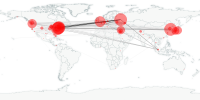
Who ruled the Middle-East? 5000 years in 90 Seconds:
Hat tip to Prometheus6
Labels: empire, map, maps of war, mideast, visualization
¶ 7:34 AM 5 comments
Colonel W. Patrick Lang, a former DIA analyst and current TV talking head on Mideast issues, has a second blog, The Athanaeum, devoted to the humanities and the sciences. On it he has posted a select bibliography on Iraq, Insurgency and Islam.
I have simply added it to my future " must read" list, though I was most pleased to note that I have several of the Colonel's recommendations on my bookshelf already. For the military theorist set, there are a number of titles of interest as well.
Labels: athanaeum, counterinsurgency, iraq, islam.insurgency, lang, mideast, military, sic semper tyrannis
¶ 11:44 PM 0 comments
The much disputed Iraq NIE key judgments summary was released in an unclassified PDF version with a description of changes in analytical methodology. These were mildly interesting to me but any intel wonk types hoping for the addition of bold, untried, new analytical techniques are going to be disappointed. What was added should help enhance clarity for non-professional readers and make any artificial, imposed, analytical consensus look more...well...marginally artificial and imposed.
As for substance, the document is remarkable for its lack of surprises. There are complaints that the NIE has not taken into account the results of a successful surge campaign on Iraq. That is true, but the surge is a tactical manuver by the U.S. military that will not change the underlying strategic dynamic among Iraqi factions. It would simply create a zone of decreased conflict level and a breathing space for a negotiation of a political solution, it is not a political solution in itself. Someone actualy has to take advantage of what a successful surge provides.
The realism about the limits of regional actors (Iran, Syria, Turkey, KSA) to influence various Iraqi factions is worth highlighting as diplomacy, while useful, is not going to be a silver bullet, even if you assume the good faith of all interested parties. In my view, these states can offer real assistance (if they were inclined ) to the U.S. in containing Iraq's problems from spreading, but that's about the best that could be expected of them as it hinges on their own self-interest.
NIE LINKS:
Haft of the Spear
Labels: analytic, intelligence, iraq, mideast, nie
¶ 7:17 PM 2 comments