Steve DeAngelis of ERMB has journeyed to the autonomous Kurdistan region of Iraq a second time on Enterra business. He's had several posts reflecting on his experiences working in " the other Iraq" or about the Mideast in general.
Probing the Edges of Globalization
Lessons from the Edge of Globalization: Part 2, Day 1
Labor Reform in the Middle East ( Dubai focus)
Islamic Finance
Kurdistan's clan-based rulers and Peshmerga leaders have been exceptionally deft players in the aftermath of the invasion of Iraq, managing to have excellent relations with the United States, Iran and ( allegedly on the quiet) Israel. Quite a neat trifecta. Only Turkey remains a serious problem, deeply fearful of Kurdish revanchism, PKK terrorism and having assumed the role of protector of the Turcoman minority in Iraq ( ironically, reprising the posture that imperial Russia once assumed toward Orthodox Christians in the Ottoman Empire that the Sublime Porte found so offensive).
To be a state or not to be a state, a choice the Kurds must make. One of the few things most countries can agree on is that international borders are no longer up for grabs via the use of force - Europe's peace was built on the permanence of German borders and the Europeans are not going to reopen that topic, even in principle. The road to sovereignty, independence and NATO membership for Kurdistan runs only through Ankara but it requires strategic choices not seen in Mesopotamia since 1919.
Labels: barnett, deangelis, enterra, international law, iraq, kurdistan, mideast, turkey
¶ 8:29 PM 0 comments
Tom brought an excellent post by Curtis Gale Weeks at 5GW to my attention and then offered his own commentary. Here are the posts:
"On the Barnettian 5GW" by Curtis Gale Weeks
"Nice post by Curtis on 5GW" by Dr. Barnett
I have to agree with Tom and Shane that Curtis really hit his stride with that post. I have a few comments of my own on their 5GW exchange.
Curtis wrote:
"—There is a term used variously and vaguely in these discussions; I myself conflated two interpretations of the term. The Robbian view seems to depend on unequal distribution of “-powerment”, in which some individuals or groups become more powerful than the general human population; whereas, at heart Thomas Barnett’s Core/Gap paradigm and strategy seem to depend upon an eventual equalization, or a relative equalization (which is a type of oxymoronic phrase), of individual empowerment across the globe"
I don't think Curtis' use of " relative equalization of individual empowerment" is actually as oxymoronic as it seems. This is an astute normative economic observation on Week's part. Instead, it illustrates the aggregate effect of Schumpeter's creative destruction rippling across the globe as the spread of economic connectivity and information technology proceeds apace. The spread, of say, cell phone-based wifi internet access to states with sketchy (at best) landline telephone service, is a quantum leap forward for equalization of empowerment on the macro- scale even as certain small networks or individuals of those states on the micro- scale, possess the ability to leverage still greater levels of empowerment to become "more equal than others".
This seeming dichotomy are flip sides of the same coin in any true market action and is always ongoing to some degree, provided the market is permitted to function. Unless the comparative advantage is artificially locked in by force ( this is what tyrants of disconnectivity, like Mugabe and Kim Jong-Il, do - force everyone else to remain still in order to retain their own local "super empowerment"), any individual or entity's "super empowerment" is apt to be a fleeting condition unless constantly maintained by adaptive improvements.
Much later, Curtis opined:
"Many people seek saviors of one sort or another; many are happy to delegate responsibility for the things they themselves cannot touch or do not have the time or motivation to fix themselves — or do not understand, themselves. The crux of the Barnettian paradox involves the manner and method of assigning these delegations so that the general man-on-the-street can rest easily knowing his prosperous future is assured. Even within the Core, much doubt about this process of delegation exists; various superempowerments within and without the Core threaten to upset faith in the systems of the Core. "
Visible super empowerment within a society is a condition representing both change as well as inequality; two phenomena against which it is nearly always possible to rally anger, envy, fear and political opposition.
Tom Barnett wrote:
" Instead of trying to be all things to all individuals in Vol. III, I'll explore the one thing I know well. I do that because I feel the knowledge is important in its own right, addressing a serious gap in our tool kit vis-a-vis other, rising societies of SEIs (especially China and India).
....The book on SEIs remaking the world in their vision--positively--is a book I could see writing with Steve a few years down the road."
The accent on positively remaking the world by Dr. Barnett is a noteworthy point to keep in mind. Numerically speaking, most highly intelligent, energetic, creative and task persistent individuals who function as change agents are overwhelmingly positive actors. Maslow wrote of a stage of self-actualization and in a certain sense, exceeding oneself by changing society in a positive direction may be an expression of both self-actualization as well as super empowerment The Ted Kaczynskis and Osama Bin Ladens are perverse and statistically rare anomalies; exceptions that prove the rule, in a sense.
Unfortunately, the exceptionally negative super empowered individuals do and will exist and have the potential to inflict system perturbations, at least on a one-shot, " black swan", basis. Deep uncertainty regarding the nature of such future superempowered individuals' actions has to be dealt with in terms of proactively engineering systemic resilience to cope with these malicious one-hit wonders. Steve's Development-in-a Box paradigm at Enterra is one effort to begin comprehensively addressing these deficits. Tom's Sys Admin is another. Building new, highly decentralized, "Wikinomic" mass-collaborative platforms from scratch, may be yet a third.
Labels: 5GW, barnett, deangelis, dreaming 5gw, superempowered individuals, wikinomics
¶ 2:22 PM 3 comments
Steve DeAngelis at ERMB recently had an important and thought provoking post that should resonate with anyone who has experienced the imposing conformity of a corporate cubicle. In " The Tension Between Creativity and Efficiency", DeAngelis spotlighted an important area of friction as organizations struggle to adapt to macroeconomic shifts created by globalization and the information revolution. While the focus in Steve's post happened to be corporations, it is a paradigm that applies equally well to public education, the military, intelligence agencies, universities - basically any entity that has a legacy organizational structure from the "mass-man", " second wave" era of industrial mass production and Cold War that was so deeply influenced by Taylorist "scientific management".
Specifically, Steve was looking at an article that detailed the implications for the rate of innovation of Six Sigma type programs. Some excerpts:
"The problem, according to the article, is that the culture created by Six Sigma clashes directly with the culture required for innovation.
"Now his successors face a challenging question: whether the relentless emphasis on efficiency had made 3M a less creative company. That's a vitally important issue for a company whose very identity is built on innovation. After all, 3M is the birthplace of masking tape, Thinsulate, and the Post-it note. It is the invention machine whose methods were consecrated in the influential 1994 best-seller Built to Last by Jim Collins and Jerry I. Porras. But those old hits have become distant memories. It has been a long time since the debut of 3M's last game-changing technology: the multilayered optical films that coat liquid-crystal display screens. At the company that has always prided itself on drawing at least one-third of sales from products released in the past five years, today that fraction has slipped to only one-quarter. Those results are not coincidental. Efficiency programs such as Six Sigma are designed to identify problems in work processes—and then use rigorous measurement to reduce variation and eliminate defects. When these types of initiatives become ingrained in a company's culture, as they did at 3M, creativity can easily get squelched. After all, a breakthrough innovation is something that challenges existing procedures and norms. 'Invention is by its very nature a disorderly process,' says current CEO George Buckley, who has dialed back many of McNerney's initiatives. 'You can't put a Six Sigma process into that area and say, well, I'm getting behind on invention, so I'm going to schedule myself for three good ideas on Wednesday and two on Friday. That's not how creativity works.'"
Does that mean that efficiency and creativity must always be at odds? Can the same company establish efficient processes and foster creativity? The article implies that it may be impossible.
....There are a couple of ways that companies can deal with this conundrum. The first is to separate creative portions of a company from process-oriented portions and apply different rules to the different parts. The second way to deal with the dilemma is to automate processes while leaving the people free to be creative. One of the reasons Enterra Solutions has attracted the interest of big companies is that they see the benefits of relieving people from the drudgeries of routine processes. Not only is process automation efficient and effective, even those who must deal with the rule automation process can be creative in how they approach their job. Six Sigma and Lean Six Sigma approaches can be used to drive automated processes without having to change an entire company's creative culture."
Read Steve's post in full here.
I agree with Steve that Six Sigma philosophy has it's place, particularly in terms of final delivery of a service or good but it is ill-suited for maximizing potential productivity in the sense of generating that which is new. Six Sigma, TQM, ISO 900 and related "zero defects" mentality programs, applied unreasonably and unthinkingly across the board by Jack Welch wannabes, have significant costs. For example:
* The emphasis shifts from finding new opportunities to not making mistakes:
This inculcates a "gotcha" attitude in middle-management and makes employees exceedingly risk-averse, conservative and uncommunicative ( when management is hunting for mistakes that will hurt your career, do you run to the boss with bad news. Or do you keep your head down ?). Moreover, employees don't actually have to "be" productive so much as they need to "appear" productive, relative to the instruments by which their performance will be measured. This analytically reductionist perspective discourages a systemic approach.
* It creates a focus on the present process, not alternative pathways:
Maximizing the present and applying multiple measurement tools for individual performance leaves little time or resources for " unproductive" time for speculation, experimentation or planning. People tack to where their incentives are. Moreover, in the hands of middle-management the measurement tools begin to replace common sense in terms of driving the setting of daily objectives and prioritizing the use of time. Independent thought is strongly discouraged.
Creativity required for innovation requires behavior that is inherently "unproductive". There is an apocryphal story of a woman being led on a tour of the Institute for Advanced Study, who was taken by an office where some old loafer had his feet up on a desk and his eyes were closed, hands serenely behind his head. The woman was indignant until her guide solemnly explained that she " had been privileged to see the great Albert Einstein at work". Creativity requires time to explore new things, time to engage in "free play" with co-workers, unstructured time, in other words. In my experience, allowing this to happen is something that appears to cause members of middle-management a significant degree of intense physical pain.
Organizational creativity requires employees who are both autonomous as well as autotelic, which means that their supervisors must be less "managers" and more " leaders" with a style that emphasizes facilitation, connection, strategic thinking and motivation. A model suitable for flatter, flexible, networked-modular organizations rather than authoritarian hierarchies that implicitly encourages intrinsic motivation to create:
Labels: cognition, corporations, creativity, deangelis, ermb, organizations, six sigma, slideshare, society, taylorism
¶ 8:09 PM 9 comments
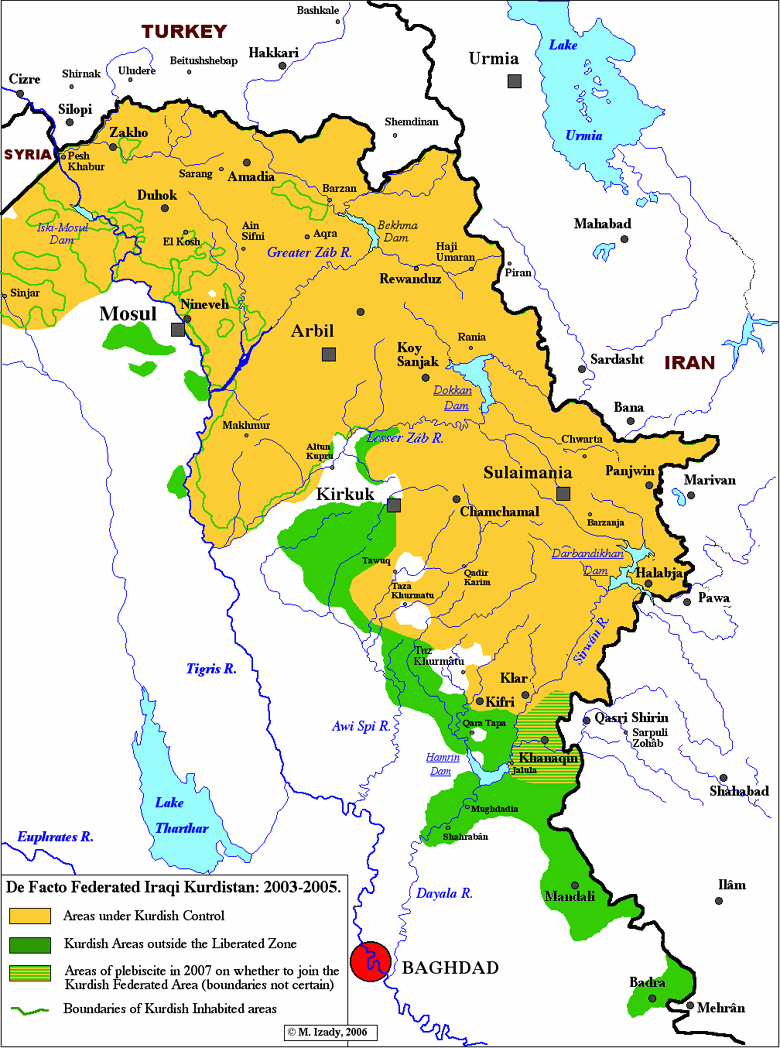
Steve DeAngelis of ERMB has been posting from (and about) Kurdistan in Iraq the past week while on a visit for Enterra Solutions. Collectively, Steve's posts provide in- depth, on-site, analysis of Kurdistan's present and future prospects with an emphasis on regional and global economic integration, security and systemic resilience; here they are in chronological order:
1. An Overview of Kurdistan
2. Resilience in Kurdistan
3. 3 days in Iraq from the Syrian/Turkish border to the Iranian border
4. Lessons from the Edge of Globalization: 3 days in Iraq from the Syrian/Turkish Border to the Iranian Border
5. Security in Kurdistan
(There were also several other Iraq-related posts "Interagency Feuding Over Iraq Reconstruction" and " Coffee for the Troops")
It would be difficult for me to briefly summarize in a mere paragraph what DeAngelis has impressively written about Kurdistan being on the " Edge of Globalization" in roughly 6000 words. Therefore, I'm going to pick out a number of select excerpts that give the feel of the sum of Steve's observations, followed by my commentary:
"We then headed further west to the border crossing checkpoint with Turkey. We entered a small U.S. military post on the border and saw how this border is managed. Completely full trucks, stretching for miles into Turkey loaded with any product you can imagine are seeking to deliver their products to buyers in Iraq. However, on the opposite side of the border another story unfolds. There is a two week wait (yes, I said two weeks!) for trucks coming from Iraq to cross into Turkey. Along the road are makeshift housing facilities equipped with satellite dishes that drivers can use during their two-week wait along a dusty and dirty road that moves trucks from one holding pen to another as they creep up to the border inspection stations in Iraq and then to their equivalent inspection stations in Turkey....
I'd be curious to know how much of this Turkish inefficiency is explicable due to legitimate security issues with the PKK, how much is due to local corruption, understaffing and incompetence and how much is calculated policy on the part of Ankara to choke Kurdish economic growth.
....Virtually all of the trucks crossing back into Turkey from Iraq are completely empty. If there were robust manufacturing and other commercial business operations in Iraq, these trucks would be full of products to be sold in Turkey and to the rest of the world as they transit through Turkey’s ports. The only kind of trucks that do cross fully loaded are 3,000 gallon tankers filled with Iraqi oil destined for a Turkish power generation facility just over the border. The electricity produced by the plant is sold back to the Iraqi’s at western market rates. What this obviously says is that Iraq has the raw materials but does not possess the production capability to turn oil into electricity and as such pays a tremendous financial and strategic price for this lack of capacity. The net result of this border crossing reality is a Current Account trade imbalance of almost 100% between Turkey and Iraq"
Steve is correct that this ad hoc mercantilist trade scenario is problematic for Kurdistan. Historically, nations that are raw commodity exporters, regardless whether it was cotton, rubber, oil, strategic minerals or foodstuffs end up in a unfavorable position vis-a-vis value-added production trading partners or merchant capital states. This applies whether we are discussing Ptolemaic Egypt and ancient Rome or the Gulf states today and the Core.
One caveat on the negative trade balance issue for Kurdistan would be the financial flows of Black Globalization. Lacking orderly markets and effective governance, ordinary Iraqis rely upon the black market for access to desired luxuries as well as necessities such as medicines or spare parts for machinery. Controlling a long border with Turkey, Iran ans Syria gives Kurdish actors the ability to become middlemen in the flow of goods and money which does not show up on the legal balance sheet. Ultimately, Barzani and Talabani's regional Kurdish government must bring this trade above ground and normalize the economic relationships ( include taxes and customs duties).
"The Peshmerga welcomed U.S. forces and fought side-by-side with them in the effort to overthrow Saddam Hussein. It is estimated that there are between 80,000 and 100,000 active Peshmerga in Kurdistan. As the attached picture of a Peshmerga soldier taken near Dohuk shows (click to enlarge), the Peshmerga are a modern and well-equipped fighting force. The Peshmerga also allow women to serve. This tradition began when the Peshmerga were a guerilla force fighting to make the Kurdish area of Iraq a safe haven. Women also fought alongside coalition forces at the beginning of the current conflict. The attached picture shows female Peshmerga celebrating the fall of Kirkuk. "
The Peshmerga have been a coherent military force(s) far longer than I have been alive. Or Steve Deangelis for that matter. Or probably any of my readers. (The ferocious and mercurial Mustafa Barzani, sire of Massoud Barzani, the Kurdish president and KPD chieftain, was once the darling of American conservatives who hated Henry Kissinger. And long before that, tribal lord Barzani was the protege of... Joseph Stalin ! History has made the Kurds the ultimate realists). Former CIA field operative in Kurdistan Robert Baer put the Peshmerga fighting credibly toe to toe with Saddam Hussein's best Republican Guard divisions during the 1990's. That ain't hay folks. Even in the 1990's decline the Republican Guard was heavily armed and well-trained, despite being hamstrung by Saddam's increasing paranoia.
The Peshmerga are perfectly suited for 4GW warfare as they combine tight military discipline, clan networks and strong primary loyalties with concurrent conventional and guerilla warfare skills. They also benefit from American patronage and a leadership that has proven unusually adept at presenting an image and engaging in politics in the international arena.
"Another new friend, Subbas Sircar, who is the regional vice president of AIG for the Middle east, Mediterranean and South Asia, had an interesting morning meeting with local bankers. They are seeking to expand and strengthen local banks as I discussed earlier. This group craved exposure to current international banking best practices, core banking information technology and know-how that would allow them to connect to the global banking industry as well as the training and education that would allow staff members to raise themselves up to a minimal level of maturity so they can foster commerce in their region. This experience with bankers in Sulaimaniyah and in Erbil, along with the telecommunications companies seeking the same capability in their industry, are proof positive of the need for Development-in-a-Box™."I think Steve is identifying a critical tipping point for Kurdistan. Leapfrogging the bazaari mentality to create a financial structure that inspires enough confidence to attract and sustain legitimate foreign investment and diversify Kurdish reliance on Turkish capital and American aid would be a milestone. This probably would not mean " best practices" in the sense of Chase Manhattan so much as " best enough practices" relative to the region. " Good enough" is what gets a healthy level of local economic growth going. " Best" can wait for the day the Republic of Kurdistan applies for admission to the WTO and the EU.
Today, Kurdistan is a nation with a virtual state shepherding its interests. More than Hezbollah in Southern Lebanon, the regional government in Kurdistan is less than Taiwan. But like Taipei, the Barzani-Talabani regional government seeks to negotiate or leverage de jure status and the full sovereignty of statehood over the virulent objections of a powerful neighbor and a nervous American patron. Economic development and integration with other global power centers ( EU, China, India, Japan, Russia) will be the key for the Kurds to create a scenario where Ankara can swallow - however bitterly, even with with ironclad security guarantees - Kurdish independence, because it will be in Turkey's economic best interests to do so.
LINKS:
"Kurdistan Rebalancing the Middle-East" and "Iraq Travel Guide" by Chirol
"The Kurdistan Problem: Part I ", "The Kurdistan Problem: Part II", "The Kurdistan Problem: Part III" by midtowing at ProgressiveHistorians"Response to Virtual Nations Will Shape World Order or Disorder" by Adrienne Redd
"The Rise of the Virtual StateWealth and Power in the Coming Century" by Richard Rosecrance
"Market-state vs. Virtual State" by John Robb
Labels: connectivity, core, deangelis, foreign policy, gap, iraq, kurdistan, military contractor, PNM, resilience, state building, virtual states
¶ 12:00 AM 3 comments

So much to try and speed-read through after my brief respite from the blogging treadmill...
One of several posts that caught my eye today was by Steve DeAngelis at ERMB on "Groupthink: Good or Bad?"; not simply because I am a regular reader of Steve's and of Tom's but because the premium put upon organizational and individual creativity in the next quarter century will put the high octane in the term " information economy". That an "edge" thinker, with the "insider" prominence of Steve, is paying attention to creativity as a subject, bodes well.
[Parenthetical aside: Creativity has two poles. Dr. Richard Florida, whose blog I also enjoy reading, represents analyzing the effects of creativity in the societal and global aggregate. The individual, cognitive processing, aspect of creativity studied by Dr. Mihaly Csíkszentmihályi is equally, important to understand. The two perspectives, in my view, need to be comprehended and integrated for creativity to be properly cultivated, as they are intimately interrelated]
Steve writes:
"When groupthink becomes the dominant paradigm in a business it can crush innovation. Innovators rarely worry about group cohesiveness or getting along. They might not all be clear-eyed pragmatists either. Janis notes that groupthink results in the lack of realistic appraisal of alternative courses of action. Innovators may be willing to take alternative paths but often those courses of action are not very realistic either. Since the invention of the Internet, critics have started to think about and define groupthink differently. They talk about the power of the many to outthink the few. Patti Waldmeir, writing last year in the Financial Times, discussed this other side of groupthink ["Why groupthink is the genius of the internet," 9 August 2006]. She begins with a short history lesson and a question:
"Friedrich Hayek, liberal philosopher and economist, was born in the 19th century. Did he accidentally predict the genius of the internet? Back in 1973, when not even the average nerd knew about the net, Hayek was writing: 'Each member of society can have only a small fraction of the knowledge possessed by all and ... civilisation rests on the fact that we all benefit from knowledge which we do not possess.' That certainly sounds like a manifesto for blogs and wikis and all the other smart collaborative tools of the information society. Like democracy, they are based on the wonderfully egalitarian notion that even the lowliest among us has something useful to contribute. But can that possibly be true?"
Of course, defining groupthink as "collective wisdom" is far different than defining it as everyone thinking alike. That, however, is how Waldmeir has chosen to define it."
Interesting. I'm not familiar with Waldmeir but my two cents here is that "groupthink" and "collective wisdom" share the common trait of collectivity but are not otherwise the same cognitive phenomena. The latter, as a market-like function, relies upon the sum of socially atomized interaction; the former is socially integrated interaction, a network or a hierarchy ( or both) which are very different from a market, at least those markets with no or minimal barrier to entry.
The problem with "groupthink" is not the formal or " official unwritten rule" requirement for everyone to march ideological lockstep. That characteristic is one easily recognized ( and cursed) by those participating within the system which enforces it. For relevant examples, read the historiography of Soviet Studies dealing with " nomenklatura", defectors and dissidents from Kravchenko forward, if not earlier. The real dilemma, the cognitive sticking point where the true damage is done, has to due with the institutional variety of what social historian Lawrence Goodwyn termed "the received culture". Another useful but highly inexact set of terms might be "worldview" or "paradigm", but writ small.
Any analytical journeymen who values his intellectual integrity is adept at spotting the ritual nonsense of their organization and compensating accordingly. A far more difficult task is self-awarenes in terms of discerning the implicit assumptions in which we have all been inculcated by experience and design. "The wisdom of crowds" functions primarily because anyone is able ( theoretically) to join the crowd at any moment. When that is no longer possible, the crowd grows increasingly stupid as the scenario upon which it is asked to pontificate, broadens and lengthens.
This has implications for America's intelligence community. The Cold War has left a peculair counterintelligence legacy known as " the background check", if you aspire to certain positions in the national security, defense and intelligence communities. It is expensive and redundant and, in many cases, periodic. It served a purpose when the US squared off against the Eastern Bloc. Today, the economic effect of this CI legacy is to slow the velocity of " new blood" into the IC and particular appointive positions to a crawl, which effectively " dumbs down" the "crowd", even in those instances in which the IC managerial hierarchy permits a "crowd" to function. Which, if you are a faithful reader of Haft of the Spear, you realize, ain't much.
Here's a wish, from a humble citizen out in flyover country, directed toward the uppermost G-somethings flitting around the new NDI: have someone with both real experience and political juice tackle revitalizing the creativity of the IC analytical process. I say " process" because I do not see this as a " people problem" but a bureaucratic one, the analysts have, as a group, good educations and fine brains.
Look for new ways to use them. Vigorously engage outsiders. Make the political case for novelty in methodology to both politicians and the public. Experimentation at this juncture beats cautious perfection.
Labels: creativity, deangelis, IC, insight, intelligence, Mihály Csíkszentmihályi, richard florida
¶ 8:33 PM 1 comments
Steve DeAngelis, who is the CEO of EnterraSolutions as well as a blogger, took a large step toward building greater systemic resilience against the dangers of WMD that form the crux of the threats detailed in Charles Ikle's Annihilation From Within. Enterra, IATGR and Oak Ridge National Laboratory are forming a more closely connected network to become:
"... a center of gravity for Enterprise Resilience Management and provide the venue for leading chemical, nuclear, biological and information technologists, political scientists and business people to join together to explore approaches to critical issues facing the world."
Steve has mapped out the functions of a SensorNet and ResilienceNet integration in a color graphic that makes the intent of the integrated system clear to try and bring first warning about biological, nuclear, chemical and cyber threats as close as possible to real-time reaction and policy response. My thoughts:
*An effort that is critically important and long overdue, five years after 9/11.
*This mirrors the emerging trend in the larger intelligence and national security communities toward creating "fusion" centers but would broaden beyond collection and analysis to connecting all the different " players" and shape their response.
* I'm wondering if the proposed ResilienceNet would resemble an "all channel" network in its effect in dissemination of information or a modular structure.
Congratulations to Steve and Shane at IATGR for taking resilience to a new level !
LINKS:
Critt has more information at ConversationBase.
Labels: deangelis, enterra, resilience
¶ 6:22 PM 1 comments
Steve DeAngelis at ERMB has two very meaty posts up "HBR 2007 Breakthrough Ideas, Part 1" and "HBR 2007 Breakthrough Ideas, Part 2" based on "The HBR List:Breakthrough Ideas for 2007". Steve gives his insights, links and extensive excerpts on the breakthrough ideas which are:
1. Accidental Influentials
2. Entrepreneurial Japan
3.Brand Magic: Harry Potter Marketing.
4.Algorithms in the Attic
5.The Leader from Hope
6.An Emerging Hotbed of User-Centered Innovation
7.Living With Continuous Partial Attention
8.Borrowing from the PE Playbook
9.When To Sleep On It
10. Here Comes XBRL
11. Innovation and Growth: Size Matters
12. Conflicted Consumers
13. What Sells When Father Knows Best
14. Business in the Nanocosm
15. Act Globally, Think Locally
16. Seeing is Treating
17. The Best Networks Are Really Worknets
18. Why U.S. Healthcare Costs Aren't Too High
19. In Defense of "Ready, Fire, Aim
20. The Folly of Accountabalism
An impressive density of concepts and commentary in just a couple of medium size posts.
Labels: 2007, business, deangelis, ermb, harvard, ideas, networks, open-source
¶ 8:10 PM 1 comments
Steve DeAngelis of the Enterprise Resilience Management Blog had a post on creative thinking on Monday that should resonate with anyone with an engineering or entrepreneurial background where practical "problem solving" was a driver for finding new ideas:
"A New Approach to Innovation"
"....A creative thinker, however, is limited if he or she has little or no expertise. Expertise is, in a word, knowledge -- technical, procedural, and intellectual. When creative, knowledgeable thinkers are presented with challenges, innovation is generally the outcome. This is particularly true if the creative thinkers are motivated. Not all motivation is created equal. An inner passion to solve problems generally leads to the most creative solutions.
....To be truly innovative, an idea must be manifested then taken to market where it changes how things are done. The prize approach is one of those vaunted "win-win" situations."
Read the whole post here.
Nothing wrong with the approach to creative thinking that Steve outlined in his post. It is possibly, given the deomographic research on thinking styles, "hands-on" tinkering may be the dominant form of creative thinking - " tweaking" already existing ideas or items to discover new uses.
However I do not think it is the only, or even the most productive form of creative thinking available. "Tweaking/tinkering or stochastic innovation by collective incremental advances is a gradualist process best exemplified by say, Thomas Edison or George Washinton Carver in the lab. There is also the route of Nikola Tesla, Leonardo DaVinci or Albert Einstein where breakthroughs arrive after a moment of insight sets a thinker working down an untrodden path.
Insight-based creativity, while more rarely taken to a successful, concrete and productive conclusion ( Steve was correct to highlight motivation or "task persistence" as an aspect of creativity. Productivity is quantifiable) can potentially shift fields by orders of magnitude or even result in revolutionary paradigm shifts. Insight, on a neuronal level is very likely a product of horizontal thinking triggering certain activity in the brain that is recognizable on MRI studies ( at least it seems to correlate).
Horizontal thinking is a skill which can be practiced and for which the environmental conditions can be deliberately organized ( Vertical thinking experts, novelty, diverse stimuli, conceptual depth, time for " free play" thought exercises and exchange of ideas).
Neither method of creative thinking should be relied upon alone. Nor should creative thinkers abandon critical analysis any more than your right hand should abandon the left. We simply need to become comfortable using all of the cognitive tools in our arsenal.
Labels: cognition, creativity, deangelis, horizontal thinking, insight, stochastic
¶ 9:22 PM 0 comments