Is not that the military dictator, General Pervez Musharraf has imposed martial law. Much like Poland under Jaruzelski or the recent crackdown in Burma, martial law in Pakistan was not a transition from one kind of state to another but rather a shift from the hypocrisy of a velvet glove to the honesty of an iron fist. Pakistan is no more a dictatorship today than it was a month earlier.
Pakistanis, it must be said, are not universally outraged by dictatorship per se. The wily and ruthless General Zia ul- Haq was a fairly popular figure in his day. Wild-eyed deobandi fanatics, opposed to Musharraf's regime, long for a Sharia-state tyranny that would be far more brutal and incompetent than is the current government in Islamabad. Nor is the growing corruption of the army in Pakistan the central problem; Benazir Bhutto's party, the democratic faction, once looted government coffers with gusto while wrecking the economy. Her father, once Prime Minister but later executed by Zia, was a notable menace to the concept of good governance.
Pakistan's central problem is a crisis of legitimacy. Nationalism is a waning force these days and even anti-Indian feeling is sustained by a marriage of nationalism with Islamist radicalism. Once, a Pakistani leader could declare that Pakistani's " would eat grass" to make their country the nuclear equal of Hindu India. No more. Musharraf's fear of "national suicide" did not rouse his countrymen to his side and there are some, even in the army, who would hold up jihad above the nation. Well above.
Without nationalism or state competence, people fall back on primary loyalties. Pakistan has no intrinsic reason to exist unless it can be welded together in men's minds.
Labels: dictator, islamic world, islamist, military, pakistan, state building, state failure, terrorism
¶ 8:04 PM 6 comments
This should intrigue readers with a range of research interests and disciplinary perspectives. Reading it right now as I post.
Dr. Christine Helms - "Arabism And Islam: Stateless Nations And Nationless States" (PDF)
Hat tip to Colonel Lang.
Labels: arab world, foreign policy, islamic world, national security, sic semper tyrannis, state building, state failure
¶ 9:43 AM 0 comments

* image and title shamelessly "liberated" from the multidisciplinarily creative Dan of tdaxp who previously posted an excellent series by the same name.
Two articles with diametrically opposed worldviews of American intervention overseas.The path to error lies in the simplification of both approaches:
"Africa Command: The Americans Have Landed" in Esquire by Dr. Thomas P.M. Barnett
(This article is currently only available in dead tree format)
"Rethinking Insurgency" (PDF) at Strategic Studies Institute by Dr. Steven Metz (hat tip to Danger Room)
Tom Barnett's Esquire article on the newly created AFRICOM is one of his best pieces in "journalist" mode and it demonstrated the dire need for establishing true ( and not primarily "kinetic") "operational jointness" in interagency cooperation in Africa. This means accepting the inherent complexity of the Gap and answering with synergistic connectivity to globalization in order to engage in societal-building and state-building .
AFRICOM

Dr. Metz also accepts the complexity and interconnectivy of globalization but prescribes defusing conflicts by disengagement, accepting the co-option of aggrieved insurgencies into the national power structure even when they are resolutely hostile to American interests. A graceful retreat does less damage, in Metz's view, than would sustained conflict fueled by American aid enhancing the power of states to resist insurgencies.
Unsurprisingly, I am in favor of Barnett's approach but recognize that it is best employed judiciously, with an economy of force and minimalist platforms where aid gives the biggest bang for the buck. Likewise, while I see the Metz approach, if raised to a general rule, as a prescription for strategic erosion of American primacy and the decline of globalization, used with discretion, it is a useful "means-test" for evaluating the strategic importance of failing states and avoiding of the waste of American blood and treasure.
Malawi is not as important as Pakistan, even if al Qaida can be found in both countries. That doesn't mean ignoring Malawi but that we engage it differently than we do Pakistan.
ADDENDUM:
Steve DeAngelis is also discussing AFRICOM at ERMB
Labels: 4GW, barnett, COIN, counterinsurgency, insurgency, national security, PNM, resilience, SSI, state building, state failure, steven metz, strategy, system administration, tdaxp, theory, war
¶ 7:56 PM 0 comments
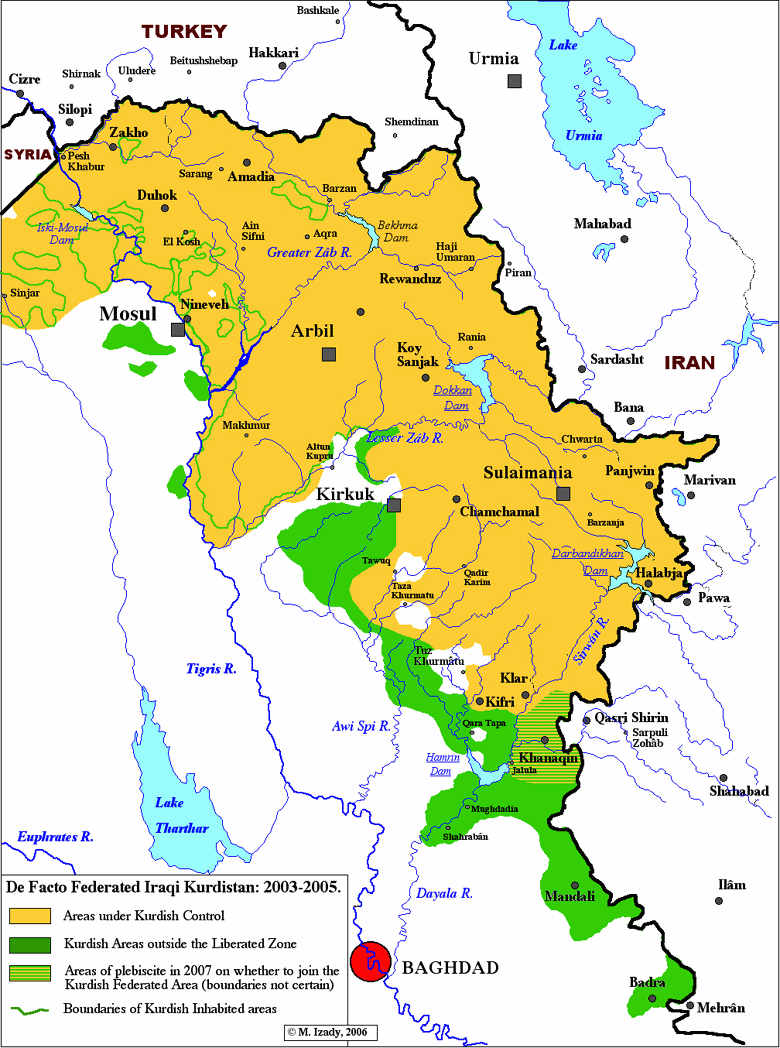
Steve DeAngelis of ERMB has been posting from (and about) Kurdistan in Iraq the past week while on a visit for Enterra Solutions. Collectively, Steve's posts provide in- depth, on-site, analysis of Kurdistan's present and future prospects with an emphasis on regional and global economic integration, security and systemic resilience; here they are in chronological order:
1. An Overview of Kurdistan
2. Resilience in Kurdistan
3. 3 days in Iraq from the Syrian/Turkish border to the Iranian border
4. Lessons from the Edge of Globalization: 3 days in Iraq from the Syrian/Turkish Border to the Iranian Border
5. Security in Kurdistan
(There were also several other Iraq-related posts "Interagency Feuding Over Iraq Reconstruction" and " Coffee for the Troops")
It would be difficult for me to briefly summarize in a mere paragraph what DeAngelis has impressively written about Kurdistan being on the " Edge of Globalization" in roughly 6000 words. Therefore, I'm going to pick out a number of select excerpts that give the feel of the sum of Steve's observations, followed by my commentary:
"We then headed further west to the border crossing checkpoint with Turkey. We entered a small U.S. military post on the border and saw how this border is managed. Completely full trucks, stretching for miles into Turkey loaded with any product you can imagine are seeking to deliver their products to buyers in Iraq. However, on the opposite side of the border another story unfolds. There is a two week wait (yes, I said two weeks!) for trucks coming from Iraq to cross into Turkey. Along the road are makeshift housing facilities equipped with satellite dishes that drivers can use during their two-week wait along a dusty and dirty road that moves trucks from one holding pen to another as they creep up to the border inspection stations in Iraq and then to their equivalent inspection stations in Turkey....
I'd be curious to know how much of this Turkish inefficiency is explicable due to legitimate security issues with the PKK, how much is due to local corruption, understaffing and incompetence and how much is calculated policy on the part of Ankara to choke Kurdish economic growth.
....Virtually all of the trucks crossing back into Turkey from Iraq are completely empty. If there were robust manufacturing and other commercial business operations in Iraq, these trucks would be full of products to be sold in Turkey and to the rest of the world as they transit through Turkey’s ports. The only kind of trucks that do cross fully loaded are 3,000 gallon tankers filled with Iraqi oil destined for a Turkish power generation facility just over the border. The electricity produced by the plant is sold back to the Iraqi’s at western market rates. What this obviously says is that Iraq has the raw materials but does not possess the production capability to turn oil into electricity and as such pays a tremendous financial and strategic price for this lack of capacity. The net result of this border crossing reality is a Current Account trade imbalance of almost 100% between Turkey and Iraq"
Steve is correct that this ad hoc mercantilist trade scenario is problematic for Kurdistan. Historically, nations that are raw commodity exporters, regardless whether it was cotton, rubber, oil, strategic minerals or foodstuffs end up in a unfavorable position vis-a-vis value-added production trading partners or merchant capital states. This applies whether we are discussing Ptolemaic Egypt and ancient Rome or the Gulf states today and the Core.
One caveat on the negative trade balance issue for Kurdistan would be the financial flows of Black Globalization. Lacking orderly markets and effective governance, ordinary Iraqis rely upon the black market for access to desired luxuries as well as necessities such as medicines or spare parts for machinery. Controlling a long border with Turkey, Iran ans Syria gives Kurdish actors the ability to become middlemen in the flow of goods and money which does not show up on the legal balance sheet. Ultimately, Barzani and Talabani's regional Kurdish government must bring this trade above ground and normalize the economic relationships ( include taxes and customs duties).
"The Peshmerga welcomed U.S. forces and fought side-by-side with them in the effort to overthrow Saddam Hussein. It is estimated that there are between 80,000 and 100,000 active Peshmerga in Kurdistan. As the attached picture of a Peshmerga soldier taken near Dohuk shows (click to enlarge), the Peshmerga are a modern and well-equipped fighting force. The Peshmerga also allow women to serve. This tradition began when the Peshmerga were a guerilla force fighting to make the Kurdish area of Iraq a safe haven. Women also fought alongside coalition forces at the beginning of the current conflict. The attached picture shows female Peshmerga celebrating the fall of Kirkuk. "
The Peshmerga have been a coherent military force(s) far longer than I have been alive. Or Steve Deangelis for that matter. Or probably any of my readers. (The ferocious and mercurial Mustafa Barzani, sire of Massoud Barzani, the Kurdish president and KPD chieftain, was once the darling of American conservatives who hated Henry Kissinger. And long before that, tribal lord Barzani was the protege of... Joseph Stalin ! History has made the Kurds the ultimate realists). Former CIA field operative in Kurdistan Robert Baer put the Peshmerga fighting credibly toe to toe with Saddam Hussein's best Republican Guard divisions during the 1990's. That ain't hay folks. Even in the 1990's decline the Republican Guard was heavily armed and well-trained, despite being hamstrung by Saddam's increasing paranoia.
The Peshmerga are perfectly suited for 4GW warfare as they combine tight military discipline, clan networks and strong primary loyalties with concurrent conventional and guerilla warfare skills. They also benefit from American patronage and a leadership that has proven unusually adept at presenting an image and engaging in politics in the international arena.
"Another new friend, Subbas Sircar, who is the regional vice president of AIG for the Middle east, Mediterranean and South Asia, had an interesting morning meeting with local bankers. They are seeking to expand and strengthen local banks as I discussed earlier. This group craved exposure to current international banking best practices, core banking information technology and know-how that would allow them to connect to the global banking industry as well as the training and education that would allow staff members to raise themselves up to a minimal level of maturity so they can foster commerce in their region. This experience with bankers in Sulaimaniyah and in Erbil, along with the telecommunications companies seeking the same capability in their industry, are proof positive of the need for Development-in-a-Box™."I think Steve is identifying a critical tipping point for Kurdistan. Leapfrogging the bazaari mentality to create a financial structure that inspires enough confidence to attract and sustain legitimate foreign investment and diversify Kurdish reliance on Turkish capital and American aid would be a milestone. This probably would not mean " best practices" in the sense of Chase Manhattan so much as " best enough practices" relative to the region. " Good enough" is what gets a healthy level of local economic growth going. " Best" can wait for the day the Republic of Kurdistan applies for admission to the WTO and the EU.
Today, Kurdistan is a nation with a virtual state shepherding its interests. More than Hezbollah in Southern Lebanon, the regional government in Kurdistan is less than Taiwan. But like Taipei, the Barzani-Talabani regional government seeks to negotiate or leverage de jure status and the full sovereignty of statehood over the virulent objections of a powerful neighbor and a nervous American patron. Economic development and integration with other global power centers ( EU, China, India, Japan, Russia) will be the key for the Kurds to create a scenario where Ankara can swallow - however bitterly, even with with ironclad security guarantees - Kurdish independence, because it will be in Turkey's economic best interests to do so.
LINKS:
"Kurdistan Rebalancing the Middle-East" and "Iraq Travel Guide" by Chirol
"The Kurdistan Problem: Part I ", "The Kurdistan Problem: Part II", "The Kurdistan Problem: Part III" by midtowing at ProgressiveHistorians"Response to Virtual Nations Will Shape World Order or Disorder" by Adrienne Redd
"The Rise of the Virtual StateWealth and Power in the Coming Century" by Richard Rosecrance
"Market-state vs. Virtual State" by John Robb
Labels: connectivity, core, deangelis, foreign policy, gap, iraq, kurdistan, military contractor, PNM, resilience, state building, virtual states
¶ 12:00 AM 3 comments
Check out the My State Failure Blog - certainly a concept whose time is come. ( Hat tip to tequila )
Labels: blogosphere, foreign policy, gap, small wars council, state building, state failure, system administration
¶ 7:07 AM 0 comments
(Cross-posted at Chicago Boyz)
One of the sharpest points of contention between Thoms P.M. Barnett and John Robb is over the feasibility of Tom's System Administration concept. This issue has been the topic of numerous posts and the occasional rhetorical jab between the two strategic theorists. This pattern repeats itself, in my view, for a number of reasons. First, even friendly professional rivalry causes a natural bumping of heads; secondly, Robb looks at a system and thinks how it can be made to fall apart while Barnett looks at the same system and imagines how the pieces can be reintegrated. Third, no one really has all the answers yet on why some states fail relatively easily while others prove resilient in the face of horrific stress.
Robb contends that Global Guerillas can potentially keep a state in permanent failure, despite the best efforts of System Administration intervention to the contrary. A new level of systemic collapse, call it State Failure 2.0, where failure constitutes a self-sustaining dynamic. Broadly defined, you would chalk up " wins" for Robb's point of view in Somalia, Iraq and the Congo. In Dr. Barnett's column you would find Germany, Japan, Cambodia, East Timor and Sierra Leone in evidence for the efficacy of Sys Admin work. Lebanon and Afghanistan perhaps could be described as a nation-building draw at this point in time.
Why permanent failure in some cases but not others ? This is something that long puzzled me. Then today, I read an intriguing pair of posts at Paul Hartzog's blog - " Ernesto Laclau and the Persistence of Panarchy" and " Complexity and Collapse". An excerpt from the first post:
"Ernesto Laclau was here @ UMich and gave a delightful talk that gave me some key insights into the long-term stability of panarchy.
...However, with the new heterogeneity of global social movements, Laclau makes the point that as the state-system declines, there is no possibility of the emergence of a new state-like form because the diverse multitude possesses no single criterion of difference around which a new state could crystallize.
Thus, there is no possibility of a state which could satisfy the heterogenous values of the diverse multitude. What is significant here is that according to this logic, once panarchy arrives, it can never coalesce into some new stable unified entity.
In other words, panarchy is autopoietic as is. As new criteria of difference emerge and vanish, the complex un-whole that is panarchy will never rigidify into something that can be opposed, i.e. it will never become a new hegemony. "
While I think Paul is incorrect on the ultimate conclusion - that panarchy is a steady-state system for society - I think he has accurately described why a state may remain " stuck" in failure for a considerable period of time as we reckon it. Moreover, it was a familiar scenario to me, being reminiscient of the permanent failure experienced by the global economy during the Great Depression. Yet some states pulled themselves out of the Depression, locally and temporarily, with extreme state intervention while the system itself did not recover until after WWII with the opposite policy - steady liberalization of international trade and de-regulation of markets that became globalization.
The lesson from that economic analogy might be that reviving completely failed states might first require a " clearing of the board" of local opposition - defeated Germany and Japan, Cambodia, Sierra Leone and East Timor were completely devastated countries that had to begin societal reconstruction at only slightly better than ground zero. Somalia, Afghanistan, Congo, Iraq, and Lebanon all contain robust subnational networks that create high levels of friction that work against System Administration. At times, international aid simply helps sustain the dysfunctional actors in their resistance.
System Administration as a cure for helping connect Gap states might be akin to government fiscal and monetary policy intervention in the economy; it may work best with the easiest and worst-off cases where there is either a functional and legitimate local government to act as a partner or where there is no government to get in the way and the warring factions are exhausted.
The dangerous middle ground of partially failed states is the real sticking point.
Labels: analogy, barnett, complexity, globalguerillas, hartzog, natiuon-building, networks, panarchy, robb, state building, state failure, system administration, theory
¶ 9:19 PM 10 comments