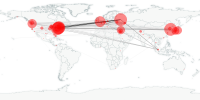
La Cosa Nostra, the Italian mafia of Big Al Capone and Lucky Luciano is on the skids these days.:
"The mob's frailties were evident in recent months in Chicago, where three senior-citizen mobsters were locked up for murders committed a generation ago; in Florida, where a 97-year-old Mafioso with a rap sheet dating to the days of Lucky Luciano was imprisoned for racketeering; and in New York, where 80-something boss Matty "The Horse" Ianniello pleaded to charges linked to the garbage industry and union corruption.
Things are so bad that mob scion John A. "Junior" Gotti chose to quit the mob while serving five years in prison rather than return to his spot atop the Gambino family.
At the mob's peak in the late 1950s, more than two dozen families operated nationwide. Disputes were settled by the Commission, a sort of gangland Supreme Court. Corporate change came in a spray of gunfire. This was the mob of "The Godfather" celebrated in pop culture.
Today, Mafia families in former strongholds like Cleveland, Los Angeles and Tampa are gone. La Cosa Nostra — our thing, as its initiates called the mob — is in serious decline everywhere but New York City. And even there, things aren't so great: Two of New York's five crime families are run in absentia by bosses behind bars.
....The oath of omerta — silence — has become a joke. Ditto for the old world "Family" values — honor, loyalty, integrity — that served as cornerstones for an organization brought to America by Italian immigrants during the era of Prohibition.
"It's been several generations since they left Sicily," says Dave Shafer, head of the FBI organized crime division in New York. "It's all about money."
At the peak of the mafia's power, the 1950's, it had only 5000 "made" members but it was deeply entrenched in a powerful national labor movement, was entwined in a numerous big city Democratic machines ( notably Chicago's notorious old 1st Ward, where Sam "Momo" Giancana's minions hustled out the ghost vote for JFK) and enjoyed the tolerance of the immensely powerful FBI Director J.Edgar Hoover, who had a taste for the track and shady associates in his off-hours. The mafia not only had mystique and physical force at their disposal, they had the political juice, having in classic Boydian fashion, strategically connected themselves to as many other centers of power as possible.
What happened to the Mob sbsequently is a lesson for all those who study the potential of networks vis-a-vis states. Despite their fluidity and adaptivity, networks are not ten feet tall. They can be disconnected and isolated. Their internal cohesion can be disrupted. Their OODA loops can be disoriented and only in the rarest of circumstances can networks stand toe-to-toe in the open with the massive power of state hierarchies. They are beatable with patience, strategic thinking, consistency and time.
Labels: 4GW, history, john boyd, network theory, networks, transnational criminal organization
¶ 6:48 PM 2 comments


In Part I. , we looked at John Kao's call for a more innovative America and Howard Gardner's analysis of the mindsets that would be required for creative, innovative endeavors. In Part II. we continue with the analysis of Frans Johansson in The Medici Effect .
Blogfriend Steve DeAngelis of ERMB has referenced The Medici Effect many times in the past two years; in his initial post on Johansson's work, Steve gave a superb summary of the Medici Effect concept:
"In his very interesting book The Medici Effect: Breakthrough Insights at the Intersection of Ideas, Concepts, and Cultures, Frans Johansson talks about the value of creating a space in which people from diverse fields of expertise can get together to exchange ideas. The Medici's, of course, were a wealthy and powerful Italian family who played an important role in the Renaissance. The family's wealth permitted it to support artists, philosophers, theologians, and scientists, whose combined intellect helped burst the historical pall known as the Dark Ages"
Johansson's thesis is that breakthrough innovation is generated most frequently at "the intersection" where two or more different domains meet rather than by predictable, linear, improvements within one field (" directional innovation"). Intersectional opportunities are increasing, Johansson argues due to increased migration, trends toward scientific consilience and ready access to the improved computational tools of the information revolution.
In The Medici Effect, Johansson tackles both cognitive tools as well as social environment that facilitate innovative thinking and productivity. Like Edward DeBono's lateral thinking exercises, Johansson encourages conscious and methodical attempts to find novel, intersectional, combinations of concepts; he points to cultivating an autotelic mindset; reversing one's premises to smash through "associative barriers"; using multiperspectivalism ( agreeing here with Howard Gardner); and defusing the social factors that inhibit organizations from effectively brainstorming. These are all solid suggestions, though most have been made elsewhere as well.

More attention is paid in The Medici Effect to the social environment that is interactive with the innovator in helping to create a climate conducive to synthesis and the generation of insight. moreover, Johansson identifies the creation of a dynamic and stimulating "community"as a critical factor for sustaining an innovation:
"Garfield offer's two reason for Magic's [ a sword & sorcery card game that was a cult hit] success: a prolonged and exciting learning phase and an expanding community of players. Examined closely, you will see that he is talking about the intersection of games and collectibles"
Gaming is itself, a very powerful tool for teaching adaptive thinking skills and for driving the assembly of a " value network" that can be turned toward productive purposes. Indeed, Johannson spends a great deal of time discussing the potential of these networks to function as a two-edged sword in regard to innovation. Moreover, the social and financial organization clustered around the innovator can be determinative in the success of the innovation in a way that is wholly counterintuitive, according to Johansson. Excess support brings restrictions in the form of vested interests from old value networks, stigmatizing failures that are a necessary part of the learning curve and blunting internal motivation with the distracting prospect of extrinsic reward. There is cognitive strength in " staying hungry" and needing to stretch resources with value-added thought ( see Don Vandergriff's Raising the Bar).
What Is To Be Done?:
Looking elsewhere, like The Smithsonian Magazine's "37 under 36 Young Innovators" we see many mining Johansson's intersections or using Gardner's Synthesizing and Creative Minds but these bright folks are social outliers. What we need is re-engineering of institutional cultures and structures, particularly that of our educational system to balance the development of analytical prowess with generative, creative, synthesisizing, capacities. John Hagel recently had a post at Edge Perspectives with a number of sage suggestions for driving innovation:
"Diversity. As Scott Page and others have persuasively suggested, new insight and learning tends to increase with cognitive diversity. This principle highlights the importance of designing institutional arrangements that extend well beyond a single institution, with particular attention to the opportunity to connect to diverse pools of expertise and experience. Diversity can often be enhanced by connecting into spikes – geographic concentrations of talent – and by targeting “brokers” within social networks, creating a multiplier effect in terms of the number of participants that are potentially accessible.
Relationships. It is not enough to have cognitive diversity. By itself, cognitive diversity often breeds misunderstanding and mistrust, seriously limiting the opportunity for people and institutions to learn from each other. Long-term trust based relationships, on the other hand, make it easier to engage in productive friction – the clash of diverse perspectives in ways that produces deep new insight and learning. The challenge is that these kinds of relationships often take a long time to develop and are hard to scale. Innovative institutional arrangements can help to accelerate and scale the formation of these kinds of relationships.
Modularity. When activities are tightly specified and hard-wired together, the opportunities for experimentation and tinkering are very limited. Segmenting people and activities into discrete modules with well-defined interfaces can help to create much more space and opportunity for distributed innovation and learning."
Read the rest here.
In practical terms, what does this mean for schools, corporations, universities and governments ? In my view, "hard-wired" hierarchy with rigid requirements, stiff penalties and centralized decision-making is going to have to be relegated to niches in the future rather than being the dominant form of organization that it is today. Hierarchy, with it's mania for control and accountability, remains useful for transactional delivery systems upon which reputations depend, logistical flows upon which production processes depend and security procedures upon which safety may depend. That being said, hierarchy will have to yield to more lateral, more collegial, more networked, more ecologically oriented models of connectivity where the generation of new ideas represents the lifeblood of an organization.
Hierarchy is Newtonian; Free Scale and Modular Networks are Darwinian. An innovation nation is, by definition, adaptive.
ADDENDUM:
Sir Ken Robinson " Do Schools Kill Creativity?"
Labels: creativity, culture, education, futurism, hierarchy, horizontal thinking, howard gardner, ideas, innovation, insight, intellectuals, metacognition, network theory, networks, synthesis
¶ 8:05 PM 2 comments
Social networking theorist/mapper Valdis Krebs, has a blog, Network Weaving. How'd I miss that one ?
Hat tip to Der Shlokmeister.
Labels: network theory, networks, shloky, social networks, valdis krebs
¶ 8:50 PM 2 comments
Very seldom do I ever lift something from the archives, but I came across a guest-post I did a number of years ago for blogfriend Josh Manchester at his now defunct The Adventures of Chester blog. The basic content of the post has held up fairly well, though some of the original links that supported the data have since vanished ( reminding me that links are really, really, transient but a footnote is forever); most of the economic data came from NIC/CIA.gov PDFs that have been moved or removed from the web, so take that for what it is worth (the dollar figures are more than stale now, regardless):
"BLACK GLOBALIZATION AND SMALL WARS
When Saddam Hussein emptied his prisons prior to the Iraq War it seemed at the time a sign of his regime’s impending doom. Either Saddam’s amnesty was an act of desperation to shore up support among the Iraqi people or his grip on power had so weakened that he had lost control even over elements of his own security apparatus. In actuality, the dictator had made a preemptive asymmetrical strike against American forces by releasing Iraq’s professional criminals whose well-organized networks badly undermined the CPA and today are connecting an otherwise heterogeneous insurgency. Although this move ultimately did Saddam Hussein little good it demonstrated the potential power that “Black Globalization” has to effect the outcome of military interventions, even those of the United States.
It’s rather strange that given our history, American intelligence did not forsee this outcome in Iraq. It was the United States government that used the Mafia of Charles “ Lucky” Luciano to gather naval intelligence, suppress sabotage on the dockyards and enlist the Sicilian Mafia to undermine Mussolini’s rule to soften the island for Allied invasion. WWII however was the age when nation-state control and the exercise of sovereignty and economic autarky were at their zenith and non-state actors like criminal syndicates were peripheral to events.
Today, the strategic situation is vastly different. The relative primacy of nation-state sovereigns has been eroded by globalization that opened their economies and borders to greater flows of “connectivity” and challenges to their political legitimacy mounted by international, transnational and subnational actors. Some of these, the WTO or the internet for example, at least have brought tremendous benefits. Not so the metastasis of transnational criminal networks that constitute black globalization and have an economic reach that in the aggregate, rivals the greatest of regional powers and are centered on a few geographic nexus points. A sampling of annual estimates:
Governmental Corruption $ 500 billion
Global Narcotics trafficking $ 400-500 billion (matching or exceeding U.S. Defense budget)
Conflict Diamond trafficking $ 24 billion/ 10 % world market
Human Trafficking $ 7 billion
Stolen Automobile Smuggling $ 9 billion
Piracy ( maritime) $ 16 billion ( high end estimate)
Even leaving aside minor or hard to estimate contraband markets or legal “ gray “ markets like international arms dealing, these revenues are enough to field armies or acquire the most expensive technology to evade capture or launch asymmetrical attacks on state forces.
Clearly, the days when even a weak state ruler like Ngo Dinh Diem could scattter a criminal organization with a whiff of grapeshot are over. Expeditions into failed Gap states like Somalia or major military invasions of countries like Iraq must take Black Globalization networks into account during strategic planning as they would subnational or even full-fledged state actors. In terms of on the ground, policy, options for U.S. policy makers and commanders for engaging these networks would include:
Alliance ( Luciano Model)
Benign Neutrality ( Transactional Model)
Armed Neutrality ( Deterrence Model)
Active Containment ( Limited military action)
Belligerence (Counterinsurgency model)
Ideally, the U.S. would seek to prevent the Black Globalization network from actively aligning itself with the enemy and avoid direct engagement to suppress the network until the primary mission was accomplished. Imagine the state of Iraq today if the criminal networks were working hand in glove with American and Iraqi troops to root out the insurgency instead to aid the insurgents against coalition forces. Circumstances, however may not always prove to be so simple, corrupt and violent networks being what they are, any negotiated result is at best transient.
A second indirect form of pressure could be exerted on the money laundering aspect of Black Globalization which must at some point attempt to “ clean” their cash flow through or by acquiring legitimate banks and financial markets in Western countries. Strategic financial attack was evidently taken against the major backers of Slobodon Milosevic during the Kosovo War with positive results. Exploiting this avenue might require that the Marines have more than just a few good accountants, a genuine financial intelligence service would be required to maximize effectiveness.
The complexity of small wars is almost enough to make diplomats and generals long for the good, old days of the Warsaw Pact. Almost. "
Labels: best of zenpundit, black globalization, brave new war, COIN, foreign policy, globalization, IC, insurgency, iraq, military, networks, piracy, small wars council, transnational criminal organization
¶ 7:24 PM 4 comments
New article in The City Journal by John Robb.
John is in the important post-publication stage of proselytizing his work and worldview which he introduces well to City Journal readers. As someone more familiar with Global Guerillas, I especially liked John's neat summative explanation of networks, tight coupling and cascading effects in a social-political-economic-infrastructural complex system.
Network theory is one of the key concepts for the intelligent public to understand for the 21st century.
Labels: 4GW, complex systems, complexity, global guerillas, john robb, network theory, networks, social networks, terrorism
¶ 8:35 AM 0 comments
"It shall be the policy of this Nation to regard any nuclear missile launched from Cuba against any nation in the Western Hemisphere as an attack by the Soviet Union on the United States, requiring a full retaliatory response upon the Soviet Union."
- John F. Kennedy, President of the United States
"Acquiring weapons for the defense of Muslims is a religious duty. If I have indeed acquired these weapons, then I thank God for enabling me to do so. And if I seek to acquire these weapons, I am carrying out a duty. It would be a sin for Muslims not to try to possess the weapons that would prevent the infidels from inflicting harm on Muslims."
-Osama bin Laden, "amir" of al Qaida
Both the Soviet Union and the United States amassed immense nuclear arsenals during the Cold War of approximately 50,000 warheads of various sizes and a range of systems with which to deliver these terrifying weapons. A number of other second and third tier states later joined "the nuclear club", seeking a hedge against regional enemies or desiring the totemic status in international relations brought by possession of nuclear arms.
None of these states, not even Israel which is reputed to have up to 200 nuclear bombs, ever developed a nuclear weapons capability that remotely matched that of the superpowers. A number of nuclear-capable states have either eschewed building nuclear weapons (Germany, Japan, Taiwan) or have been persuaded to disarm those that they had inherited or assembled ( Belarus, Ukraine, Kazakhstan and South Africa).
So lopsided are the throw-weight ratios between countries with small yield or primitive atomic weapons and the stockpiles retained by the U.S. and Russia that most of the nuclear club have arsenals that are useful only for deterring a military attack from their immediate non-nuclear neighbors or a nuclear peer. Pakistan's nuclear status was of no help in warding off American demands after 9/11; had Islamabad attempted to brandish, much less use, nuclear weapons in defense of their Taliban clients, it would have surely invited Pakistan's immediate destruction.
Cheryl Rofer of Whirledview, had a post "The Necessity of the U.S. Nuclear Deterrent: A White Paper" that analyzed a recent quasi-official document “White Paper on the Necessity of the U. S. Nuclear Deterrent” authored by a cluster of national security VIPs, including several past CIA directors and current advisers to the US Strategic Command. The paper summarizes many obvious points about American nuclear deterrence and calls for a " debate". Cheryl found the paper to be lacking:
"No real threat assessment is offered, just vaguely threatening words about Russia, China, North Korea and Iran. For a group of folks trying to move out of the Cold War mindset, that’s an interesting ordering of countries.
....Is the white paper saying that US nuclear policy is only about deterrence? Nothing about the Nuclear Nonproliferation Treaty and its obligations? Nothing about the uselessness of deterrence against mobile subnational groups with no territory to defend? The only thing that is important to our allies is US security assurances, backed up by the threat of nuclear warfare?
....This white paper is stuck in the the Cold War, circa 1969. "
I think the white paper authors are correct that the perceived credibility of American nuclear guarantees dampen down potential nuclear arms races among third parties, notably in Northern Asia. Cheryl however, is correct on the larger point that the analytical assumptions of the paper are shot through with Cold War legacy mentalities.
Arguably, the white paper does not even match the Cold War era in terms of nuanced thinking. In 1958, in Nuclear Weapons and Foreign Policy, Henry Kissinger wrote:
"It is the task of strategic doctrine to strike a balance between the physical and the psychological aspects of deterrence, between the desire to pose a maximum threat and the reality that no threat is stronger than the belief of the opponent that it will in fact be used. A strategy which poses alternatives that policy-makers are unwilling to confront will induce either inaction or improvisation. A strategy which establishes a superior balance between power and will may then gain a crucial advantage, because it permits initiative and shifts to the other side the risks inherent in making countermoves" (Kissinger, 175)
CKR aptly pointed out the obvious alternative of non-state and subnational actors with nuclear weapons that the white paper's authors were " unwilling to confront" in their state-centric focus.
Here are a few others that would relate to the state of American deterrence, enhancing or undermining it:
* Potential, novel, weaponization of of aspects of nuclear particle research outside classic uranium 235 and plutonium bombs.
* The need for more effective controls and tracking of trade in esoteric, dual-use, technologies of weaponization that make nuclear devices useful militarily. Increasing transparency level of same.
*Identifying non-nuclear technologies that could result in weapons of a comparable order of magnitude of destruction or loss of life as with low-level nuclear weapons.
* Strengthening and expanding the inspections regime under which NPT signatories are permitted access to nuclear technology for peaceful purposes. Addition of automatic penalties if NPT signatories are caught cheating, subject to removal or waiver by the UNSC ( putting the burden on the accused proliferator to come clean instead of on the IAEA or UNSC states to get any meaningful sanctions applied).
* De-escalating the potential for future conflict between nuclear and nuclear capable states by instituting new regional diplomatic and security structures.
* International nuclear convention regarding the security of nuclear materials and command and control by the nuclear weapons states.
* Moral-political-legal campaigns that degrade the credibility of American deterrence by ratcheting upward the "unthinkability" of nuclear weapons use, thus tempting potential adversaries to risk the very brinksmanship scenarios ( war, apocalyptic terrorism) that would make the use of nuclear weapons possible or likely.
* Avoiding "nuclear weapons deflation" as an unintended consequence of arms control. Striking a balance between reducing large American and Russian arsenals and unduly increasing the military value of small ones and the temptation to increase them in order to reach "parity" with America and Russia ( "linkage" for all nuclear club arsenals). Or worse, the temptation to sell or use them.
* Removal of strategic nuclear materials from the global black market by vastly accelerating certified destruction or reprocessing of obsolete national stocks.
* Developing new models of deterrence that would be concurrently perceived as credible by states, non-state actors and subnational/ transnational networks who may all be within an interdependent nexus of responsibility for a catastrophic WMD attack.
* Identifying and categorizing non-state network threats to American security with potential WMD capacity.
* Understanding the parameters of the possible in terms of private networks and WMD capabilities, through intellectually honest red team exercises.
* Examining the balance of utility between emphasizing clarity and uncertainty in American nuclear response and deterrence policy in a multi-polar and non-state actor era.
Many of my variables are not new but they are of at least more recent vintage and of a broader horizon than what the white paper has considered. I'm interested in hearing your thoughts as well.
Labels: 21st century, al qaida, America, arms control, CKR, deterrence, diplomacy, military, networks, nuclear, terrorism, war, whirledview, youtube
¶ 12:38 PM 7 comments
I'm preparing to leave town on another trip and find myself overstretched in terms of time but I have to note that Kent's Imperative had some intriguing posts up ( hat tip to Michael Tanji) , about which I'd like to offer a few comments:
"Life at Google from an outside perspective"
Aside from seeing how uber-techies live and making me nostalgic about past years of reading defector-dissident Soviet bloc lit, I'd like to highlight this passage regarding a KI suggestion to the IC for personnel reform:
"A chance for line level workers to do the kind of intel they want to do (versus the latest crisis they have been thrown into), at least part of the time? Or to contribute to the literature of intelligence? (Modeled along Google’s 20% time.)"
My unqualified guess is that this would increase the productivity and prescience of the IC by roughly the same proportion that expanding private farming helped the Chinese economy under Deng Xiaoping. People typically generate their most valuable insights about those subjects which they are both curious as well as passionate - i.e. earlier in the learning curve than the status of graybeard authority ( once you think you know everything, you tend to stop learning).
The bar to doing this is not a manpower shortage but a middle-management fear of subordinate autonomy. Forcing a talented subordinate to do irrelevant busywork confirms a manager's authority and power. Autonomous subordinates who do self-directed productive work tend to confirm the irrelevance of middle-management. Few managers have the psychological wherewithal to be adept facilitators, mentors or coaches of gifted employees as an efficient "management" outlook is an inimical perspective to generating creativity and sustaining " unproductive" exploration.
"Regional versus functional issue accounts"
From a historian's perspective, a cool post ( perhaps less interesting to others). Some historiography, lots of methodology. Money quote/conclusion:
"As for our opinions on the great divide between the two kinds of houses, we find ourselves veterans of uniquely transnational issues, having been subject to every manner of surge and task force and working group and crisis cell, in the most unusual of niches. We prefer to see small, aggressive, ad-hoc structures comprised of both analysts and operators from a wide range of issues and regional desks with interests and equities in the same target which overlaps their accounts. Only then, by throwing everything against the wall in a structure short lived enough to avoid its own bureaucracy, and disconnected enough to be (at least partially) immune from the day to day politics within a given agency or office, have we found the kind of answers we sought regarding the great questions of process.
We strongly believe such radically unstable and short lived environments are most effective because they are the very manifestation of Schumpeter’s process of creative destruction. It is certainly no way to create a sinecure, nor even to build a long term career path – but it is the best way we have found to generate new and innovative approaches and answers to hard target problems, and to the problems others have not yet begun to identify let alone address."
Hear, Hear! Very strong agreement in a John Arqilla-esque vein.
It will happen but not until after several more disasters force that kind of transformation or an unusually bold and subtle visionary implements it on the quiet. There is far too much bureaucratic inertia because the vested interests prefer paralysis in which they hold the reins to successful action where they become recognized for the marginalized support staff they really are.
In my turn, if any KI gents happen upon this post, I suggest they look here. From this acorn of an idea, an oak will grow. Mark my words.
Labels: analytic, CIA, haft of the spear, IC, ideas, innovation, insight, intelligence, kent's imperative, networks, social networks, synthesis, tanji, theory, visualization
¶ 8:25 PM 3 comments

At the behest of Critt, I'm now on twitter as a complement to the blog. Sean and Dan are with me so at least I'm not out there shouting into the wind.
I'll give twitter a fair trial. The geek world, of which I claim no membership in due to technical incompetence and sheer lack of time to fully investigate, seems to be very excited about this app ( though not everybody). Rick Klau (previous link) called it "micro blogging" which I think is probably a sustainable, cognitive format for holding attention, moreso than "hey...I'm going to take a shower now" type messages, which would become a tyranny of the mundane once the novelty of using twitter wears off.
We get a mental "charge" or arousal from connectivity with another personwith the social networking aspect but without some kind of interesting content to sustain the connection, our attention is apt to wander.
Labels: blogging, cognition, networks, social networks, twitter
¶ 7:35 AM 0 comments

A fascinating economics paper sent to me by Fabius Maximus (hat tip accorded) that took me a few days to get to reading. Wish I had looked at it earlier:
"An-arrgh-chy: The Law and economics of Pirate Organizations" (PDF) by Dr. Peter T. Leeson
Peterson argues that historical pirates, far from being Hobbesian outlaws, governed themselves with rule-sets that minimized conflict and maximized cooperation and profit ( albeit at the expense of civilized seafaring states). Looking at broad principles of functionality, Leeson's work is applicable to other violent non-state actors - Latin American drug cartels, 4GW insurgencies and terror networks, warlord and sectarian militias, Bunker's 3 Gen gangs, TOC groups like Chinese Triads and Russian mafiya and so on.
This argument struck a chord with me on two points. First, it mirrors the historical experience of traditional Russian banditry where robber chieftains ruled over there fellows according to "Thieves Law", something Solzhenitsyn discusses at length in The Gulag Archipelago.
Secondly, network theory research indicates that small systems that seem chaotic or "noisy" actually develop emergent rule-sets that bring the system into an orderly pattern, even if the rules and patterns are very simple ones. A pirate ship, even a fleet, much like a terrorist network, is simply a small, complex, social network. Rules accepted on a consensual basis cut down on " noise" and allow the network to become more efficient.
A must read.
Labels: economics, fabius maximus, navy, network theory, networks, non-state actors, piracy, social networks, terrorism, theory, transnational criminal organization
¶ 7:25 PM 2 comments
Ok, just started the first chapter in each, so I have little to say - but here they are!

Wikinomics

Medici Effect

Wealth of Networks
They have reinvigorated my interest in a currently moribund collaborative project with Dr.Von (hmmm...his blog seems a touch moribund as well- political office must be eating up all his time LOL!) Perhaps, if I can get some serious momentum going on it this summer, he'll hop back on the bandwagon.
Labels: book, business, complex systems, complexity, consilience, creativity, economics, horizontal thinking, medici effect, networks, social networks, theory, wikinomics
¶ 10:18 AM 3 comments

About time.
FORBES - "Special ReportNetworks"
(Hat tip to Dave Davison)
Labels: davison, forbes, networks, social networks
¶ 7:21 PM 0 comments
Tech guru Ross Mayfield has an important post "Social Technographics and a Power Law of Participation" that would be of interest to most serious bloggers. In it, Mayfield analyzes the results of a demographic study that examined the nature and degree of interactivity of participation on the Web, displayed in the visual hierarchy below:
A closer look at Mayfield's visualization can be found here at Flickr
An excerpt:
"I still contend that a more ideal community is scale free in structure. What I wonder is if you could benchmark these levels of engagement against a power law -- not just to test Forrester's findings, but to help a given company realize -- "we are under-weighted in critics!"
LOL! I agree. Try to love your critics. Even when they are dead wrong they are the ( sometimes irritating) guides toward truth.
On a personal level, I am a creator and a critic foremost, followed closely by spectator. I dip my toe in being a joiner and I am not a collector at all. I'm not sure why this is. I had a bloglines account and then a blogbridge aggregator and both fell into immediate disuse. I don't subscribe to a single RSS feed and I've been told that mine malfunctions a lot. I don't do digg or that delicious thing and I understand neither. Recently, eerie, the mistress of the group blog Aqoul indicated she kept track of about 240 blogs(!). My hat is off to her, I can't muster that kind of interest.
How about you ?
Labels: blogging, computers, creativity, flickr, futurism, networks, ross mayfield, social networks, tech, visualization, web 2.0, youtube
¶ 10:33 AM 3 comments
"Follow up on this vein of research suggests that as the task gets more complex, that decentralized networks actually do better than centralized. An interesting and relevant critique of this research, by Guetzkow and Simon (1955), was that all-channel networks can and do sometimes perform better than hub-spoke networks. That is, the performance of all channel networks was contingent on how they were used. The original Bavelas findings were based on the fact that they were usually used badly."
- David Lazer
"Bavelas revisited: hub-spoke vs all-channel networks" at Complexity and Social Networks Blog
Sounds reasonable to me. If you have ever been part of a team that seemed to reach a moment of " flow" where everyone was intuitively "in synch" in handling a creative or complicated performance task, then that dynamic probably "felt" much like the findings of the research described by Lazer.
Applicable, it seems to me, to any " free play" group learning scenario - whether it be small unit combat, improv theater, team sports and many others.
Labels: complexity, complexity and social networks blog, david lazer, networks, social networks, tribes
¶ 7:14 PM 0 comments
Brave New War by John Robb is a book that was really written for two audiences.
The first is the relatively small number of specialists in military affairs, serious students of geopolitics and bloggers who are already avid readers of Robb’s Global Guerillas site. For them, Brave New War is a systematic and footnoted exposition of the theories of conflict and “dangerous ideas” that Robb discusses daily on his blog. They will be entertained and challenged by the same analysis that makes them return again and again to Global Guerillas to debate John Robb and one another.
The second audience is composed of everyone else. Brave New War is simply going to blow them away.
Brave New War is a tightly written, fast-paced work on the emergent nature of warfare, conflict global society with a decidedly dystopian take. In a mixture of original ideas and synthesis of the works of other cutting edge “thought leaders”, Robb, a platform designer and former mission commander for USAF Counterterrorism operations, draws analogies from the tech world to explain changes in warfare in the age of globalization. Calling the Iraq War “ the modern equivalent of the Spanish Civil War” Robb highlights a robust number of critical concepts in Brave New War that are, in his view, altering international and subnational conflict, including:
Bazaar of Violence
Black Swans
Brittle Security
Dynamc Decentralized Resilience
Emergent Intelligence
Fourth Generation Warfare
Guerilla Entrepreneurs
Global Guerillas
Market-States
Minimalist Platforms
Open-Source Warfare
Plausible Promises
Primary Loyalties
Stigmergic Systems
Superempowered Groups
Systempunkt
The Long Tail of Warfare
Urban Takedowns
Some of these concepts are Robb’s, some belong to others and in Brave New War you will find citations for figures as diverse as William Lind, Chris Anderson, Nicholas Nassim Taleb, Valdis Krebs, Eric S. Raymond, Thomas P.M. Barnett, Albert-Laszlo Barabasi, Philip Bobbitt, Moises Naim and David A. Deptula. One of the great strengths of Brave New War is Robb’s capacity as an analyst and theorist to apply the revelations of research into network theory to warfare, and to conceptualize armed political conflict within the framework of platforms and ecosystems. This gives Robb’s arguments a degree of horizontal “interconnectedness” seldom seen in works on military affairs ( except, as Robb himself points out, in the work of his frequent online sparring partner, Thomas Barnett).
Robb is betting heavily on increasing levels of global instability and systemic breakdown as “feedback” from global guerillas overloads “the system” and disrupts globalization. It is this orientation toward discerning the worst-case scenarios and descent into entropy that will raise hackles amongst some readers, though Robb ultimately predicts a strengthening of systemic resilience and a burst of innovation as a result of these tribulations.
Brave New War is the must read book of 2007.
OTHER REVIEWS:
Haft of The Spear
Simulated Laughter
Futurejacked
Labels: book, brave new war, defense, global guerillas, iraq, john robb, market states, military, national security, networks, theory
¶ 12:00 AM 6 comments
Most bloggers are pleased when a post generates some decent traffic and an intelligent remark or two in their comments section or email box. Therefore, it was quite gratifying to see how many thoughtful and incisive thinkers took the time to critique "Modern Foreign Policy Execution" at Democracy Projectthe other day. ( I'd also like to thank Bruce Kesler for kicking my butt into gear).
While I keep email correspondence private unless the author indicates otherwise, I've gathered some excerpts of the rebuttals that have appeared online below:
Dave Schuler at The Glittering Eye- "And Never the Twain Shall Meet":
"Bureaucracies are not networks. And never the twain shall meet. Bureaucracies are hierarchical, rules-based, static, slow to adapt, and have a single, constant imperative: survival. Networks are flat, conventions-based, highly adaptable, and, consequently, varied. They can spring into existence when a need arises and vanish when the need has ended. Networks are a challenge and a rebuke to bureaucracies.
....I think that Mark’s proposal, while interesting, is doomed. The existing bureacracies will fight any change tooth and nail simply because it is a change, simultaneously insisting that any new institutions be subsumed into their own bureacratic structures, effectively strangling them at birth."
Steve Schippert at Threatswatch -"Monolithic Foreign Policy Needs A Net-Centric Overhaul"
" He continues to list the clear (and spot on) advantages that a flatter, net-centric approach affords over the ‘immovable objects’ of today’s bureaucracies. Those who have read Networks and Netwars: The Future of Terror, Crime, and Militancy will have a jump-start and likely a fuller appreciation for his approach.
The crucial issue is the existing institutions’ inability to regularly interact and cooperate with any alacrity, consistency or theater-level effectiveness. As a prime example of the absence of synergy, consider the foreign policy turf war on display recently in Somalia
The apparent current search for a ‘Czar’ to address the same problems is not the solution. The current bureaucratic inefficiencies and ineffectiveness is akin to viewing State, Defense and other institutions as individual trains, bound to their own tracks and propelled by their own inherent inertia.
The solution, as Safranski ably elaborates, needs to be implemented at the 1,000 ft. to ground-level in respective regions and/or theaters. It cannot possibly be effectively employed in this manner from the 25,000 ft. level of a Washington, DC über-bureaucrat."
Bill's Bites's
" Mark Safranski, below, writes a guest post for Democracy-Project readers which is MUST reading: ..."
Cernig at NewsHog - "Good Theory, Shame About The Reality ":
"It sounds great - in theory - and in theory I'm right there with him on this.
But unfortunately, in practise the current administration would see such modular networks as an anathema to their rigid top-down heirarchy unless the whole process of creating these teams could be politically controlled and biased. Thus, team leaders would inevitably be cronies and yes men rather than actual experts. Or if experts at all would be hand-picked from the ranks of the neoconservative think-tankers favored by the likes of the Democracy Project who have made good use of the revolving door between those think tanks and the Bush administration to push their own failed ideology of American hegemony. "
John Burgess of Crossroads Arabia ( in Glittering Eye Comment section)
"A network of really smart people (I’m drawing a best-case here) can certainly come up with policies. But governance isn’t the same as finding the most efficient solution to a traveling salesman problem. It depends on politics and political will and that’s not just a matter of routing the salesman around a broken bridge. It’s also the matter of dealing with the salesman who won’t go over particular bridges because of factors non-essential to salesmanship, but vital for other reasons. It has to deal with the destination that simply won’t accept your salesmen or don’t want your product. When you try to figure out all the potential variables you simply run out of computing time.
I do think that networking as described can play a vital function within bureaucracies. Many–and I put State at the head of the list–are now dysfunctional due to their near-total top-down orientation"
More to come as the conversation develops.
Labels: feedback, foreign policy, networks
¶ 6:59 AM 0 comments
Through the kind invitation of my friend, columnist and former FPRI analyst, Bruce Kesler, the well-regarded blog, Democracy Project, is running a guest post "Modern Foreign Policy Execution" by your humble host, subtitled "Instead of Crowning a New Czar, Bush Should Ignite A Revolution", where I offer some suggestions for changing the decidedly broken interagency process for foreign policy. A brief excerpt:
"Secretary Rice rattled cages at Foggy Bottom by prioritizing Iraq assignments over the “old boy” network and PC concerns that dominated past FSO assignments, making official the informal practice that prevailed under Secretary Powell. Resistance by diplomats and bureaucrats to working in dangerous locales that are critical national security priorities remains unacceptably high. This is partly due to reasonable safety concerns but also stems from political opposition to administration policy and simple resistance to a synergistic mindset that requires housing “other agencies” in “their” embassies. Even the DIA has been credibly accused of holding back Arabic linguists from Iraq duty and of having managers who retaliate against analysts with Arabic skills who volunteer for Baghdad duty and of enforcing a “groupthink” company line in analysis. Frankly, this is no way to run a foreign policy in a time of peace, much less one of war. "
Read the rest here.
A personal aside: Bruce is a veteran of the Vietnam War and he has both an interest and some healthy skepticism toward the many newer military theories. One of those is 4GW, which I believe has utility for analysts, historians and statesmen as well as for military professionals. While I write about 4GW with some frequency, it is properly associated with William Lind, Martin van Creveld, Chet Richards, Thomas X. Hammes, "Fabius Maximus" and other writers featured at the excellent and always thought-provoking Defense and the National Interest.
Labels: bush, Democacy Project, diplomacy, foreign policy, intelligence, kesler, military, national security, networks, state department
¶ 7:59 PM 3 comments
What's the benefit to this Jaiku social network over the other platforms ?
Labels: networks, social networks, tech
¶ 8:10 AM 0 comments
Relaying information from my friends in the tech world:

Both Critt Jarvis and Dave Davison are very high on Robert Scoble's new "networked book" Naked Conversations. As I am out of my element here, I'll refer you to their substantial investments in things Scoble:
"Lunching with Scoble " - Davison.
"Skinny Dippin' in Naked Conversations" - Jarvis.
As blogger will not let me put Critt's summative Scoble grazr in a post for whatever reason, I may put it in the margin tonight to temporarily replace the old one where the feeds were axed the other day.
Also have to check out this Twitter thing and add it to LinkedIn, which I am already using as a contact and social networking tool.
Addendum:
"WIKINOMICS-another "Networked" book example "
Labels: blogging, book, critt jarvis, davison, networks, scoble, tech
¶ 7:19 AM 0 comments
Steve DeAngelis at ERMB has two very meaty posts up "HBR 2007 Breakthrough Ideas, Part 1" and "HBR 2007 Breakthrough Ideas, Part 2" based on "The HBR List:Breakthrough Ideas for 2007". Steve gives his insights, links and extensive excerpts on the breakthrough ideas which are:
1. Accidental Influentials
2. Entrepreneurial Japan
3.Brand Magic: Harry Potter Marketing.
4.Algorithms in the Attic
5.The Leader from Hope
6.An Emerging Hotbed of User-Centered Innovation
7.Living With Continuous Partial Attention
8.Borrowing from the PE Playbook
9.When To Sleep On It
10. Here Comes XBRL
11. Innovation and Growth: Size Matters
12. Conflicted Consumers
13. What Sells When Father Knows Best
14. Business in the Nanocosm
15. Act Globally, Think Locally
16. Seeing is Treating
17. The Best Networks Are Really Worknets
18. Why U.S. Healthcare Costs Aren't Too High
19. In Defense of "Ready, Fire, Aim
20. The Folly of Accountabalism
An impressive density of concepts and commentary in just a couple of medium size posts.
Labels: 2007, business, deangelis, ermb, harvard, ideas, networks, open-source
¶ 8:10 PM 1 comments
(Cross-posted at Chicago Boyz)
One of the sharpest points of contention between Thoms P.M. Barnett and John Robb is over the feasibility of Tom's System Administration concept. This issue has been the topic of numerous posts and the occasional rhetorical jab between the two strategic theorists. This pattern repeats itself, in my view, for a number of reasons. First, even friendly professional rivalry causes a natural bumping of heads; secondly, Robb looks at a system and thinks how it can be made to fall apart while Barnett looks at the same system and imagines how the pieces can be reintegrated. Third, no one really has all the answers yet on why some states fail relatively easily while others prove resilient in the face of horrific stress.
Robb contends that Global Guerillas can potentially keep a state in permanent failure, despite the best efforts of System Administration intervention to the contrary. A new level of systemic collapse, call it State Failure 2.0, where failure constitutes a self-sustaining dynamic. Broadly defined, you would chalk up " wins" for Robb's point of view in Somalia, Iraq and the Congo. In Dr. Barnett's column you would find Germany, Japan, Cambodia, East Timor and Sierra Leone in evidence for the efficacy of Sys Admin work. Lebanon and Afghanistan perhaps could be described as a nation-building draw at this point in time.
Why permanent failure in some cases but not others ? This is something that long puzzled me. Then today, I read an intriguing pair of posts at Paul Hartzog's blog - " Ernesto Laclau and the Persistence of Panarchy" and " Complexity and Collapse". An excerpt from the first post:
"Ernesto Laclau was here @ UMich and gave a delightful talk that gave me some key insights into the long-term stability of panarchy.
...However, with the new heterogeneity of global social movements, Laclau makes the point that as the state-system declines, there is no possibility of the emergence of a new state-like form because the diverse multitude possesses no single criterion of difference around which a new state could crystallize.
Thus, there is no possibility of a state which could satisfy the heterogenous values of the diverse multitude. What is significant here is that according to this logic, once panarchy arrives, it can never coalesce into some new stable unified entity.
In other words, panarchy is autopoietic as is. As new criteria of difference emerge and vanish, the complex un-whole that is panarchy will never rigidify into something that can be opposed, i.e. it will never become a new hegemony. "
While I think Paul is incorrect on the ultimate conclusion - that panarchy is a steady-state system for society - I think he has accurately described why a state may remain " stuck" in failure for a considerable period of time as we reckon it. Moreover, it was a familiar scenario to me, being reminiscient of the permanent failure experienced by the global economy during the Great Depression. Yet some states pulled themselves out of the Depression, locally and temporarily, with extreme state intervention while the system itself did not recover until after WWII with the opposite policy - steady liberalization of international trade and de-regulation of markets that became globalization.
The lesson from that economic analogy might be that reviving completely failed states might first require a " clearing of the board" of local opposition - defeated Germany and Japan, Cambodia, Sierra Leone and East Timor were completely devastated countries that had to begin societal reconstruction at only slightly better than ground zero. Somalia, Afghanistan, Congo, Iraq, and Lebanon all contain robust subnational networks that create high levels of friction that work against System Administration. At times, international aid simply helps sustain the dysfunctional actors in their resistance.
System Administration as a cure for helping connect Gap states might be akin to government fiscal and monetary policy intervention in the economy; it may work best with the easiest and worst-off cases where there is either a functional and legitimate local government to act as a partner or where there is no government to get in the way and the warring factions are exhausted.
The dangerous middle ground of partially failed states is the real sticking point.
Labels: analogy, barnett, complexity, globalguerillas, hartzog, natiuon-building, networks, panarchy, robb, state building, state failure, system administration, theory
¶ 9:19 PM 10 comments