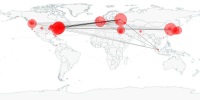
For wordsmiths, Visuwords.
I looked for an embed code and did not see one anywhere on the site. If one exists, could the more technically capable out there point it out ? I'd like the graphic to appear in this post.
Labels: blogging, tech, visualization
¶ 8:17 PM 1 comments

One of the more significant developments in terms of creativity in the past decade has been the advance of open-source platforms that permit asynchronous but real-time, mass collaboration to occur. A phenomena that has been the subject of recent books like Frans Johansson's The Medici Effect and Wikinomics:How Mass Collaboration Changes Everything by Don Tapscott and Anthony Williams; or, become a functioning business model as with Ross Mayfield's Socialtext; or, a metaphor for the evolution of a new dynamic of warfare, as in John Robb's book, Brave New War. And nearly everyone with an ISP is familiar with Wikipedia and most have at least heard of Linux.
The open source concept is a very useful one because it has efficiency, in both the evolutionary and economic senses, adapting faster than closed, hierarchical, competitors and at lower transactional cost ( the price for these advantages is diminished control and focus). As with scale-free networks, it was the advent of the internet and the web that brought the potential of mass collaboration to the attention of economists and social scientists. But did mass collaboration on the cognitive level (the physical level is as old Stonehenge or the pyramids) only start with the information revolution ?
Probably not.
If we look back far enough in the history of great civilizations, you will find semi-mythological figures like Homer or Confucius to whom great, even foundational, works of cultural creativity are attributed. Intellects of a heroic scale who were philosophers and kings, lawgivers, prophets or poets and who produced works of timeless genius. Except that they may either not have existed or their works represent efforts of refinement by many generations of anonymous disciples ( eventually, scholars) who interpreted, polished, redacted and expanded on the teachings of the revered master.
This too was mass collaboration, over a much longer time scale and of a much more opaque character than Wikipedia. Scriptural works went through a similar process, whether it was the scribes of King James, or a medieval Ulemna favoring some teachings of the Hadith over others, or Jewish sages translating the Torah into Greek, despite occasional claims of divine inerrancy, most religious texts were shaped by a succession of human hands.
What the Web has done is to vastly accelerate and democratize the process of mass collaboration and render it more transparent than ever before.
Labels: ancient history, creativity, culture, tech, web 2.0, wikinomics
¶ 3:03 PM 5 comments
Blogfriend Critt Jarvis has reinvented his online presence and returned to some of his original intellectual concerns from back in the days when he was a founding member of The New Rule-Sets Project, later purchased by Enterra Solutions. Critt is jumping off a post by Steve Rubel at Micro Persuasion and extending the argument with "Steve Rubel is right, do you know why ?":
"He’s right. Here’s why. Web portals are social networks, and social networks aggregate to a global conversation market.
Like global or world cities — for example, New York, Paris, Tokyo, London — where, from the transparent nexus of culture, governance, infrastructure, commerce, and fashion, we expect to consistently have a really good time,
The global conversation market has the necessary resources to accommodate a global social network.
For a really good time in the global conversation market …
Find your portal to social networks
Web portals provide stability in social networks, requisite to emerging conversation markets.
Web portals provide growth of social networks.
Web portals provide resources for social networks.
Web portals provide infrastructure for social networks.
Web portals provide money for social networks.
Web portals provide rules for social networks.
Web portals provide security for social networks.
And remember this
Absent stability, there’s no conversation market.
Absent growth, there’s no stability.
Absent resources, there’s no growth.
Absent infrastructure, there’s no resources.
Absent money, there’s no infrastructure.
Absent rules, trust me, there’s no institutional investor money.
Absent security, the rules don’t work.
For me, the social networking wars are over. What I need to do now is find my place in the portals. Which makes me wonder, What is going to happen to Twitter?"
One of the interesting things about Critt is his ability to embed a large number of important concepts at the implicit level in his writing. Critt's primary interest for the past few years has been facilitating "global conversation"; that is people to people connection on a global scale of magnitude. An interest that is congruent with his expertise in technical platforms as tools of communication.
These platforms and by extension, the portals that serve as gateways, represent rule-set systems that offer maximum connectivity and transaction of a certain kind with a minimum of friction and direct cost. These are rule-sets for the enjoyment of "ordered liberty". For example, Second Life provides the user with system access and tools with which to communicate and create but within these strong minimalist confines, citizens of Second Life primarily must self-regulate. This contrasts with the fairly stringent, proprietary, ethos of other MMORPG like Everquest or World of Warcraft.
These services, while entertaining, stifle user creativity and innovation via techno-paternalism. Arguably, in an economic sense, these companies have a business model that opts for maintaining hierarchical control over outcomes within their system over maximizing the growth of their market share or the growth of the user-market itself by limiting user transactions by orders of magnitude. Ultimately, as Web 2.0 concepts permeate the wider global culture, this position becomes self-defeating - the creation of virtual ghettos.
Mr. Jarvis understands that, in the long run, it's a road to nowhere.
Labels: critt jarvis, rule-sets, tech, web 2.0
¶ 7:51 PM 0 comments
Away today at a history conference - " 21st Century Freedom" - a refreshing combination of GWOT from a historian's perspective combined with Web 2.0 changing society and the discipline of teaching history. Back later tonight.
Labels: academia, history, personal, tech
¶ 5:21 AM 0 comments

As Dan of tdaxp would say,"Woot!".
Labels: blogging, personal, tech
¶ 6:00 PM 0 comments
My PC problems continue apace after the second system crash in as many weeks. It's up and running again but the question is for how long ? It's the oldest computer in the house and has worked well for the most part but it may be time to start saving all my files and scanning for the next generation of home electronics. The laptop is cool to take to work, not so cool to hunch over for an hour writing blog posts.
As I was reloading lost programs and apps last night, I fiddled with the SpringWidget in the margin to add some new RSS feeds to my own( Tom and The Small Wars Council). I'll round it out in a few days with a mil-theory circle of bloggers and sites. Once I'm done, readers who really enjoy this genre can simply copy the embed code and stick it on their own pages (it goes into blogs, myspace, xanga -whatever) or modify it as they wish.
If you are, unlike myself, genuinely computer-crafty, you might wish to look at Grazr's capabilities first, as this app migt suit your needs better. Critt, who was an early adapter of OPML, can do some amazing things with a grazr.
The blogroll needs updating, pruning and featuring of new additions.
Much to do. Much to do....
Labels: blogging, blogroll, personal, tech
¶ 8:27 AM 0 comments
Blogfriend Matt at MountainRunner is concerned about the military use of robots and the perception such use in warfare may possibly create. He also is taking a survey which I hope that you can give him a hand with by taking a few moments to fill out.
And...as a reward for your presumptive online altruism:
" The Terminator vs. Robocop "
Labels: mountainrunner, tech, youtube
¶ 8:44 PM 2 comments
From Dave Davison at Thoughts Illustrated:
"Here is a test presentation of a new slideshare feature I have been waiting for. Combine your slideshare presentations with an audio track and Voila! an audiographic presentation. Voice over PPT - Very effective for rehearsal or for cleaning up and redubbing a previous audio recording of your presentations. Also useful as soundbite creator for selected segments of a presentation. And, all nicely microformatted by Slideshare to support remixing. Could be a new style of podcasting."
Here is the slidecast that Dave was writing about, "Differentiation and Engagement" by Garr Reynolds at Presentation Zen ( kudos on the blog name, Garr !):
Labels: davison, powerpoint, presentation zen, slideshare, tech, thoughts illustrated, web 2.0
¶ 6:29 PM 0 comments
PC World magazine has named their " 25 Websites to Watch" ( hat tip to Mrs. Zenpundit) though how many will still exist in 2 years is an open question. Some of these, I have immediate use for; others, I'm not sure how anyone outside of an undergraduate munching cheetos in a dorm room will have the time. I suggest you read the article, as my opinion on tech matters is of negligible weight.
Here are the sites they have chosen by category and see for yourselves. Epistles from the tecno-geek blog set, on the merits of any of these sites, are welcomed.
Mashups, Maps, and More:
Popfly, Yahoo Pipes, BuzzDash, Wayfaring, CircleUp .
Organizers, Searchers and Optimizers:
Pageflakes, Spock, Swivel, Clipmarks, OpenDNS .
Real Estate, Bookmarks and Blogs:
Trulia, PopURLs, Groowy, BlogBackupOnline, Ma.gnolia .
Five ways to Create and Share:
Yodio, Meebo Rooms, Squidoo, SpashCast, Eyespot .
Sites for Collaborative Work and Play:
Approver, Pbwiki, MyPunchBowl, Picnik, Quintura .
Labels: blogging, computers, fun, social networks, tech, web 2.0
¶ 3:52 PM 5 comments

Multiple "meat space" projects and family activities have partially pulled me offline the last few days. Getting this HP and trying it out was one of them. The wireless connection speed is fantastic! Originally, Mrs. Zenpundit had to talk me in to it as our house has no shortage of available PCs, including a brand new Mac, but this laptop is already proving to be quite handy.
Someday, I may even liveblog an event on location. :o)
Labels: blogging, personal, tech
¶ 2:35 PM 7 comments
StatisfyZenpundit
Located on the sidebar above the blogroll. A hat tip to Matt at MountainRunner.
Labels: blogging, blogosphere, blogroll, google, map, tech, web 2.0
¶ 9:17 AM 4 comments
Tech guru Ross Mayfield has an important post "Social Technographics and a Power Law of Participation" that would be of interest to most serious bloggers. In it, Mayfield analyzes the results of a demographic study that examined the nature and degree of interactivity of participation on the Web, displayed in the visual hierarchy below:
A closer look at Mayfield's visualization can be found here at Flickr
An excerpt:
"I still contend that a more ideal community is scale free in structure. What I wonder is if you could benchmark these levels of engagement against a power law -- not just to test Forrester's findings, but to help a given company realize -- "we are under-weighted in critics!"
LOL! I agree. Try to love your critics. Even when they are dead wrong they are the ( sometimes irritating) guides toward truth.
On a personal level, I am a creator and a critic foremost, followed closely by spectator. I dip my toe in being a joiner and I am not a collector at all. I'm not sure why this is. I had a bloglines account and then a blogbridge aggregator and both fell into immediate disuse. I don't subscribe to a single RSS feed and I've been told that mine malfunctions a lot. I don't do digg or that delicious thing and I understand neither. Recently, eerie, the mistress of the group blog Aqoul indicated she kept track of about 240 blogs(!). My hat is off to her, I can't muster that kind of interest.
How about you ?
Labels: blogging, computers, creativity, flickr, futurism, networks, ross mayfield, social networks, tech, visualization, web 2.0, youtube
¶ 10:33 AM 3 comments

Admittedly, I am far from the best person to do blog posts on things technological but via Ross Mayfield, I found this platform aggregator/bundler application Suite Two which handles RSS feeds, wikis, blogs, social networking and more.
While I personally don't need something this elaborate, if I was trying to jump my organization into the Web 2.0 world in one leap it would be handy to have a one-stop-shop site with which to launch everyone from the same page at the same time.
I welcome comments from the IT guys in my readership.
Labels: blogging, ross mayfield, suite two, tech
¶ 6:49 AM 3 comments
Happily "liberated" from Dave " Papadavo" Davison at Thoughts Illustrated.
Labels: cluetrain manifesto, davison, slideshare, tech, web 2.0
¶ 10:23 AM 0 comments
Bruce Kesler at Democracy Project asked me to respond in greater detail to the critical feedback that the post on Modern Foreign Policy Execution sparked, in particular, Dave Schuler's post that I linked to yesterday and to a detailed treatise by Kurt Hoglund at The Jacksonian Party. Bruce has kindly put my remarks up in his post "The Difficult We Do Today; The Impossible Just Takes A Little Longer" where he expounds on the need for reform of foreign policy structure to be a task for which we must take the long view but for which steady pressure must be applied. Bruce explains:
"Schuler’s skepticism is warranted, but self-limiting. As we used to say in the Marine Corps: The Difficult We Do Today; The Impossible Just Takes A Little Longer. That’s not meant to infer that our foreign policy become Marine-like in spirit, but to suggest that focus and organization coupled with faith in mission will overcome.
....I believe that although difficult, and the impossible will take a bit longer, that one inevitable result of our current troubles will be the development of a flatter interdepartmental foreign policy and execution that will be much more informed, prescient, coordinated, and effective."
I agree. This is going to be politically difficult because we are proposing taking some power away from senior Washington mandarins - both in the positive as well as the liberum veto sense - and moving it to the experienced field hands who will be collectively given the financial independence ( perhaps by initiating " foreign policy block grants" instead of line-item departmental appropriations) and tasking authority to accomplish foreign policy objectives. If ever seriously proposed by a president ( even in watered down form), there will be an epidemic of apoplexy inside the beltway and every knife will come out to stop this reform from becoming a reality. Nevertheless, the weight of cultural evolution, technological innovation and globalization will continue rushing forward in the world whether bureaucrats like it or not. Networks are here, friendly and hostile and they must be engaged.
Regarding Mr. Hoglund's post, the "Jacksonians" occupy an aggressive but "swing" position in American politics according to the taxonomy developed by Walter Russell Mead ( a subject Dave has previously explored in his informative posts here and here). Their attitude might be epitomized by the military writer Ralph Peters - they are seekers of clean and clear victories and have scant patience for the building of nations. Despite my being more " Wilsonian" than is Hoglund, he has keyed on to the same problem that I have discerned (frankly, the current foreign policy process is going to produce mediocre results regardless of whether the president is a neoconservative adventurer or a dovish isolationist - the bureaucracies pursue their agendas under every president). An excerpt from "Taming the Turf Wars ":
"The topics cited in the Article I cover in Reforming the Intelligence Community, which looks at the massive and internecine 'turf wars' as the main problem for the IC and getting the best cross-specialization INTEL available for multi-level analysis and then synthesis of knowledge. This would require not only a complete overhaul of how work is approached, but remove the Agencies from the 'product ownership' area and put them into a 'skills management' role. By enforcing the idea that certain types of INTEL can stand alone, the entire IC is dysfunctional as there is no lower level cross-agency working system. Thus each Agency gets its own view of the INTEL it *has* but no ability to synthesize across many Agencies and outlooks. Here non-traditional INTs such as economic and agricultural forecasting would also come into play for a full synthesis of necessary knowledge types available. By removing the Agency fiefdoms and making INTEL gathering and analysis a shared Community Level activity, the internecine turf wars are removed and Agencies are judged on how well they manage contributed skills within the Community at large, not how much work product and viewpoint they turn out. This does require moving clandestine ops back to something directly under Presidential control, like the old OSS. They can be sent to gather specific INT needs, but only with full knowledge and approval of the President."
Aside from my remarks that Bruce has published, the National Intelligence Council is supposed to help in the synthesizing process and was somewhat more aggressive in doing so, reportedly, under NID John Negroponte. Assuming that was the case, that synthesis is being layered on top of the analytical process, like frosting on a cake, rather than occurring in the mixing of the batter by the analytical " cooks". There people out in the blogosphere with direct experience working in the IC and the NIC who are better placed than I to comment further here.
A further point on synthesis, I had envisioned these field teams be appropriately IT-networked so as to allow continuous virtual as well as F2F collaboration. Critt Jarvis at Conversationbase, himself a former member of the IC community, responded with a post "Modern foreign policy execution needs mass collaboration", tying my idea to the principles enunciated in the networked book Wikinomics and to Dr. Barnett's A-Z Ruleset. Further and deeper exploration of the topic of the intersection of the IC with the tools of IT can be had by diving into the archives of Haft of the Spear and Kent's Imperative, both of which I heartily recommend.
Labels: foreign policy, glittering eye, intelligence, kesler, tech, the jacksonian party, wikinomics
¶ 8:41 AM 3 comments
What's the benefit to this Jaiku social network over the other platforms ?
Labels: networks, social networks, tech
¶ 8:10 AM 0 comments
Relaying information from my friends in the tech world:

Both Critt Jarvis and Dave Davison are very high on Robert Scoble's new "networked book" Naked Conversations. As I am out of my element here, I'll refer you to their substantial investments in things Scoble:
"Lunching with Scoble " - Davison.
"Skinny Dippin' in Naked Conversations" - Jarvis.
As blogger will not let me put Critt's summative Scoble grazr in a post for whatever reason, I may put it in the margin tonight to temporarily replace the old one where the feeds were axed the other day.
Also have to check out this Twitter thing and add it to LinkedIn, which I am already using as a contact and social networking tool.
Addendum:
"WIKINOMICS-another "Networked" book example "
Labels: blogging, book, critt jarvis, davison, networks, scoble, tech
¶ 7:19 AM 0 comments